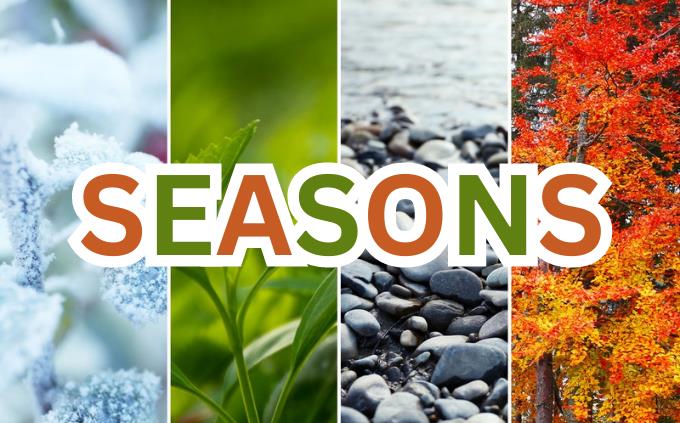
Welcome to our Seasons Trivia Quiz! In this challenge, we'll test your knowledge on the four seasons, their unique characteristics, and how they differ across the hemispheres. From solstices to equinoxes, from hibernation to blooming flowers, get ready to dive into the wonders of our planet's yearly cycle. Whether you're a budding meteorologist or simply a trivia enthusiast, we hope you'll find this quiz both engaging and enlightening. Let's get started!
Which of the following best describes the reason for changing seasons on Earth?
The Earth's distance from the Sun changes significantly throughout the year
The tilt of the Earth's axis as it orbits the Sun
The Earth's magnetic field shifts
The Moon's gravitational pull on the Earth
In the Northern Hemisphere, what season does the Vernal Equinox signal the start of?
Spring
Fall
Winter
Summer
When it's summer in the Northern Hemisphere, what season is it in the Southern Hemisphere?
Winter
Summer
Spring
Fall
What date is the longest day of the year?
21st of June
20th of July
15th of June
10th of July
What's the name of the point directly above the equator during the Spring and fall Equinoxes?
Celestial Meridian
Celestial Horizon
Celestial Equator
Zenith
During the summer, the Arctic Circle experiences a period of _______-hour daylight
12
23
24
8
When is summertime in the Southern hemisphere?
December to February
October-January
January-April
March-June
Which hemisphere is tilted towards the Sun during the September Equinox?
The Southern hemisphere only
The Northern hemisphere only
Both
What is the term for the time when day and night are of approximately equal duration all over the planet?
Solstice
Equinox
Perihelion
Aphelion
Where on Earth are seasons the least noticeable?
At the poles
At the equator
In the temperate zones
In the tropics
The fall equinox occurs in which month in the Southern Hemisphere?
March
September
December
June
Which of the following correctly pairs the month of the solstice or equinox with the corresponding season in the Southern Hemisphere?
March equinox - Autumn
June solstice - Summer
September equinox - Winter
December solstice - Spring
What is the term for the phenomenon when the Sun does not set at the Arctic Circle for 24 hours, typically around the Summer Solstice?
Night Solstice
Winter Solstice
Midnight Sun
Dark Sun
You've Got More to Learn
That's perfectly alright, nobody becomes an expert in a day. The changing of seasons is a complex and fascinating subject. You've made a good start and with a little more reading, you'll get there. Remember, every expert was once a beginner. Keep up the learning and you'll improve.
Well done! You've got a good grip on the topic. Your understanding of the Earth's seasons shows, and it's clear that you've done your homework. But there's always more to learn in this vast universe, so keep exploring and expanding your knowledge. You're on a great track.
Excellent! Your mastery of the Earth's seasons is truly impressive. You've demonstrated a deep understanding of this dynamic, constantly changing phenomenon. It's inspiring to see such curiosity and dedication to learning. But don't stop here, keep feeding your curiosity. You're doing fantastic!
Subscribe and REMOVE ALL ADS
LOVE our articles but HATE our ads? For only $3.89 per month, enjoy a seamless, ad-free experience that lets you focus on what matters most — enjoying all of our content, uninterrupted. 🔒 100% Secure Payment 📅 Cancel Anytime, No Strings Attached Unlock a cleaner, faster browsing experience today and gain the freedom to navigate without visual clutter.
Ready for a Ad-Free experience? Upgrade now for just $3.89/month!
To enable your Ad-Free Subscription, please fill the fields below
Thank you for your subscription!
Your subscription was successful, now you can enjoy an ad-free experience!! Note: To make sure you get no ads, please make sure to log in to your account. If you are logged in already, then refresh the page. The subscription can be cancelled at any time.
This content is reserved for our members
Join Our Community for FREE and Enjoy:
Full and free access to ALL content.
The 'Daily Mail' service sends the highest quality and the most fascinating content directly to your inbox.
 Shai K.
7/3/2023
Shai K.
7/3/2023



 Go to BabaMail