
If the word "exercise" makes you picture punishing gym sessions and hours you simply do not have, here is some genuinely cheering news. A wave of research published in 2025 and 2026 has landed on a message that is not only hopeful but wonderfully practical, especially for those of us past 60. Taken together, four recent findings tell one clear story: you do not need to overhaul your life to add years to it, there is a sensible ceiling to how much exercise you need, lifting a little weight keeps your brain young as well as your body, and, best of all, it's never too late to begin. Let us walk through what the scientists actually found, and what it means for you.
The headline study came from researchers at the University of Sydney, who examined the habits of nearly 60,000 older adults and followed them for about eight years. Participants wore wrist trackers that measured their sleep and movement, and their diets were scored for quality. The researchers then looked at how these three everyday behaviors, sleep, activity, and eating, related to how long and how healthily people lived.
What they found is quietly astonishing. Compared with those who had the poorest habits, sleeping only around five and a half hours, moving barely seven minutes a day, and eating a low-quality diet, people who made only tiny improvements tended to live meaningfully longer. And "tiny" really does mean tiny: a few extra minutes of sleep, a couple more minutes of brisk activity, and half a serving more vegetables a day were linked to roughly an extra year of life.
At the other end of the scale, those who got all three into a healthy range, sleeping seven to eight hours, moving 40 minutes or more a day, and eating well, were linked to something remarkable: over nine additional years of life, and nine more years of healthy, disease-free living. One intriguing detail stood out. Improving any single habit on its own had only a modest effect, and diet by itself did not move the needle much. The real power came from combining all three. They work best as a team, each amplifying the others.
You can read more about this research here.
Hidden inside that same research is a fact that comes as a relief to many. The benefits of exercise did not keep climbing forever. They rose steeply at first, then leveled off at around 50 minutes of activity a day. Beyond that point, doing more brought little additional gain in lifespan.

This carries two liberating messages. First, if you are doing a great deal already, you can relax, since you do not need to punish yourself with ever more. But the second message matters even more for those just starting out: the single biggest payoff comes from the very first few minutes. Going from doing almost nothing to doing just a little brings a greater benefit than going from a lot to a little more. In fact, adding as few as five minutes of brisk daily movement was linked to a notable drop in the risk of dying over the study period. If you have been sitting on the sidelines, those first modest steps are the most valuable ones you will ever take.
You can read more about the exercise findings here.

We tend to think of strength training as something for the muscles alone, or for much younger people. Recent research is overturning that idea in a striking way. In a 2026 study, older adults were divided into groups, some doing resistance training, others aerobic exercise, and others no exercise, then had detailed brain scans over the course of a year. Those who did the strength training showed a slowing of the biological aging of their brains.
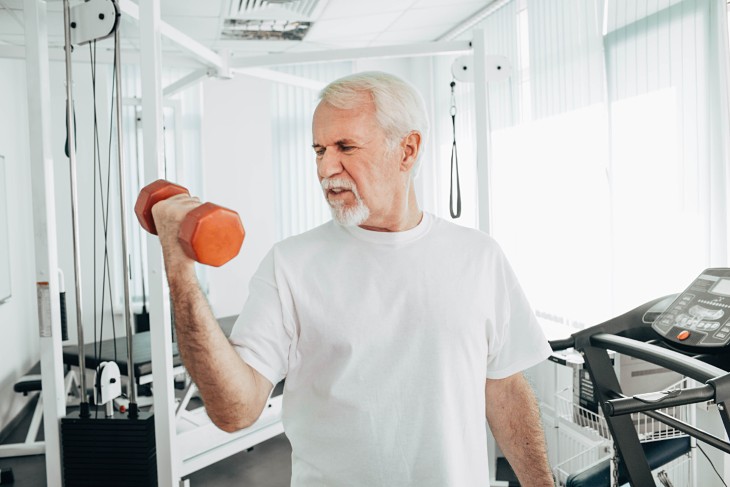
The scientists believe this works not by targeting one small area of the brain, but through the whole body, improving the health of blood vessels, calming inflammation, and steadying the body's chemistry, all of which the brain depends upon. This echoes an earlier study in which older adults with mild memory problems who did just six months of twice-weekly weight training improved their recall and showed less shrinkage in the very brain regions affected by Alzheimer's disease. It seems that building a little strength does not just help you carry the shopping and rise from a chair. It may help protect your memory and your mind.
You can read more about the brain and strength research here, and about the weight training and memory study here.
Perhaps the most encouraging finding of all speaks to anyone who fears they have left it too long. In a 2026 study published in the journal Nature Aging, researchers looked deep inside the muscle cells of older adults, comparing those who were physically trained with those who were not.

The difference was profound. Many of the molecular changes we think of as simply belonging to age, the quiet decline in how cells produce energy, were markedly reduced in the trained older adults. In fact, around half of those age-related differences were simply absent in the people who kept active, leaving their cellular profiles looking more like those of much younger adults. In other words, a good deal of what we accept as inevitable aging may really be the effect of inactivity, and the body appears able to respond to exercise and renew itself at any age. You have not missed your chance. It is genuinely never too late to begin.
You can read the published study here.
Line these four findings up side by side, and they offer one of the most encouraging and doable prescriptions for healthy aging you could wish for. Here is how to put them into practice:
It's only fair to add some honest perspective. Much of this research is observational, meaning it shows a strong association between healthy habits and longer life rather than absolute proof that one causes the other, and some of the longevity figures come from statistical models rather than guarantees. Real people are more complicated than any study. But the beauty of these particular findings is that the advice they point to, move a little more, sleep a little better, eat a few more vegetables, and build a little strength, carries essentially no downside and a great deal of potential reward. As always, it's wise to check with your doctor before beginning a new exercise routine, particularly if you have any health concerns, and to build up gently.
This article is general information and not a substitute for medical advice. Speak with your doctor before starting a new exercise program, particularly if you have existing health conditions.