
Some of the most dangerous cancers are the ones that learn to survive our best medicines. A tumor may respond to treatment at first, only to bounce back stronger and harder to stop. Now, researchers at the Technion in Israel have come up with an approach that turns a cancer cell's own survival tricks against it, and the early laboratory results are encouraging.
The scientists created a family of experimental molecules they call R4VPs. In lab dishes, these molecules killed aggressive, treatment-resistant melanoma and sarcoma cells within just a few hours, while leaving healthy cells largely untouched. The findings were published in the scientific journal Oncogene.
Don't Block the Protein. Remove It.
Many cancer drugs work by blocking a protein that the tumor needs in order to grow. Think of it like jamming a lock so a key no longer turns. The problem is that not every harmful protein can be blocked this way, and clever cancer cells often find a detour around the blockage. That is one of the main reasons tumors become resistant to treatment.
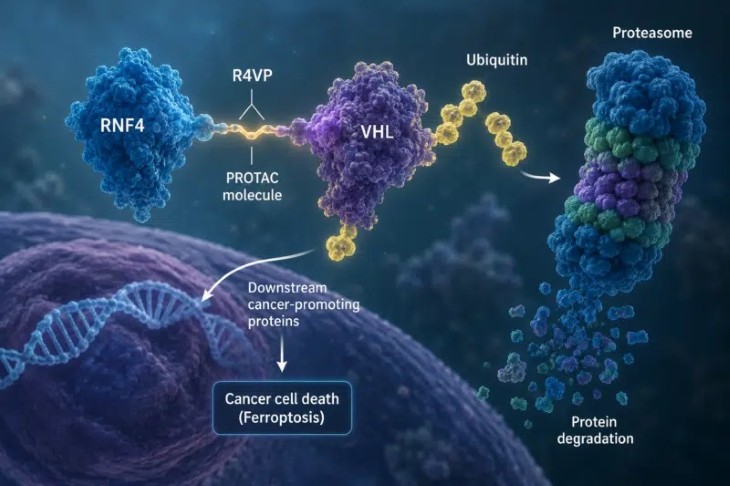
This new approach takes a different path. Instead of jamming the lock, it removes the entire lock from the door. The molecule grabs onto a harmful protein and hands it over to the cell's built-in recycling system, which then breaks the protein down and clears it away. Scientists call these molecules "degraders," because they cause the target to be degraded rather than simply switched off.
A Surprising Double Punch
What makes the Technion molecules unusual is that they knock out not one but two proteins that cancer cells lean on to survive.
The first is a protein called RNF4. In many aggressive tumors, RNF4 acts like a bodyguard, propping up other proteins that drive cancer growth. High levels of it have been found in melanoma, sarcoma, and certain other cancers, and those high levels have been linked to poorer outcomes. When the R4VP molecules break RNF4 down, the cancer-promoting proteins it was protecting begin to fall apart too.
The second protein, called VHL, normally helps shield the cancer cell from a particular kind of self-destruction. As the molecules did their work, they unexpectedly cleared away VHL as well. With both survival helpers gone at the same time, the cancer cell is left far more vulnerable than either change alone would allow.
A Form of Cell Death That Depends on Iron
The type of cell death triggered here is known as ferroptosis. It is a controlled form of self-destruction that depends on iron and builds up through damage to the fatty membranes that hold a cell together. It is different from the more familiar kind of programmed cell death that scientists have studied for decades.
Resistant cancer cells are often good at defending themselves against this iron-driven damage. One of their key shields is a protein that keeps harmful byproducts from piling up inside the cell. The R4VP molecules appear to weaken that shield too. With their defenses stripped away on several fronts at once, the cancer cells accumulate damage quickly and die.
Why Healthy Cells Were Mostly Spared
One of the most promising parts of the study is how the molecules behaved toward normal cells. The researchers tested them on several kinds of tissue, including sarcoma cells taken directly from patients' tumors. The cancer cells died quickly. Yet the healthy, non-cancerous cells in the experiments were largely unharmed.
The team also noticed that the effect was not identical across every tumor. Cancer cells carrying certain genetic changes were especially sensitive, while others carrying different changes responded far less. That suggests any future treatment, if it ever reaches that stage, would likely need to be matched to the particular makeup of a person's tumor rather than used as a one-size-fits-all option.
A Long Road Still Ahead
It is important to keep this discovery in perspective. The work so far was done almost entirely in laboratory dishes, and the results do not prove that these molecules are safe or effective as a medicine in people. A compound that destroys cancer cells in a dish may behave very differently inside the body. It might break down too quickly, never reach the tumor, or affect tissues that were never tested.

The next steps involve studies in animals to learn how the molecules travel through the body, what dose is needed, whether they can shrink a whole tumor, and what side effects they might cause. Only after further work like that could human trials even be considered, and that process typically takes years.
Still, the idea behind it is a genuinely fresh one. By designing a molecule that removes a cancer cell's protections instead of merely blocking them, and by hitting several of those protections at the same time, the Technion team has opened a promising new direction in the long effort to outsmart the cancers that have been hardest to treat.
You can read the full research paper here: Discovery of ferroptosis-inducing R4VP compounds for targeting aggressive cancers (published in Oncogene).