Have you ever been scrolling through TikTok or Facebook and felt that something about the person on your screen just did not add up? You are not imagining it. A wave of videos faked with artificial intelligence is sweeping across social media, and they grow more convincing from one month to the next. Knowing where to look is your best defense, so we have gathered the most important signs for you, from the obvious ones to the subtle ones, that will help you catch a fake before you fall for it.
The problem has become especially urgent. Until about a year ago, most fakes looked clumsy and unconvincing, and were easy to laugh off. Today, new tools can produce talking figures that look almost completely real, and anyone with a reasonable home computer can create them in minutes and for pennies. That is exactly why it pays to learn the methods, and just as importantly, to understand their limits.
There are two main methods worth knowing about. The first is called face swapping, in which scammers take a completely genuine video of a real person and place a new face over it. This approach has spread widely across social media. Fake accounts download videos from real content creators, isolate their voices, and dress a synthetic face onto their body in order to promote products or deliver messages the original creator never actually said. The result is genuine digital identity theft, in which people find themselves appearing to recommend products they never even saw.
The second method is creating an entire video from scratch. Here there is no real person and no original footage. The artificial intelligence builds the figure, the background, the movement, and the voice entirely on its own, based on a simple text instruction. It is actually easier to catch mistakes in videos like these, because the system has to guess for itself how the world should look.
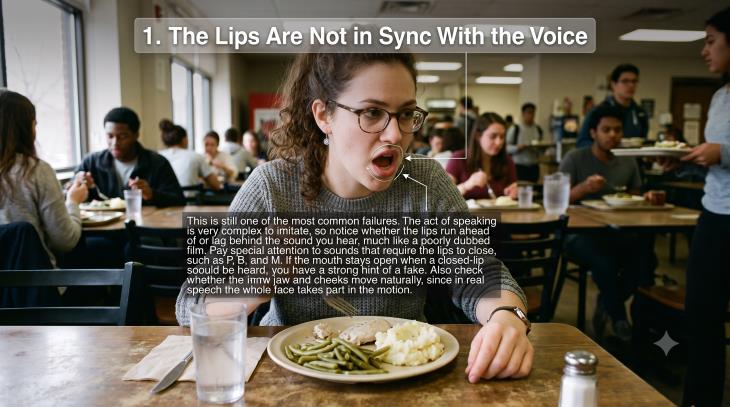
This is still one of the most common failures. The act of speaking is very complex to imitate, so notice whether the lips run ahead of or lag behind the sound you hear, much like a poorly dubbed film. Pay special attention to sounds that require the lips to close, such as P, B, and M. If the mouth stays open when a closed-lip sound should be heard, you have a strong hint of a fake. Also check whether the jaw and cheeks move naturally, since in real speech the whole face takes part in the motion.
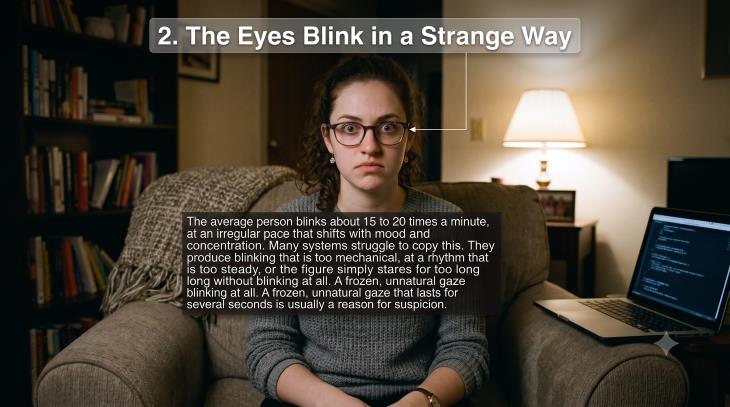
The average person blinks about 15 to 20 times a minute, at an irregular pace that shifts with mood and concentration. Many systems struggle to copy this. They produce blinking that is too mechanical, at a rhythm that is too steady, or the figure simply stares for too long without blinking at all. A frozen, unnatural gaze that lasts for several seconds is usually a reason for suspicion.
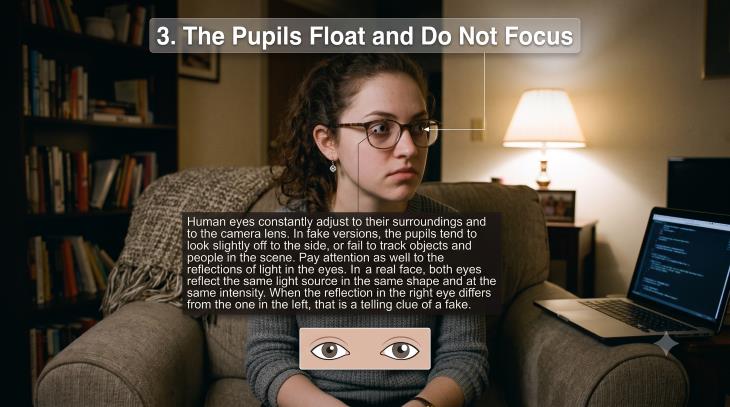
Human eyes constantly adjust to their surroundings and to the camera lens. In fake versions, the pupils tend to drift, look slightly off to the side, or fail to track objects and people in the scene. Pay attention as well to the reflections of light in the eyes. In a real face, both eyes reflect the same light source in the same shape and at the same intensity. When the reflection in the right eye differs from the one in the left, that is a telling clue of a fake.
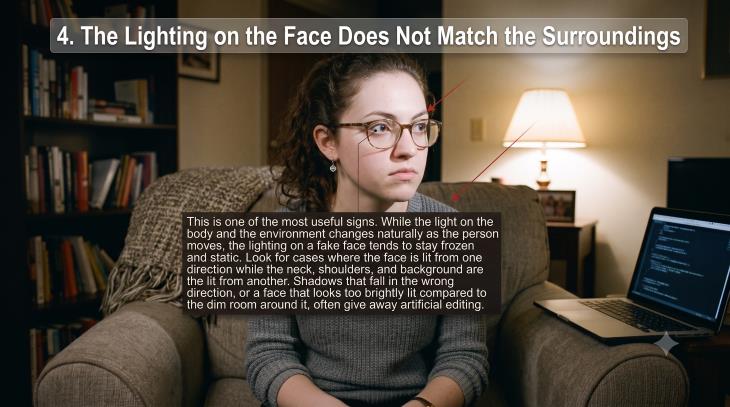
This is one of the most useful signs. While the light on the body and the environment changes naturally as the person moves, the lighting on a fake face tends to stay frozen and static. Look for cases where the face is lit from one direction while the neck, shoulders, and background are lit from another. Shadows that fall in the wrong direction, or a face that looks too brightly lit compared to the dim room around it, often give away artificial editing.
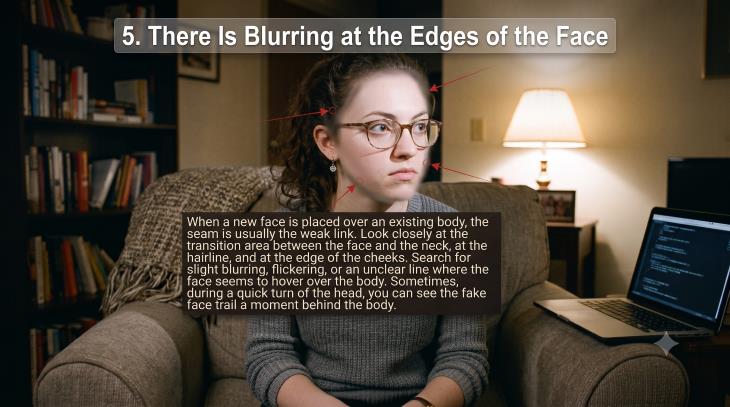
When a new face is placed over an existing body, the seam is usually the weak link. Look closely at the transition area between the face and the neck, at the hairline, and at the edge of the cheeks. Search for slight blurring, flickering, or an unclear line where the face seems to hover over the body. Sometimes, during a quick turn of the head, you can see the fake face trail a moment behind the body.
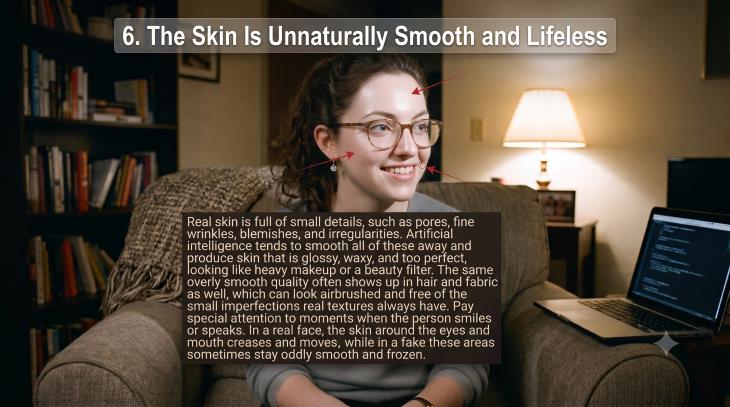
Real skin is full of small details, such as pores, fine wrinkles, blemishes, and irregularities. Artificial intelligence tends to smooth all of these away and produce skin that is glossy, waxy, and too perfect, looking like heavy makeup or a beauty filter. The same overly smooth quality often shows up in hair and fabric as well, which can look airbrushed and free of the small imperfections real textures always have. Pay special attention to moments when the person smiles or speaks. In a real face, the skin around the eyes and mouth creases and moves, while in a fake these areas sometimes stay oddly smooth and frozen.
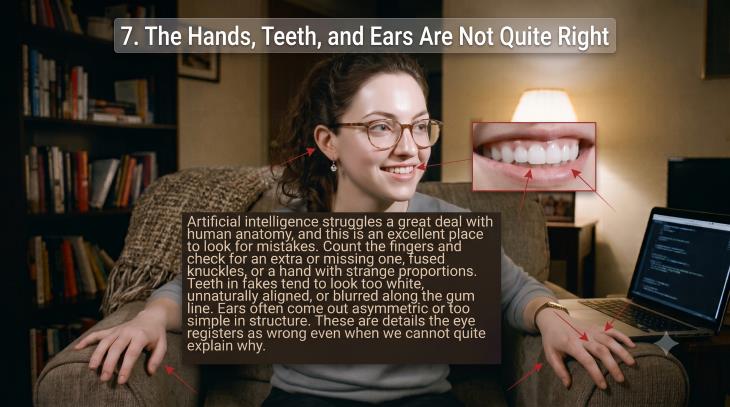
Artificial intelligence struggles a great deal with human anatomy, and this is an excellent place to look for mistakes. Count the fingers and check for an extra or missing one, fused knuckles, or a hand with strange proportions. Teeth in fakes tend to look too white, unnaturally aligned, or blurred along the gum line. Ears often come out asymmetric or too simple in structure. These are details the eye registers as wrong even when we cannot quite explain why.
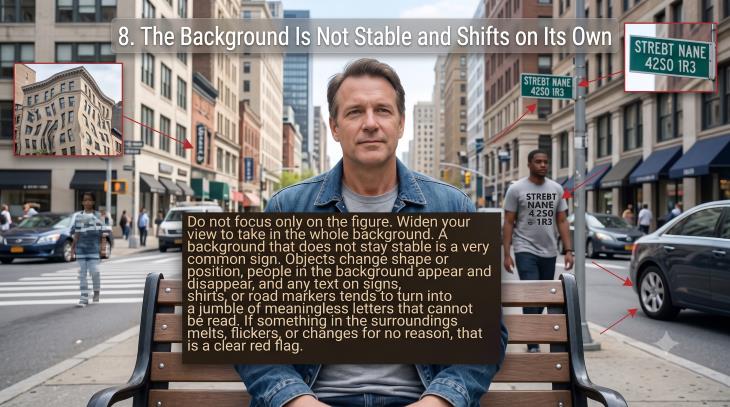
Do not focus only on the figure. Widen your view to take in the whole background. A background that does not stay stable is a very common sign. Objects change shape or position, people in the background appear and disappear, and any text on signs, shirts, or road markers tends to turn into a jumble of meaningless letters that cannot be read. If something in the surroundings melts, flickers, or changes for no reason, that is a clear red flag.
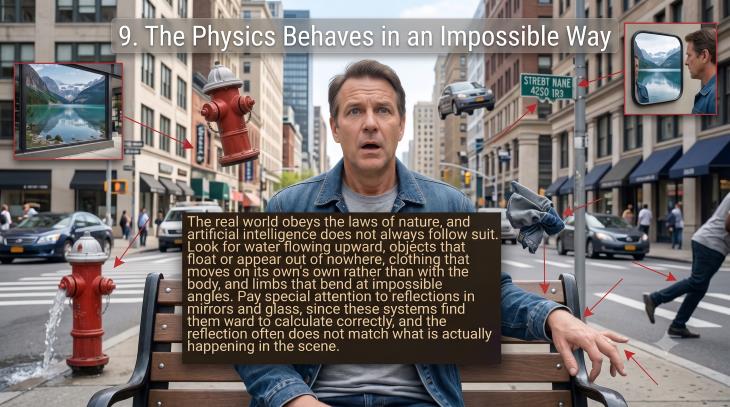
The real world obeys the laws of nature, and artificial intelligence does not always follow suit. Look for water flowing upward, objects that float or appear out of nowhere, clothing that moves on its own rather than with the body, and limbs that bend at impossible angles. Pay special attention to reflections in mirrors and glass, since these systems find them very hard to calculate correctly, and the reflection often does not match what is actually happening in the scene.
The ears have something to contribute too. If you put on headphones, you can sometimes hear a muffled, metallic quality, especially when the voice has been isolated from the original video. Listen to the silence between the words. In a fake it tends to be total and artificial, with no natural background noise, no breaths from the speaker, and none of the small hum that is always present in a real recording. A voice that sounds emotionally flat, without natural rises and falls in tone, is also a reason for suspicion.
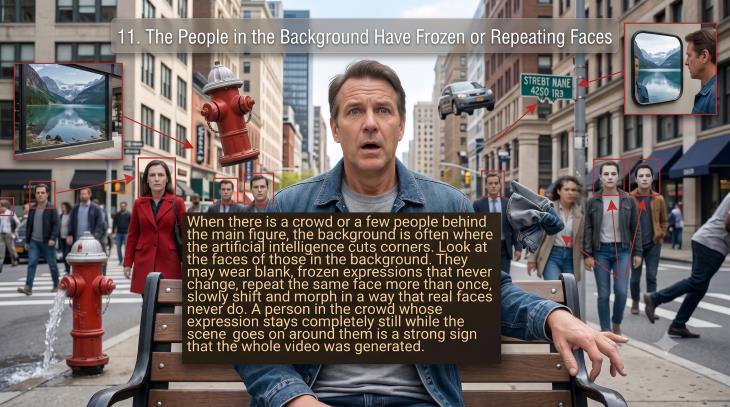
When there is a crowd or a few people behind the main figure, the background is often where the artificial intelligence cuts corners. Look at the faces of those in the background. They may wear blank, frozen expressions that never change, repeat the same face more than once, or slowly shift and morph in a way that real faces never do. A person in the crowd whose expression stays completely still while the scene goes on around them is a strong sign that the whole video was generated.
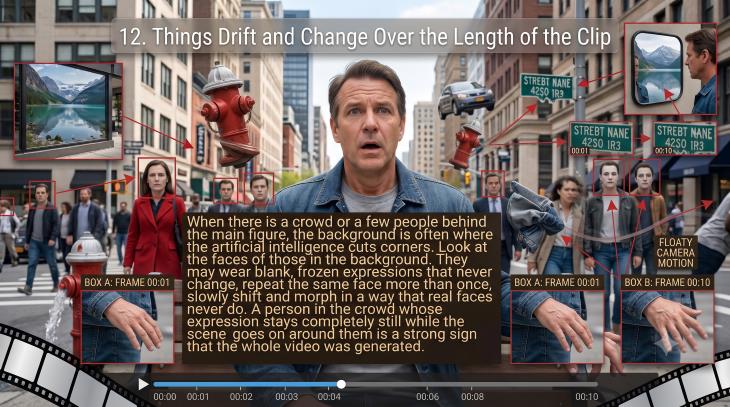
Some of the best clues do not appear in any single frame but reveal themselves over time. Watch the entire video from start to finish, and if you can, play it once more at half speed. Faces, hands, and objects that look perfectly fine when frozen often stretch, flicker, or slowly change shape as the seconds pass. Compare how the person looks at the beginning of the clip to how they look at the end, since small details tend to drift. Pay attention to the camera as well. A floaty, gliding motion that no real camera operator would produce is another quiet giveaway.
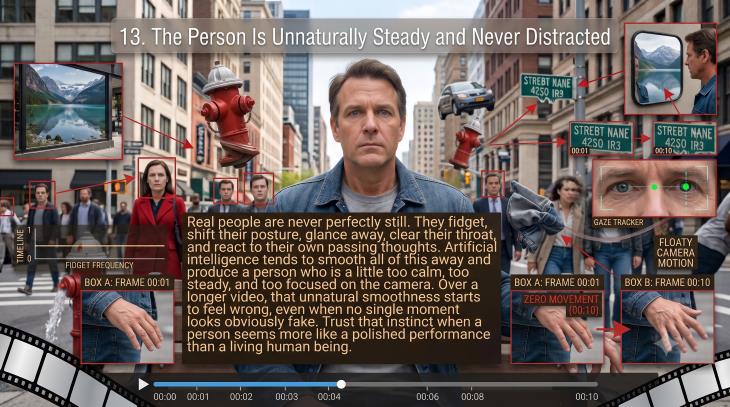
Real people are never perfectly still. They fidget, shift their posture, glance away, clear their throat, and react to their own passing thoughts. Artificial intelligence tends to smooth all of this away and produce a person who is a little too calm, too steady, and too focused on the camera. Over a longer video, that unnatural smoothness starts to feel wrong, even when no single moment looks obviously fake. Trust that instinct when a person seems more like a polished performance than a living human being.
It helps to know when these tools work less well, so you do not fall into false confidence. The simpler the scene, the harder it is to spot a fake. A short clip of a single person talking to the camera, with a plain background and little movement, can look completely convincing. By contrast, scenes with several people, fast motion, water or fire, and complex lighting have a much harder time hiding the fakery. Very short clips of just a few seconds also give mistakes less time to pile up. So if the video is short, simple, and static, the visual signs alone may not be enough.
Because the technology keeps improving, your strongest defense is not sharper eyesight but more careful thinking. Before you believe a video or share it, ask yourself the simple questions. Who posted it, and where did it first appear? A dramatic video that exists only on one anonymous account, with no established source covering it, is suspicious by its very nature. Look for the original clip, and check whether other reliable sources are also carrying it.
If the video asks you for something urgent, such as transferring money, handing over details, or clicking a link, stop completely. The single most important rule is to verify through a second channel. If a family member or a manager appears in a video making an unusual request, hang up and call them at the phone number you already know in order to confirm it is really them. One short phone call is worth more than any visual inspection.
Finally, it is worth knowing that digital origin markers exist as well. Major technology companies now embed labels and invisible watermarks that flag content created by artificial intelligence, and there are dedicated tools that analyze videos and estimate the likelihood that they are fake. These tools are helpful, but remember that they are not definitive and are always one step behind the newest technology. So treat them as an added layer of defense, not as final proof.