
When it comes to the way they experience emotions, there appears to be a divide between men and women. Men are stereotypically seen as rational, level-headed thinkers, while women are often viewed as being more emotional. But are these assumptions entirely unfounded? Perhaps not completely.
A recent study, conducted by researchers at the University of Montreal and the Institut Universitaire en Santé Mentale de Montréal, has found that certain differences in brain functioning affect the way in which men and women respond to negative imagery.
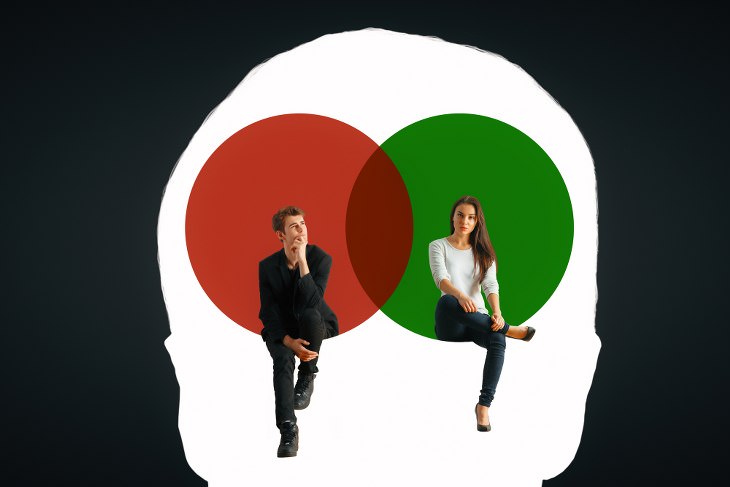
The researchers drew their inspiration from the differences they observed in mental illness between the sexes. “Not everyone’s equal when it comes to mental illness,” said Adrianna Mendrek, one of the researchers. "Greater emotional reactivity in women may explain many things, such as their being twice as likely to suffer from depression and anxiety disorders to men.”
Earlier studies have also given credence to the theory that women and men react to emotional stimuli in different ways. Mendrek and her co-researchers had previously found that the limbic system (the brain's emotion and memory center) reacted differently for men and women, when participants were shown negative images. They decided to go a step further for this study, as they now chose to research whether hormonal levels affect this psychological processing, too.

There were 46 participants who took part in the study (25 female and 21 male), and the researchers ruled out potential contributing factors such as age, education, ethnicity, marital status, and socioeconomic status. Every volunteer was given a blood test at the start to assess their levels of testosterone and estrogen in order to see in what way they affected the results. They were then exposed to images that evoked positive, negative, or neutral emotions, while they underwent fMRI brain scans. Participants also had to review their emotional responses when looking at each image.
Overall, men seemed far less reactive to the emotional images than their female counterparts. Higher estrogen levels seemed to indicate increased sensitivity to the images, while higher testosterone levels appeared to make the subjects more desensitized.
When assessing the brain's reaction to the images, they discovered that the dorsomedial prefrontal cortex (dmPFC) and amygdala on the brain's right hemisphere were activated for both men and women. However, the connection between these two components was discovered to be more powerful in men, leading to the additional interaction between these two parts, and thus further decreased sensitivity to the stimuli.

The researchers explained that the reactions of the dmPFC and amygdala can tell us loads about how people process their emotions. The dmPFC is the part of the brain that helps process social interactions and mediates reasoning, emotions, and perception. The amygdala, on the other hand, is the part that is used to detect threats, and is often triggered when somebody experiences sadness or fear.
“A stronger connection between these areas in men suggests they have a more analytical than emotional approach when dealing with negative emotions,” said Stéphane Potvin, associate professor at the University of Montreal’s Department of Psychiatry. “It is possible that women tend to focus more on the feelings generated by these stimuli, when men remain somewhat ‘passive’ toward negative emotions, trying to analyze the stimuli and their impact.”
Mendrek's team believes that their study shows just how the male and female brains seem to function differently at a psychological level. “There are both biological and cultural factors that modulate our sensitivity to negative situations in terms of emotions,” Mendrek said. She concluded that the next step forward is to research exactly how hormones affect people's reactions to various types of emotions, such as sadness, fear, or anger.
Source
Images

The Hidden Side Effects of GLP-1 Medication
A major new study suggests there may be quite a bit more going on beneath the surface - side effects that patients are experiencing but that rarely come up in the doctor's office.
Can We PREVENT Type 1 Diabetes?
The study's findings point toward developing a simple blood test that could detect the immune failure leading to type 1 diabetes before insulin-producing cells are permanently lost.
The Naked Truth Behind Why Men Don't Listen to Women
Have a good look at the 10 biggest reasons why men don't always appear to listen to the women in their lives.
WARNING TO MEN: Here's Another Reason to Cut out Red Meat
It's becoming an increasingly well-known fact that high red meat consumption is bad for our health, and this new study only adds to that knowledge.
New Research Shows Eating Sweets Won't Make You Crave More
A groundbreaking new study challenges conventional wisdom, suggesting our preference for sweet tastes may be more stable than we think.
The Musical Test That Could Detect Dementia Early
Researchers have developed a promising new approach: using music to detect the early signs of cognitive decline.
8:11
Fascinating: What is the Deepest Hole Humanity Has Dug?
This video explains how low humanity has dug down so far.
18:21
Fascinating: How Do Cats TRULY See Humans?
Understanding a cat's world is the key to strengthening your bond. Let's decode your cat's mind!
These Underwater Craft Are Changing Marine Science
Here's a look at the most remarkable machines currently expanding our understanding of the underwater world.
10 Obscure Inventions by World Famous Inventors
We’d like to bring your attention to 10 lesser-known inventions of famous figures in history, which will reveal a new and different side of these inventors to you.
7:56
These 6 Chemical Reactions Changed the Course of History
Although we rarely pay much attention to the chemistry that constantly surrounds us, these 6 reactions changed history.
22:52
Will AI Take Your Jobs? An Expert Explains the Future
Gonzaga University's AI professor Graham Morehead some of our most pertinent questions related to AI.
New Research Shows Eating Sweets Won't Make You Crave More
A groundbreaking new study challenges conventional wisdom, suggesting our preference for sweet tastes may be more stable than we think.
4:51
The Oldest Medicines That Have Stood the Test of Time
Learn about some fascinating old medicine and general healing practices that have survived for thousands of years.
8 Biggest Mysteries Still Surrounding the Human Body
Although modern science has revealed much about the human body, there are some things that still remain unknown. Here are the 8 biggest mysteries about it.
14:58
Why IS Fentanyl So Dangerously Addictive?
In this video, we break down what opioids really do to your brain and body, what using them actually feels like, and why so many people are dying from Fentanyl overdoses.
14 Times Nature Inspired Groundbreaking Technology
Let’s explore 14 remarkable examples of how nature has shaped modern technology.
9:13
Want to Travel Quickly Through Space? Try Using a Wormhole
If you want to know what a wormhole is and how it is supposed to work, then you've come to the right place!
TRIVIA: 25 Shocking Differences Between the Sexes
Did you know that there are some vast differences between the sexes? These 25 scientific facts will probably come as a big surprise to you, they did to me.
4:05
Kirobo: First Robot in Space!
It was one small step for robot and another giant leap for mankind...
Why It's So Hard to Get People to Change Their Stance
You feel that your knowledge is broader because you've read and researched a lot on the topic, but the other side still isn't convinced, even when you present facts and statistics. Why isn't that enough?
11:28
India Built a Monster Dam That Controls the Weather!
The Polavaram Dam doesn't just control floods - it moves water between regions and much more!
These Optical Illusions Will Shock Your Mind!
Optical illusions create miscommunication between our eyes and brain making, us see things that are not really there or not see things that are right in front of us. See for yourself.
36:24
Ever Wonder How a Steel Locomotor Works?
Let’s take a closer look at the engineering behind these compact workhorses.
Science News: AI-Designed Drugs Move to Human Trials
Isomorphic Labs, is positioning itself to begin human clinical trials of medications designed entirely through artificial intelligence, marking a potentially transformative shift in how we develop life-saving treatments.
Uncover the Secrets of the Universe in These Documentaries
This list of riveting space documentaries will help you unlock the mysteries of the universe and beyond.
10:11
10 Smart Home Gadgets You Didn’t Know You Needed
If you’ve ever wanted a smarter, more efficient home, these 10 gadgets might be exactly what you need.
10:46
12 SUPER COOL Military Inventions You’ve Never Seen
Check out this list of amazing new military innovations. They will transform warfare in the near future!
There are Some Great Secrets Found in Mathematics...
Numbers hold some great secrets - they even tell us about life!
11:15
These Paradoxes Continue to Mystify Scientists
Take a look at 7 scientific paradoxes that may never get solved.
4:20
Ever Wondered About How Our Minds Retain and Lose Memories?
Ever wondered why you can remember something from 20 years ago, but have difficulty remembering what you had for lunch the other day? Learn why here.
Chocolate Exposed! Here's What It Does to Your Brain!
Just what is it that makes chocolate so irresistible to so many people around the world? Find all of the answers in the article.
25 Pics Showing How People in the Past Imagined the Future
Let’s see how the people of the past imagined the future and find out if their fun predictions came true with these 25 vintage pictures
20:32
History: Did the Trojan War REALLY Happen?
The Trojan War, the most famous of the ancient wars, fought by thousands of men for ten long years on the beaches of the famed city of Troy. Was all that real?
This is How to Activate Your Brain's Ability to Learn
A recent study has shown that overlearning might improve performance in a particular task by altering the chemicals in the brain that "lock" in training.
4:13
What Does Medicine ACTUALLY Do In the Body? Fascinating.
What really happens in our bodies when we take medicine, have you ever wondered? This video will answer your question.
5:17
How Exactly Do We Hear? All is Revealed Here!
In this informative TED-Ed video, Douglas L. Oliver explains the complete science behind hearing.
New Study: Dopamine Does Way More Than We Thought!
How the brain's reward system physically rewires the motor cortex during skill learning — and what happens when that reward signal gets cut off.
What is the Troxler Effect and How Does it Affect You?
Learn about Troxler's effect and the optical illusions it creates in life.
Will We Ever Solve Our Universe's Most Complex Mysteries?
Here are 8 of the biggest unsolved mysteries from the world of physics.
3:55
50 Years Later, We're Debunking the Moon Landing "Hoax"
How do we prove to people the moon landing was real? By answering their doubtful questions in this video.
Phone Overheating? Use Our Guide to End The Problem!
Is your cell phone overheating? If so, read this handy guide, which will help pinpoint the source of the problem and offer a solution for fixing it.
Science: Can Plants That Come Back From the Dead Save Us?
These extraordinary organisms may hold the key to solving one of the world's most urgent problems: feeding a growing population on a warming, drying planet.
5:06
The Only Manmade Object That Will Last Forever
This copper discus contains 116 images we launched into space for aliens to see

58:37
Science: Here's Everything We Know About Pluto
Join us as we unravel the mysteries of far off Pluto, 3.7 billion miles from our Sun.

34:33
Is China Number 1 in Global Technology?
In this video, we’ll take a closer look at the new developments hitting the market — and what they could mean for the future of transportation.
2:06
Can Your Brain Get to Grips with These Weird Illusions?
I could have sworn what I was seeing in this video was real! But it wasn't. It was all just an illusion.
To enable your Ad-Free Subscription, please fill the fields below
Your subscription was successful, now you can enjoy an ad-free experience!! Note: To make sure you get no ads, please make sure to log in to your account. If you are logged in already, then refresh the page. The subscription can be cancelled at any time.