
On May 24, 2000, a crowd of mathematicians gathered in a lecture hall at the Collège de France in Paris to hear an unusual announcement. A private foundation was offering $7 million, split into seven prizes of $1 million each, to anyone who could solve seven specific math problems. Some of these puzzles had already defeated the greatest minds of the previous century.
For 26 years, the scoreboard barely moved. Only one problem was ever officially solved, by a reclusive Russian genius who then refused the money. Then, this September, an artificial intelligence company announced that its computers had cracked a second one in less than four days.
Here is a plain-English tour of all seven problems, what solving each one would mean for the rest of us, and the remarkable stories behind the two solutions so far.
The prizes were created by the Clay Mathematics Institute, a nonprofit founded in 1998 by Boston businessman Landon Clay and his wife, Lavinia. The idea echoed a famous moment exactly 100 years earlier, when the German mathematician David Hilbert stood before a conference, also in Paris, and listed 23 problems he believed would shape mathematics in the 1900s.
A panel of leading mathematicians chose problems that were old, deep and central, the kind whose solution would open doors across many fields. The rules are strict. A solution must be published in a respected math journal, then survive at least two years of scrutiny by the world's experts before the Institute will even consider paying out.
One thing to keep in mind as you read: mathematicians take the word "proof" very seriously. It's not enough to test an idea on a billion examples. A proof must show, with airtight logic, that something is true in every possible case, forever.
Think about a Sudoku puzzle. If a friend hands you a completed grid, you can check whether it's correct in a few minutes. Solving it yourself from scratch could take much longer. Now imagine a Sudoku grid the size of a football field. Checking a finished one is still fairly quick, but finding the solution could keep every computer on Earth busy for longer than the age of the universe.
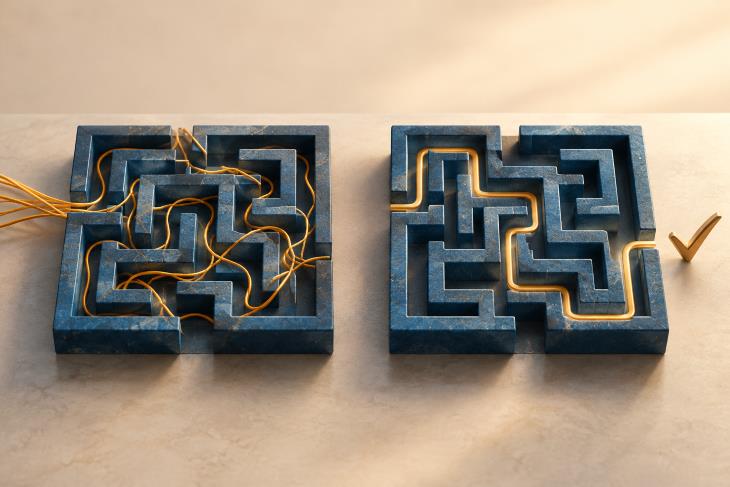
The P vs NP problem, posed in 1971 by computer scientist Stephen Cook, asks a simple-sounding question: is that gap real? In other words, is every problem whose answer can be quickly checked also a problem whose answer can be quickly found, if only we were clever enough to discover the right method? "P" stands for problems that are quick to solve, and "NP" for problems whose answers are quick to check.
What a solution would mean: This is the problem with the most dramatic real-world stakes. If someone proved that P equals NP (meaning shortcuts always exist) and found those shortcuts, much of the encryption that protects online banking, email and medical records could crumble, because it relies on puzzles that are easy to check but hard to crack. On the bright side, the same breakthrough could transform drug design, airline scheduling and factory planning almost overnight. Most experts, however, believe P does not equal NP. A proof of that would confirm that some problems are simply hard by nature, which, oddly enough, is exactly what keeps your passwords safe.
Prime numbers are the whole numbers that can only be divided evenly by 1 and themselves: 2, 3, 5, 7, 11, 13 and so on. They are the atoms of arithmetic, since every other whole number can be built by multiplying primes together. Yet they appear along the number line in a pattern that looks almost random. Sometimes two primes sit close together, like 11 and 13, and sometimes there are long stretches with none at all.
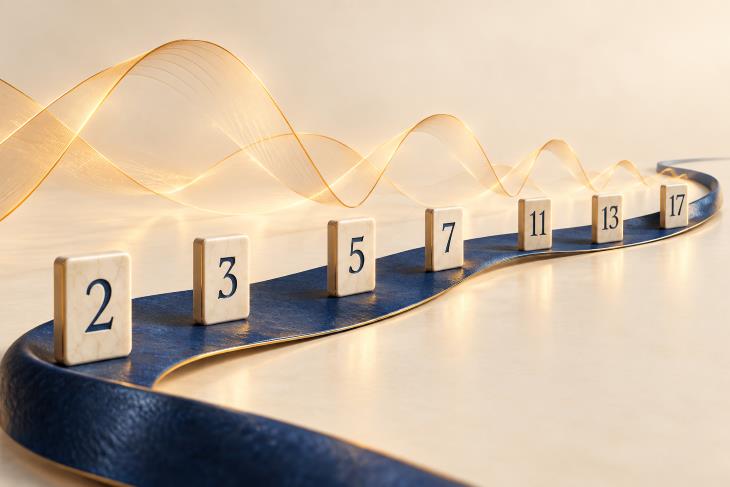
In 1859, the German mathematician Bernhard Riemann published a short paper suggesting that the primes follow a hidden order after all. He connected them to a special mathematical formula, known today as the zeta function, and guessed that certain key values of this formula all line up neatly along a single straight line. If he was right, the primes are scattered about as evenly as they possibly can be.
Computers have since checked trillions of these values, and every single one sits exactly on Riemann's line. But checking trillions of cases is not a proof, and the hypothesis has stood unproven for more than 165 years.
What a solution would mean: Hundreds of published mathematical results begin with the words "assuming the Riemann Hypothesis is true." A proof would confirm all of them at once, like finally pouring the foundation under a skyscraper that has been hovering in midair. Because modern encryption leans heavily on prime numbers, a proof would also deepen our understanding of the math that keeps information secure, though it would not, by itself, break any codes.
Every time you watch cream swirl into coffee, smoke curl from a chimney or waves crash on a beach, you're seeing the Navier-Stokes equations at work. Developed in the 1800s by the French engineer Claude-Louis Navier and the Irish-born physicist George Stokes, these equations apply Isaac Newton's laws of motion to liquids and gases. Engineers use them every day to design airplane wings, forecast the weather, model blood flowing through arteries and plan pipelines.
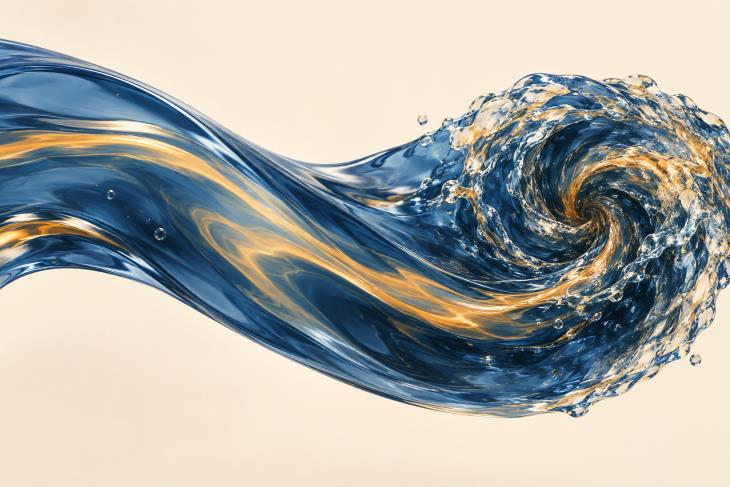
Here's the strange part. Nobody had ever proved that the equations always work. The Millennium Prize question asks: if you start with a smooth, calm flow of fluid in three dimensions, will the equations always keep producing a sensible answer? Or could the flow, in some extreme situation, twist itself into a knot so violent that at a single point the fluid would have to move infinitely fast? Mathematicians call such a breakdown a "blowup" or a "singularity."
What a solution would mean: Either answer counts. A proof that the equations always behave would give scientists complete confidence in the math behind countless technologies. A proof that they can break down would tell us the equations are an imperfect description of nature at the tiniest scales, and that turbulence, one of the great unsolved puzzles of physics, is even stranger than we thought. As you'll read below, this is the problem that artificial intelligence now claims to have solved.
In 1954, physicists Chen Ning Yang and Robert Mills developed a theory that would become the backbone of modern particle physics. Their equations describe forces that operate inside atoms, including the "strong force" that glues the atomic nucleus together. Theories built on their work have predicted the results of experiments with astonishing precision, and several Nobel Prizes have been awarded along the way.
The problem is that physicists and mathematicians play by different rules. Physicists are satisfied when a theory matches experiments. Mathematicians want proof that the theory is logically sound from the ground up, and that has never been done for Yang-Mills theory. The prize asks for two things: a rigorous mathematical foundation for the theory, and a proof of something called the "mass gap." In everyday terms, the mass gap means that the lightest possible particle the strong force can produce still has some mass, rather than none at all. This is believed to be the reason the strong force only reaches across the tiny space inside an atom's nucleus, while forces like magnetism and gravity stretch across enormous distances.
What a solution would mean: It would put a huge part of modern physics on solid mathematical ground for the first time. It would also likely require brand-new mathematical tools that could open up whole new fields of research.
Even professional mathematicians admit that this one is the hardest of the seven to explain. Proposed by the Scottish mathematician William Hodge around 1950, it deals with incredibly complicated geometric shapes that exist in many dimensions and can't be pictured by the human eye.
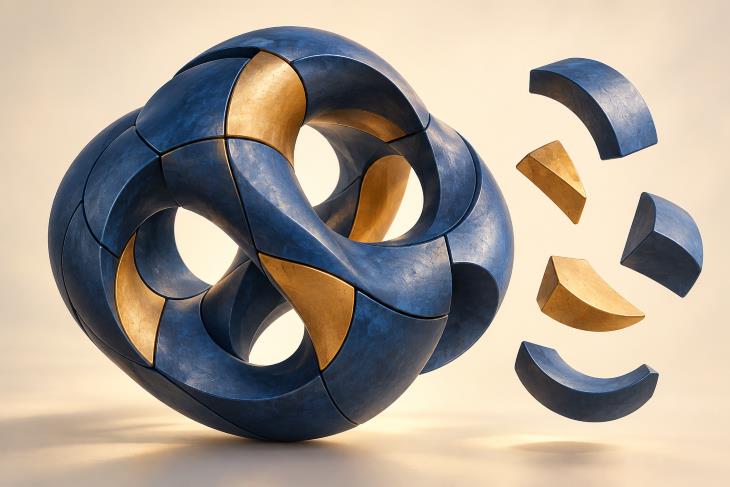
The best everyday comparison is a box of Lego bricks. Imagine being handed an elaborate, sculpted object and asked whether it could be rebuilt entirely from standard bricks. The Hodge Conjecture suggests that for a certain important family of shapes, the answer is yes: the interesting parts of these shapes can always be assembled from simpler, well-understood pieces described by basic algebra equations.
What a solution would mean: The Hodge Conjecture sits at a crossroads where algebra (the math of equations), geometry (the math of shapes) and topology (the math of how shapes are connected) meet. A proof would build a sturdy bridge between these fields, letting mathematicians carry tools from one area into another. Its impact would be felt mostly inside mathematics itself, but many of history's "purely abstract" discoveries later turned out to have practical uses nobody expected.
Here's a puzzle that has fascinated people for over a thousand years. Take a right triangle, the kind with one square corner. Which whole numbers can be the area of a right triangle whose three sides are all whole numbers or fractions? The number 6 works: a triangle with sides of 3, 4 and 5 has an area of exactly 6. Surprisingly, 5 also works, though you need sides of 3/2, 20/3 and 41/6 to get there. But the numbers 1, 2 and 3 never work, no matter what you try.
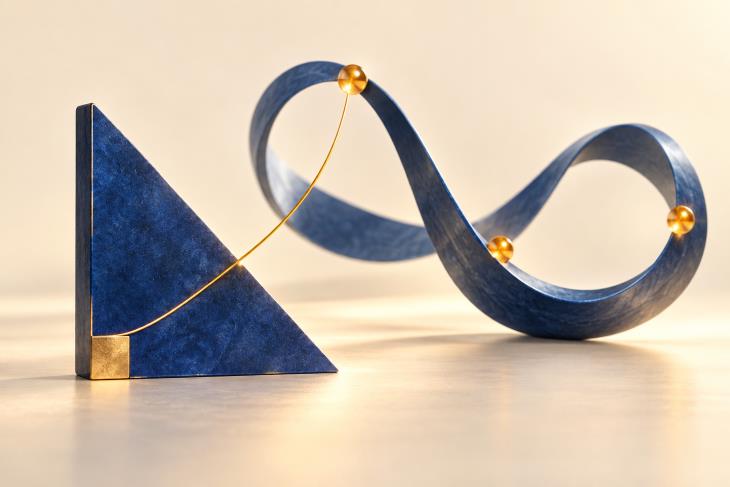
Questions like this lead to equations called elliptic curves, and the big question is whether a given curve has a limited or an unlimited number of solutions made of fractions. In the early 1960s, British mathematicians Bryan Birch and Peter Swinnerton-Dyer ran experiments on one of the earliest computers at Cambridge University and noticed a striking pattern. They proposed that a special formula tied to each curve can reveal the answer, without anyone having to hunt for solutions one by one.
What a solution would mean: A proof would give mathematicians a master key for a whole class of equations that has puzzled people since ancient times. It would even settle the triangle puzzle above, since a simple test for it, discovered in 1983, is only guaranteed to work if the conjecture is true. Elliptic curves are no mere curiosity, either. They played a central role in the proof of the famous Fermat's Last Theorem in the 1990s, and they secure many of the encrypted connections your smartphone makes every day.
Stretch a rubber band around an apple. No matter where you place it, you can slowly slide the band over the apple's surface and shrink it down to a single point without ever lifting it off or tearing anything. Now try the same thing on a doughnut. Loop the band through the hole, and it gets stuck. You can't shrink it away without cutting the doughnut.
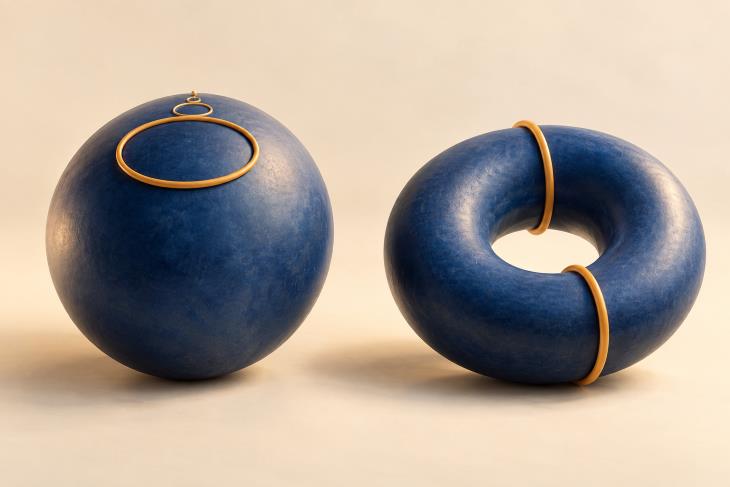
Mathematicians use this rubber band test to tell shapes apart. In 1904, the French mathematician Henri Poincaré asked whether the same test works one dimension up, for three-dimensional "surfaces" that are impossible to picture directly but could, for instance, describe the overall shape of our universe. If every possible loop can be shrunk to a point, he asked, must the shape be a sphere in disguise?
What the solution means: This is the one we no longer have to wonder about. The answer is yes, and it came from one of the most unusual people in the history of science.
Grigori Perelman was born in 1966 in Leningrad, in what was then the Soviet Union. As a teenager, he won a gold medal at the International Mathematical Olympiad with a perfect score. After research posts in the United States in the early 1990s, where he turned down offers from top universities, he returned home to the Steklov Institute of Mathematics in St. Petersburg and all but disappeared from view.
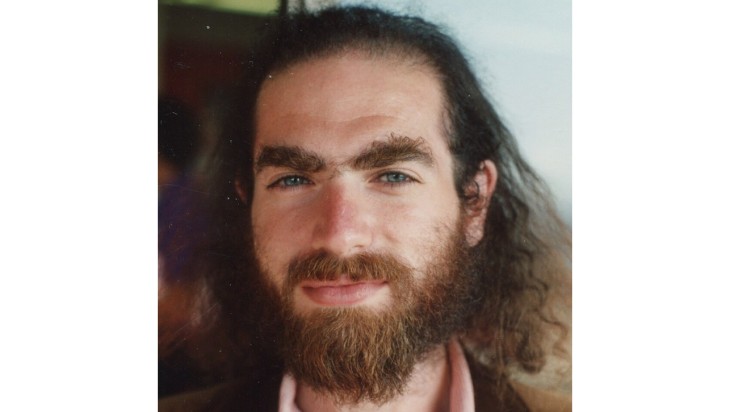
He was quietly working on Poincaré's question. In November 2002, he posted the first of three papers on a free website where scientists share early drafts of their work. He never submitted them to a journal. He simply put them online and, in effect, left it to the world to check.
His approach built on a technique developed by the American mathematician Richard Hamilton, called Ricci flow. Picture a lumpy, misshapen balloon that gradually smooths itself out, the way heat spreads evenly through a room. The idea was to let any shape that passes the rubber band test smooth itself out until its true identity as a sphere became obvious. The trouble was that during this smoothing, the shape could develop sharp pinches and spikes. These are singularities, the very same troublemakers at the heart of the Navier-Stokes problem. Perelman found a way to understand and surgically remove every possible kind of pinch, and in doing so, he also proved a much bigger conjecture describing all three-dimensional shapes.
Several teams of experts spent years checking his dense, compact arguments and filling in the details. By 2006, the mathematical world agreed he was right. That summer he was awarded the Fields Medal, often called the Nobel Prize of mathematics. He became the first person ever to refuse it.
In March 2010, the Clay Mathematics Institute officially declared the Poincaré Conjecture solved and awarded him the $1 million prize. He turned that down too. He explained that he felt Hamilton's contribution was no less important than his own, and he disagreed with the way the organized mathematical community made its decisions. He had made it clear before that he had no interest in money or fame. The Institute used the funds to create a research position in Paris for promising young mathematicians.
Perelman left professional mathematics and has lived an intensely private life ever since, avoiding interviews and public appearances.
Fast forward to Tuesday, September 8, 2026. The artificial intelligence company OpenAI, maker of ChatGPT, announced that one of its unreleased AI models had solved the Navier-Stokes problem.
The way it happened would have been unimaginable in Perelman's day. Instead of one person working alone for years, OpenAI set loose a swarm of about 10,000 AI "agents," copies of its model working side by side, sharing ideas and dividing up the labor. They ran for 88 hours, a little under four days, and exchanged roughly 2.7 million messages with one another. The result was a 166-page paper. The computing bill ran to several million dollars.

And the answer? The equations can break down. The AI constructed a precise scenario, a kind of spinning vortex, in which a smooth, calm fluid develops a singularity within a limited amount of time. The scenario involves a carefully designed but perfectly smooth outside push on the fluid, a bit like very precise, gentle stirring. The Clay Institute's official rules list this as one of the acceptable ways to settle the question.
To guard against mistakes, the proof was also translated into a computer language called Lean, which checks every single logical step and leaves no room for a hidden error. That's an important difference from past claims. Over the years, many people have announced solutions to Millennium Problems that fell apart under inspection. Human experts still need to confirm that the statement the computer checked matches the original problem exactly, but the formal check gives mathematicians strong reason for confidence.
What does it mean for everyday life? Honestly, very little in the short term. Real water and air are made of molecules, not the perfectly smooth, endlessly divisible substance the equations imagine, so your weather forecast and your next flight are unaffected. What changes is our understanding. The equations that so beautifully describe fluids contain a hidden flaw, and the chaos of turbulence runs deeper than anyone could prove before.
The announcement was historic, but it quickly became messy.
About 12 hours before OpenAI went public, New York University mathematician Tristan Buckmaster announced that he and his collaborator Levent Alpöge, a mathematician who also works at the rival AI company Anthropic, had solved closely related problems after roughly a year of work. Their results dealt with the Euler equations, a simpler cousin of Navier-Stokes that describes fluids with no friction at all. They, too, had used AI tools along the way, including OpenAI's.
OpenAI acknowledged that it launched its all-out effort on September 1 after hearing rumors that a Millennium Problem had been cracked. Buckmaster suggested that word of his team's progress had reached OpenAI and influenced its approach, and he raised questions about whether the company could have benefited from the pair's use of its products. OpenAI firmly denied this. It said its researchers never saw the pair's work before it was released, that an internal investigation confirmed their inputs could not have influenced its system, and that the two proofs differ significantly. OpenAI credited the pair with the first result on the Euler equations while claiming the Navier-Stokes result as its own.
On one point, nearly everyone agrees: the key idea behind both breakthroughs came from two human mathematicians in Spain, Diego Córdoba and Luis Martínez-Zoroa. They spent years developing a pen-and-paper technique that stacks an endless cascade of well-behaved flows into one that eventually breaks down. Buckmaster publicly said Martínez-Zoroa deserves a Fields Medal, and Córdoba told reporters that without their work, the AI would not have solved the problem.
The episode set off a wider debate. On September 11, a group of Fields Medal winners, eventually numbering 26, published an open letter warning that the race among AI companies to conquer famous problems could harm mathematics, a field that depends on human understanding, collaboration and the training of the next generation.
There's also a curious echo of the Perelman story: OpenAI has said it will not claim the $1 million prize. On September 11, the Clay Institute said the problem appears to have been settled, but stressed that its review process is deliberately slow and will take years, and it has not said who should receive credit. Until that process is complete, the Navier-Stokes solution remains an extraordinary claim awaiting its official stamp.
That leaves five problems still standing: P vs NP, the Riemann Hypothesis, Yang-Mills, Hodge, and Birch and Swinnerton-Dyer. Not long ago, most mathematicians would have bet that none of them would fall in their lifetime. Today, AI companies are openly racing to tackle them, and OpenAI has hinted that it has made significant progress on another one, without saying which.
Whatever happens, the story of the Millennium Problems has become a tale of two very different ways of doing mathematics. One is a lone genius in St. Petersburg, working in silence for years and refusing every reward. The other is an army of machines that can do years of work in less than four days. Perelman's name will always be tied to Poincaré's question. Who, or what, gets remembered for Navier-Stokes is a question the world is still answering.