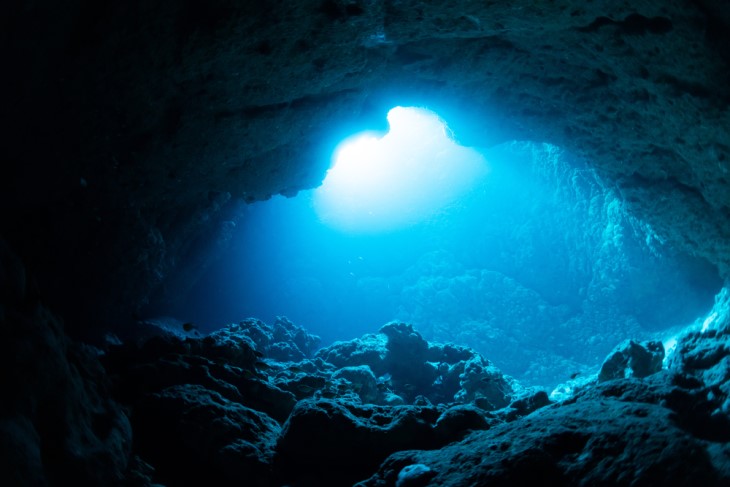
A groundbreaking discovery by Northwestern University researchers reveals an enormous water reservoir deep beneath the Earth's surface, fundamentally altering our understanding of the planet's water origin. This vast underground ocean, found approximately 700 kilometers below us, challenges previously held notions about the Earth's water, suggesting it may have emanated from the planet's interior rather than being introduced from extraterrestrial sources.
The study, published in 2014 and titled "Dehydration melting at the top of the lower mantle," offers compelling evidence of the reservoir's existence within a type of blue rock known as ringwoodite. This mineral, situated in the Earth's mantle—the hot, dense layer of rock between the crust and the core—has the remarkable ability to store water within its structure. The mantle acts as a colossal sponge, holding water in the form of hydrogen and hydroxide ions.
Steven Jacobsen of Northwestern University, who played a pivotal role in the research, conveyed to New Scientist the significance of the discovery, emphasizing its implications for our understanding of Earth's water cycle. The existence of such a reservoir supports the theory that Earth's surface water originated from within, seeping out over time to form oceans.
The researchers utilized a network of 2000 seismometers to analyze the seismic waves generated by over 500 earthquakes. These waves, which travel through the Earth's interior and can be detected at the surface, provided invaluable insights into the subterranean world. By observing variations in wave speed at different depths, the team could identify the presence of dampened rock, indicating water.
This method of investigation highlights the dynamic and interconnected nature of Earth's layers, offering a glimpse into deep geological processes. Jacobsen likened the planet's reaction to seismic waves to a bell that continues to resonate long after the initial event, a phenomenon that allowed for the detailed analysis of the underground landscape.
The discovery not only enriches our understanding of Earth's geology but also carries profound implications for the global water cycle. According to Jacobsen, without this deep reservoir, Earth's surface would be vastly different, with significantly higher sea levels covering much of the land. This hidden ocean, therefore, plays a crucial role in maintaining the balance of water on and within our planet. It could very well be that the oceans we know are actually LEAKAGE of this proto-ocean, a huge body of water coming from inside the earth.
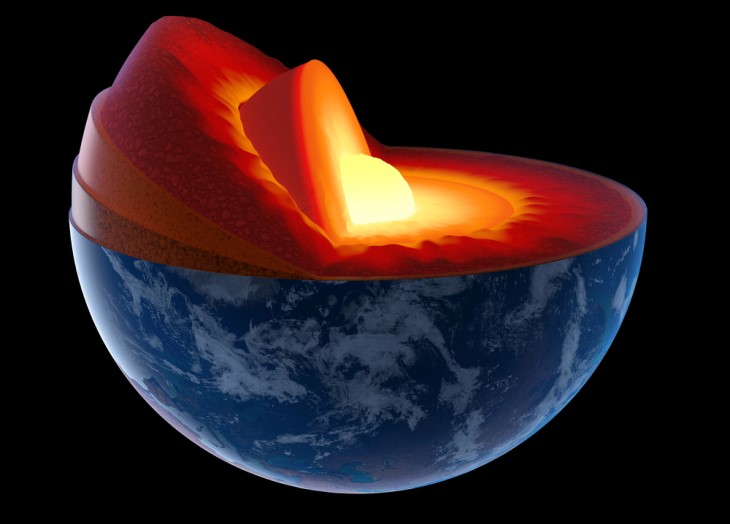
Above is the traditional section of what we THOUGHT Earth's mantle and core looked like. Now imagine that between the different parts is a huge body of water, slowly leaking out to the oceans we know.
Supporting evidence from a separate 2014 study by the University of Alberta researchers further solidifies the findings. They analyzed a diamond expelled from deep within the Earth by a volcano, which contained traces of water-bearing ringwoodite. This additional proof underscores the prevalence of water in the Earth's mantle, specifically within the transition zone—a region characterized by dramatic shifts in temperature, pressure, and mineral composition, located between the upper and lower mantle.
Together, these studies revolutionize our comprehension of Earth's water sources, suggesting a much more complex and internally driven water cycle than previously thought. The existence of such an immense subterranean ocean opens new avenues for research, potentially reshaping our approach to studying Earth's geological and hydrological phenomena.

4:17
Watch and Understand Why the Octopus Brain Is So Special
Here's a video that gives us an in-depth look of the octopus brain and shows why it is so extraordinary.
5:48
3 Surefire Ways to Always Identify Pseudoscience
Find out how you can identify pseudoscience, and learn how it differs from actual science.
13:41
The 5 Most Important Fossil Discoveries from Last Year
2024 saw some really amazing fossil discoveries!
12:57
The Curious Science of Tricking Your Taste Buds
Did you know you could confuse your sense of taste? Find out how!
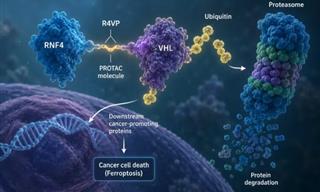
A Smart New Way to Kill Cancer Cells That Resist Treatment
In lab dishes, these molecules killed aggressive, treatment-resistant melanoma and sarcoma cells within just a few hours, while leaving healthy cells largely untouched.
Enjoy the Natural Beauty of 2025 Ocean Photography Winners
This year's winning photographs combine delicacy and drama, science and art, and offer a rare glimpse into life that is far from sight yet close to the heart.
Movement and Strength: What Four New Senior Studies Show
Four recent findings tell a clear story: you do not need to overhaul your life to add years to it, there is a sensible ceiling to how much exercise you need, lifting a little weight keeps your brain young as well as your body, and it's never too late
A Quantum Leap? Revolutionary Technique Discovered
Scientists at Singapore University have developed a groundbreaking manufacturing method powered by artificial intelligence that may revolutionize how we understand and create quantum materials at the atomic level.
These Are the Miracles That Happen in Our Bodies Every Day
There is a lot that happens inside our bodies every single day. Did you know any of these facts?
5:16
How The Brooklyn Bridge Narrowly Escaped Never Being Built
Learn about the fascinating, but equally tragic history of the construction of Brooklyn Bridge in this engaging and educational video
Remembering the Life and Wisdom of Stephen Hawking
Stephen Hawking possessed one of the greatest minds the world has ever seen, but was also impaired by a debilitating disease. Here are his life ant times.
5:56
What on Earth Is a Black Hole? This Video Explains All...
What on Earth are black holes, how do they affect us, and should we be at all worried about their existence? Find out here.
NVIDIA CEO Reveals Which Degree Is Worth Studying
Electrical Engineering, Computer Science, or Physics? Nvidia's CEO has a surprising answer to which area should be studied nowdays.
Science: Can Plants That Come Back From the Dead Save Us?
These extraordinary organisms may hold the key to solving one of the world's most urgent problems: feeding a growing population on a warming, drying planet.
I Bet You Didn't Have a Clue About These Human Body Facts!
The human body is the most complex machine known to mankind, but I bet you don't know these 10 amazing facts about it...
6:47
7 Exciting Physics Tricks You Have to See!
Watch these seven remarkable physics tricks in this exciting and fun video.
New Research Shows Eating Sweets Won't Make You Crave More
A groundbreaking new study challenges conventional wisdom, suggesting our preference for sweet tastes may be more stable than we think.
2:56
Watch as a Fun-Filled Day of Balloons Turns to Disaster!
The 1986 Cleveland Balloon Festival was meant to be a truly joyous occasion but instead quickly turned into a grave tragedy
14:21
Mark Rober’s $60 Million Science Experiment
YouTube’s favorite mad scientist is launching his biggest mission yet: a $60 million reimagining of STEM education
Is Microsoft's "AI Doctor" Better Than a Real Doctor?
A new study presents a committee of digital doctors achieving approximately 80% accuracy in complex medical diagnoses – far beyond the average of general practitioners.
These Ancient Inventions Have Got Scientists Stumped!
Here are 12 items from long ago which prove that our ancestors possessed knowledge and skills far more advanced than we once believed them to be.
20:32
History: Did the Trojan War REALLY Happen?
The Trojan War, the most famous of the ancient wars, fought by thousands of men for ten long years on the beaches of the famed city of Troy. Was all that real?
9:03
24 Unbelievable Abilities Your Body Has
The human body is a complex and endlessly fascinating machine, and it might be even more sophisticated than you know...
Study Shows Seniors Still Grow New Brain Cells Daily
A new study shows that even the elderly keep on growing new brain cells, which could be the breakthrough the scientific community was waiting for...
5:39
Why Are Your Ears Ringing? The Causes Explained
Nearly 15% of the human population worldwide are plagued by this strange sensation, but most people don't know the causes behind ringing in the ears...
Anti-Aging Science in 2026: What's Real and What's Hype?
Here's an honest look at where anti-aging medicine stands in 2026 - the promising, the disappointing, and the surprisingly simple things that still beat almost everything in a pill bottle.
34:33
Is China Number 1 in Global Technology?
In this video, we’ll take a closer look at the new developments hitting the market — and what they could mean for the future of transportation.
11:02
Ever Wonder What Ancient Egyptian Sounded Like?
Researchers have used all the information we know to create what they think it may have sounded like.
10 Fascinating Psychological Facts You Should Know About
Psychology is the science of studying the individual and the things that make us, as humans, tick. These 10 psychological facts you've never heard of before will make for fascinating reading material.
These 11 Brain Facts Are Enough to Boggle Your Mind
When you consider the sheer complexity of the human brain, it's difficult to wrap your head around it. Learn these 11 fascinating facts about the human brain.
4:57
Fascinating: How Does Our Digestive System Work?
This video explains how the human digestive system does its daily.
13:55
WATCH: What Is the Fingerprint of God's Creation?
The golden pattern, describes the mathematical code of the universe. Is this the scientific evidence of God's will and plan?
15:18
The Entire History of the Universe in One Year
Imagine compressing the entire 13.8-billion-year history of the cosmos into a single calendar year. In this cosmic calendar, the Big Bang erupts on January 1st, but our home planet and the Sun don’t even exist until late August.
20 Incredible Inventions That We Have Completely Lost
Here are some of the most amazing ideas and inventions we have ever seen. But, sadly, all of them have been lost to science in the mysterious mists of history.
Chocolate Exposed! Here's What It Does to Your Brain!
Just what is it that makes chocolate so irresistible to so many people around the world? Find all of the answers in the article.
11:43
Learn While Laughing: The Incredible Tardigrade
If you love nature and you love laughing, this incredible series of nature videos are a great way to spend a few minutes.
6 Signs That Someone is Listening on Your Cellphone Calls!
With technology advancing all the time, there is the ever-increasing chance of our phones being tapped. Here are 6 signs that your phone could be tapped.
Science Lesson: 10 Fiery Facts About the Sun You Must Know
Learn some fascinating and little-known facts about the Sun in this article.
7 Discoveries of Albert Einstein that Changed the World
The 7 biggest discoveries of Albert Einstein and how they changed the world forever.
14:58
Why IS Fentanyl So Dangerously Addictive?
In this video, we break down what opioids really do to your brain and body, what using them actually feels like, and why so many people are dying from Fentanyl overdoses.
Wow! Who Knew That Jupiter Was So Mesmerizing?
Take a look at Jupiter like you've never seen it before!
0:55
China's G1 Robot is Showing Some Incredible Moves
The G1 is a new robot developed in China and in this video shows some amazing moves.
Alzheimer's: What Recent Breakthroughs Have Taught Us
Now, you can discover 4 new studies that show how to do this in ways you haven’t heard of.
Hubble Telescope: 35 Years of Incredible Photos
Exploring 35 years of reality-changing, universe-enhancing photos that opened the sights of outer space to us all.
10:19
What a Bullet Blast Looks Like Underwater!
The slow motion kings are back with incredible effects.
This is How to Activate Your Brain's Ability to Learn
A recent study has shown that overlearning might improve performance in a particular task by altering the chemicals in the brain that "lock" in training.
This New Blood Pressure Drug Could Be a Game-Changer
Zilebesiran, an investigational drug that is showing profound success in late-stage clinical trials is offering hope for millions who struggle to keep their blood pressure in check.
58:37
Science: Here's Everything We Know About Pluto
Join us as we unravel the mysteries of far off Pluto, 3.7 billion miles from our Sun.
To enable your Ad-Free Subscription, please fill the fields below
Your subscription was successful, now you can enjoy an ad-free experience!! Note: To make sure you get no ads, please make sure to log in to your account. If you are logged in already, then refresh the page. The subscription can be cancelled at any time.