
For the first time ever, scientists have taken a collection of lifeless molecules, tucked them inside a tiny bubble, and watched in amazement as the whole thing began to behave like something alive. This little lab-made cell grew, copied its own DNA, and then split neatly into two. In other words, it did the very things that living cells do every day inside our bodies.
It sounds like something out of science fiction, but it happened in the laboratory of Kate Adamala, a synthetic biologist at the University of Minnesota. And while the achievement raises some big, wonderful questions about the nature of life itself, it may also open doors to new medicines, cleaner materials, and a deeper understanding of how we all came to be here in the first place.
What Exactly Did They Make?
To be clear, no one is claiming this creation is truly alive. It cannot survive on its own. It needs a steady supply of food and other building blocks delivered to it constantly, and it has no way to defend itself or clean up its own waste. Left alone, it would simply stop working.
But here is what makes it remarkable. Every single piece of this cell was built by human hands in the lab. The scientists know exactly what went into it, like a cook who has a complete recipe listing every ingredient. That means they can swap parts in and out, adjust the mixture, and see what happens. Nothing about it is a mystery to them.
Researchers have been chasing this goal for decades. Many consider it a kind of holy grail: taking dead components and coaxing them into acting like a living thing. This new cell is the closest anyone has come so far. Jack Szostak of the University of Chicago, who studies the origins of life and was not part of the work, called it an impressive step, saying he knew of no other effort to build an artificial cell from biological parts that had come this far. Sijbren Otto, a chemist at the Stratingh Institute for Chemistry in the Netherlands, agreed that while it is not quite there yet, it is getting very close.
A Recipe Billions of Years in the Making
Roughly four billion years ago, a group of ordinary, non-living molecules somehow came together and formed the very first cells. They fed, they grew, and they divided. Over an enormous stretch of time, those simple cells changed, multiplied, and eventually gave rise to every plant, animal, and person alive today. A purely chemical world slowly bloomed into a living one.
Scientists still cannot agree on exactly how that leap from non-life to life happened. So a handful of curious researchers decided to try recreating it themselves, starting from the ground up.
The team behind this new cell studied what all living things have in common. Every cell grows. Every cell copies its DNA. Every cell divides. And every cell reads its genetic instructions to build the proteins that keep it running. All of this happens inside a thin, oily wrapper called a membrane, which holds everything together in one tidy package.
So the researchers set out to give their cell each of these abilities, one piece at a time.
Building It Piece by Piece
They began with the most basic job of all: copying DNA and passing it along, borrowing a system first developed by the synthetic biologists Hannes Mutschler and Christophe Danelon. Then they added a set of tiny biological tools that let the cell read its own genetic code and produce proteins. Getting all these systems to cooperate was no small feat. It took a great deal of patient adjusting, switching ingredients around, and fine-tuning the amounts of each.
Because this simple cell could not make everything it needed on its own, the team also prepared little supply bubbles filled with sugars, fats, and other essential materials. They designed the cell so that when one of these supply bubbles bumped into it, the two would merge and the goods would spill inside. It was a bit like a delivery truck pulling up and unloading groceries.
After plenty of trial and error, the cell finally began to grow and copy its DNA. The scientists were nearly ready to celebrate. But one crucial step remained: the cell still had to divide.
The Tricky Business of Splitting in Two
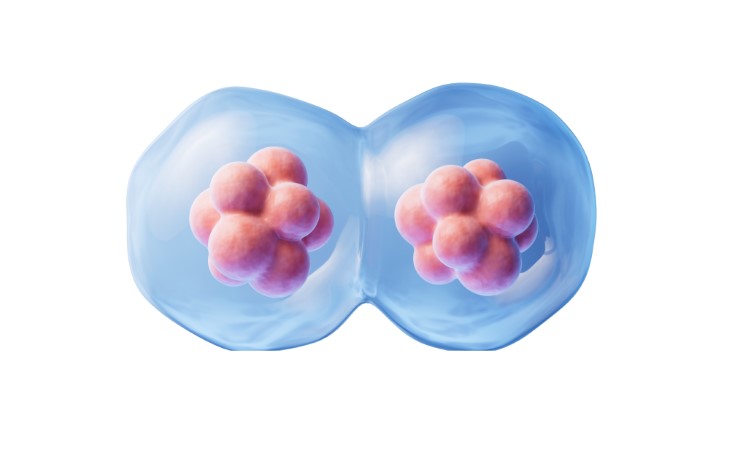
Cell division had stumped researchers for a long time. In nature, a cell uses an intricate internal scaffolding to pull itself apart into two. Recreating that machinery from scratch proved nearly impossible.
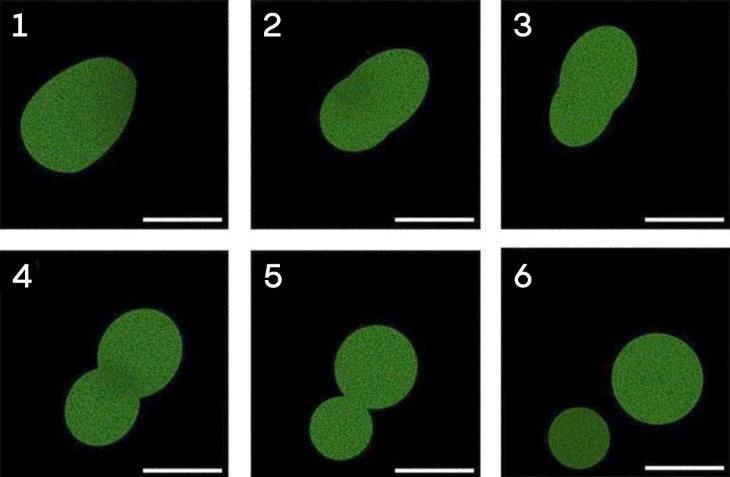
So Adamala tried a clever shortcut inspired by the work of Reinhard Lipowsky at the Max Planck Institute of Colloids and Interfaces. Instead of building the complicated scaffolding, she used special proteins that crowd together along the cell's outer wall and physically pinch it in the middle, squeezing it until it splits. After several attempts, it finally worked. The cell elongated, pinched at its waist, and separated into two daughter cells.
The team had trouble believing it at first, checking their results again and again until there was no doubt left. They had built a cell that could divide.
Other scientists were quick to praise the accomplishment. Job Boekhoven, a chemist at the Technical University of Munich, said the paper beautifully demonstrated this division method and called it a huge achievement. John Glass of the J. Craig Venter Institute described the whole effort as a staggering technical feat that could prove to be a landmark moment for biology. Michael Lynch, an evolutionary biologist at Arizona State University, called it a tour de force, though he wisely cautioned against overstating things, since the cell still cannot sustain itself.
Why "Spudcells"?
Here is a charming detail. Once the cells were created, students in the lab began calling them by the last name of the scientist who led the work. She did not care for that at all and insisted they pick another name, jokingly suggesting they call them potatoes instead. And so the little creations earned the nickname "spudcells." Being of Polish heritage, she happily embraced it, noting with a laugh that she is mostly made of potatoes anyway.
Under a microscope, she admits, the cell does not look like much. To her it is thrilling, but to everyone else it simply looks like a tiny blob.
What Comes Next?

The team even coaxed some of these cells to grow larger and produce more offspring, an early hint of the kind of change that drives evolution. There is still a long way to go before these cells can truly evolve on their own, but it is a promising start.
Looking ahead, scientists hope that decades from now, cells like these might be put to work making useful things: plastics that do not rely on fossil fuels, better fertilizers, or new medicines. Adamala and her colleagues have even formed a nonprofit called Biotic to share their tools and methods freely, so that labs around the world can build on the work.
Adamala offered a lovely comparison to describe where things stand today. A modern living cell, she said, is like a sleek passenger jet. What her team built is more like the very first flying machine the Wright brothers cobbled together, a simple frame with wings that managed to lift off the ground and travel a hundred feet. It is humble, but it flies.
And that first short flight, as history has shown us, can change everything.