
Ask most people what they should be doing for their health, and they will sigh and mention the treadmill they never use, or the gym membership quietly draining their bank account. Almost nobody says "I should go dancing." Yet a growing body of research suggests that dancing may do more for an aging body and mind than almost anything else we could choose, and that it beats the treadmill on several counts that matter enormously.
The reason is not that dancing is a superior form of exercise in the narrow sense. A brisk walk raises your heart rate just as well. The reason is that dancing does several completely different good things at the same time, and it is the combination that turns out to be remarkable. Here is what the research actually shows, and how to get started.
The finding that made researchers sit up appeared in the New England Journal of Medicine in 2003. Over 21 years, researchers followed hundreds of adults aged 75 and older, tracking how often they took part in a whole range of leisure activities: reading, writing, crossword puzzles, playing cards, playing a musical instrument, walking, swimming, tennis, golf, and dancing.
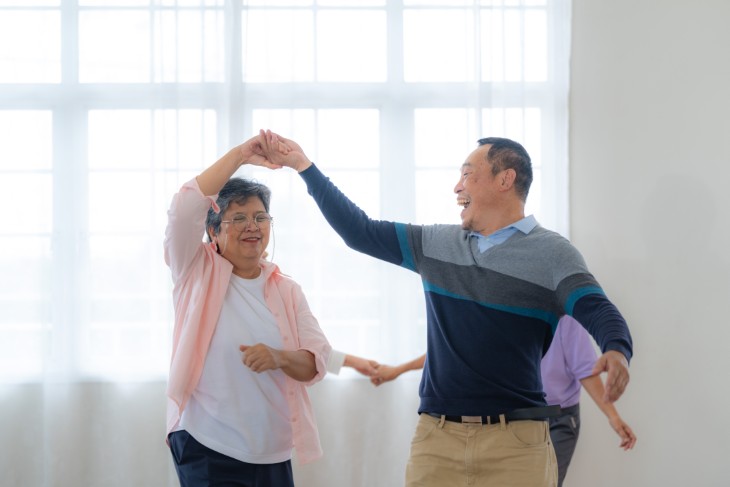
Then they looked at who developed dementia. Several mental activities helped, with reading associated with a 35 percent lower risk and crossword puzzles rather more. But among all the physical activities studied, only one was linked to a significantly lower risk of dementia. It was dancing, associated with a striking 76 percent reduction. Walking, swimming, and cycling showed no significant effect in this particular group.
You can read the study here: Leisure Activities and the Risk of Dementia in the Elderly.
A word of caution is only fair. This was an observational study, meaning it found an association rather than proving that dancing causes the benefit. It is also possible that people in the earliest, undetected stages of dementia stop dancing before they stop walking, which would exaggerate the effect. Still, the finding was arresting enough to send researchers looking for the reason, and much of what they have found since supports it.
The explanation seems to lie in everything your brain must do while your body is moving. Walking on a familiar route is largely automatic. Dancing is not. You are learning and recalling steps, keeping time with music, coordinating with a partner or a group, anticipating what comes next, and constantly adjusting your balance as you shift weight and change direction.
In other words, dancing asks your body and your brain to work hard together, in real time, on something new. That combination of physical effort, mental challenge, and split-second balance is unusual, and it appears to be exactly what an aging brain benefits from most.
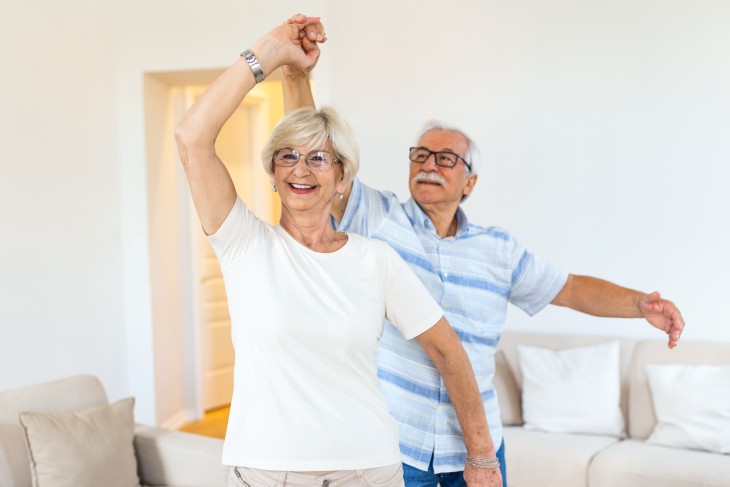
A particularly elegant study put this to the test directly. Researchers took healthy volunteers with an average age of 68 and assigned them either to an eighteen-month weekly dance course, learning new routines constantly, or to conventional endurance and flexibility training. Everyone was scanned before and after.
Both groups showed increases in the volume of the hippocampus, the brain region central to memory and learning and one of the first areas affected in Alzheimer's disease. That alone is encouraging news about exercise generally. But the dancers showed additional gains in particular parts of the hippocampus, and, crucially, only the dancers showed a meaningful improvement in balance. The researchers attributed the difference to the constant challenge of learning new steps rather than repeating the same movements.
The study is here: Dancing or Fitness Sport? The Effects of Two Training Programs on Hippocampal Plasticity and Balance Abilities in Healthy Seniors.
More recent work has extended this to people already experiencing memory difficulties. In a randomized trial, older adults with mild cognitive impairment who took up aerobic dance for three months showed changes in hippocampal volume and cognition compared with a control group: Effect of 3-Month Aerobic Dance on Hippocampal Volume and Cognition in Elderly People With Amnestic Mild Cognitive Impairment.
A 2023 review pooling 29 dance studies involving more than 1,700 older participants with mild cognitive impairment, Alzheimer's, or dementia reached broadly supportive conclusions: The effectiveness of dance movement interventions for older adults with mild cognitive impairment, Alzheimer's disease, and dementia.
The brain is only part of the story. One of the largest studies on the subject pooled eleven population surveys from the United Kingdom, following 48,390 adults aged 40 and over who were free of heart disease at the start.
Those who took part in moderate-intensity dancing had a lower risk of dying from cardiovascular disease, and notably, the association was stronger than it was for walking. The researchers suggested three reasons: dancing naturally includes short bursts of higher intensity mixed with easier stretches, rather like interval training; it carries social and psychological benefits; and people tend to keep doing it for life. That last point may be the most important of all.
The study is here: Dancing Participation and Cardiovascular Disease Mortality: A Pooled Analysis of 11 Population-Based British Cohorts.
Of all the benefits, this may be the most immediately practical. Falls are among the greatest threats to independence in later life, and balance is the first line of defense against them.
Dancing trains balance in a way few other activities do, because it constantly asks you to shift your weight, turn, change direction, pause, and recover, all while your attention is on the music rather than on your feet. That is much closer to real life than standing still on one leg, and it builds the kind of recovery reflexes that catch you when you stumble on a curb. It is worth remembering that the eighteen-month brain study found balance improved in the dancers and not in the conventional exercise group.
There is one more benefit, and it may be the quiet reason dancing works so well: it is sociable, and it is a pleasure.
Loneliness in later life is now taken seriously as a genuine health risk, comparable in its effects to some well-known physical risk factors. Dancing puts you in a room with other people, moving together to music, often touching hands, laughing at mistakes. It comes with conversation before and after, familiar faces week to week, and a reason to leave the house on a dark evening.
Music adds something of its own too, lifting mood, stirring memory, and making effort feel like enjoyment rather than duty. There is a reason people will happily dance for an hour when they would not dream of spending an hour on an exercise bicycle.
Dance has also found a place in the management of specific conditions. It has been studied particularly in Parkinson's disease, where the rhythm of music seems to give the body an external cue for movement, helping with the initiation and flow that the condition disrupts. Argentine tango in particular has been explored for balance, mobility, and quality of life: Therapeutic Argentine Tango Dancing for People with Mild Parkinson's Disease.
Adapted, low-impact dance programs have also been trialed for people living with dementia, with improvements measured in balance and walking speed. If you or someone you love has a diagnosis of this kind, it is worth asking whether a dance-based program exists locally, and worth mentioning to your doctor.
Here is a point the studies rarely capture but that matters more than any of them. The best exercise is the one you actually do, week after week, for years.
Gym memberships famously go unused. Treadmills become clothes racks. But people who take up dancing tend to keep dancing, because they enjoy it, because friends expect them, and because it never feels like a chore. A moderately good activity done faithfully for twenty years beats a perfect one abandoned in March. On that measure alone, dancing may be the most valuable thing on the list.

You do not need talent, a partner, or any previous experience. Almost every form works, so choose by what appeals to you:
To find a class, try your local community center, senior center, place of worship, or town recreation department. Many run classes specifically for older beginners, often at modest cost, and some offer a free first session.