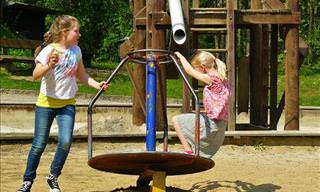

Running, jumping, climbing, and crawling are not just ways for children to burn off energy during a break. A growing body of research suggests that this kind of active, self directed play plays a real part in how children develop physically, socially, and mentally. It also raises a quiet question worth thinking about: what do children lose when we make their play spaces as safe and controlled as we possibly can?
Over the last couple of decades, the emphasis on preventing injuries in schools, playgrounds, and public spaces has grown a great deal. The wish to protect children is completely understandable. But taken to an extreme, it can also shrink their chances to explore, to climb, to test themselves, and to make small decisions on their own.
The goal here is not to turn the schoolyard into a dangerous place. Just the opposite. It is to create a space that is safe and still leaves room for challenge and for risk that fits the child's age. Children need places where they can run, climb, crawl, keep their balance, and cope with ground that is not perfectly flat and predictable.
One of the most useful ideas in this field is the difference between a hazard and a risk. A serious hazard is a situation where a child could be badly hurt, such as a broken railing or a sharp piece of metal hidden in the grass. A risk that fits the child's age is different. It is a challenge that sits within reach of what the child can handle, one they can face, work through, and learn from.
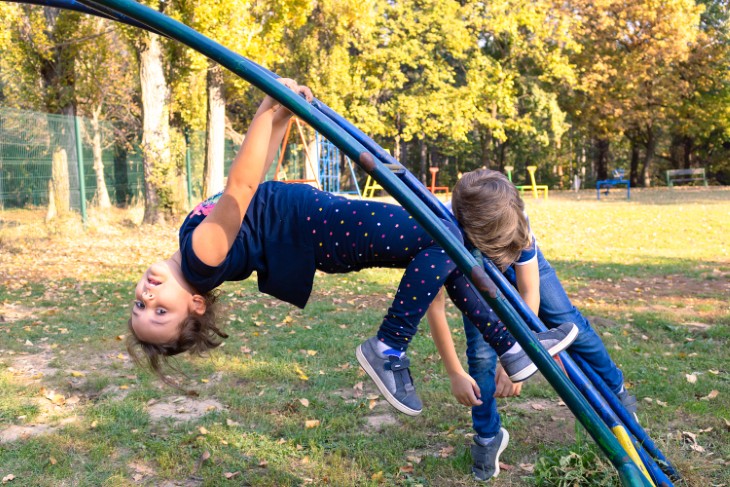
Researchers sometimes sum up the mindset in a simple line: keep children as safe as necessary, not as safe as possible. In practice that means scanning the play space for genuine hazards and removing them, then stepping back and letting children take on the manageable challenges that are left.
The value of active, hands on experience is not a new discovery. It appears in a classic experiment from the 1960s carried out by Richard Held and Alan Hein at Brandeis University. They compared kittens that moved through their surroundings under their own power with kittens that received almost identical visual scenery but were carried along passively. The kittens that moved for themselves developed normal, well coordinated, sight guided behavior. The ones who were moved passively struggled with the same tasks, at least until they were later allowed to move freely.
A related line of research used the famous "visual cliff," a table with a glass surface over an apparent drop, to study how babies judge a situation that looks risky. This area of study is genuinely complex, and the findings do not point to a simple rule where more experience always leads to safer behavior. What they do highlight is how much real, physical experience shapes the way a child reads the world and makes decisions inside it. You come to understand what your body can do by using it, not by watching from a stroller.
The Norwegian researcher Ellen Beate Hansen Sandseter spent years watching how young children really play, and she sorted the thrilling, slightly scary kind of play into a handful of clear categories. They include playing at height, such as climbing and balancing, playing at speed, such as running and sliding, rough and tumble play, playing with tools, playing near elements like water, and heading off to explore a little on their own.

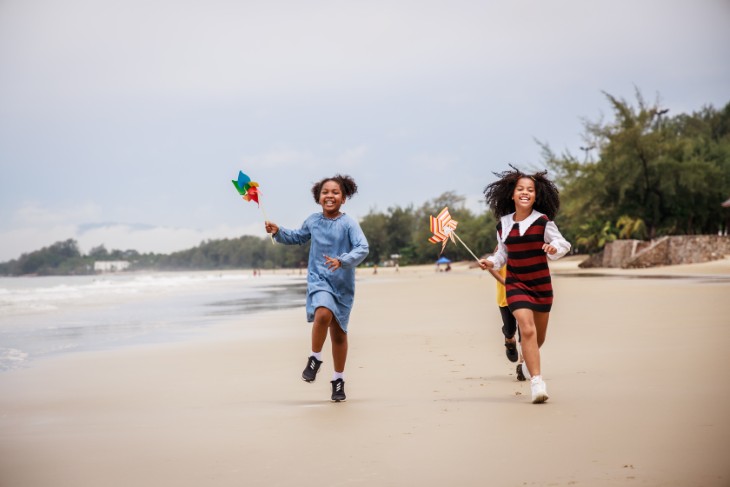
Games of tag, hide and seek, and chase fit this picture too. They mix movement with quick decisions, social give and take, and managing strong feelings. In this kind of play the child is not simply following instructions. The child chooses where to run, when to stop, and how to handle a sudden change. Sandseter has also pointed out that when a play space offers none of these thrills, children tend to go looking for them anyway, sometimes in places with far less supervision.
A large international review led by Mariana Brussoni at the University of British Columbia gathered the available studies on risky outdoor play and children's health. Across the research they examined, the overall picture leaned positive. Risky outdoor play was linked most often with more physical activity, and also with better social health and behavior, without the flood of serious injuries that worried parents might expect. The reviewers also noted that this kind of play has quietly faded over the years, alongside rising concern about child safety.

The broader case for play carries the weight of the medical world as well. In its clinical report "The Power of Play," reaffirmed in 2025, the American Academy of Pediatrics describes play as fundamental to healthy development, not a frivolous extra. Free, child led play, the report explains, helps build the mental skills children use to plan, focus, solve problems, and manage stress. Some pediatricians have gone as far as recommending that doctors "prescribe" play at checkups.
Reviews of the topic also find a familiar tension among the adults in charge. Teachers and caregivers often recognize the developmental value of a bit of managed risk, yet they worry about responsibility, safety, and injuries. The encouraging part is that when staff feel more confident and better supported in this approach, they tend to let children explore and test themselves rather than shutting the activity down.
Sometimes what a play space needs is not another elaborate climbing structure. It may simply need more variety underfoot. A study carried out in Finland with 75 children between the ages of three and five looked at what happened when daycare yards were enriched with forest floor material, soil, grass, and natural elements for a short period. Over the four week experiment, the mix of bacteria living on the children's skin changed, and several markers tied to how the immune system regulates itself shifted in a favorable direction. The researchers were careful to call these results encouraging rather than proof that any natural setting will prevent illness.

The practical message is friendly and low cost. Trees, sand, grass, branches, ropes, and uneven natural surfaces can make a play space richer and more interesting. They also invite children to invent their own games instead of using a structure in the one way it was designed to be used.
So the real question was never whether we should keep children safe. Of course we should. The question is whether the best way to do that is to strip almost every challenge out of their surroundings. Future play spaces can blend varied surfaces, climbing zones, crawling areas, and loose natural materials that children can use however their imagination leads. Alongside that, it helps to protect real time for free play, where not every minute is planned out and watched closely.
Schools and local authorities do not have to choose between safety and development. It is possible to design a space that cuts out serious hazards while still leaving room for a little uncertainty, a little challenge, and plenty of movement. Because a child who never falls may stay a bit cleaner, but they also get fewer chances to discover what their own body is capable of.