
Meet our newest neighbor in the galaxy - a black hole was discovered, and it is the closest one to our solar system yet! The exciting findings were published in a study in the journal Astronomy & Astrophysics, as recently as this Wednesday. The black hole is about 1,000 light-years away, and each light year is 5.9 trillion miles away (or 9.5 trillion kilometers). It may not sound all that close but in terms of the cosmos and even the galaxy, it’s considered practically next door according to European Southern Observatory astronomer Thomas Rivinius, who led the study.
For proportion, the black hole that was previously considered the closest one is about three times further - 3,200 light-years away. The black hole at the center of the Milky Way lies more than 25,000 light-years away, and another black hole which astronomers managed to capture in unprecedented detail in April last year is a whopping 55 million light-years away, in another galaxy altogether.
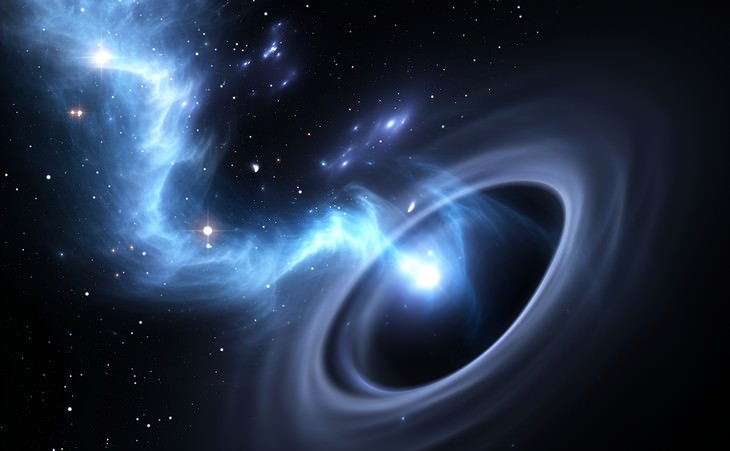
So if this newly discovered black hole is so close, how come it was wasn’t known to us until now? Black holes are regions in space that exert a force of gravity so strong that nothing can escape, not even light. Because no light is reflected, black holes are invisible, and the only way for astronomers to discover them is by noting the luminous bodies that orbit them. Most of the black holes we know of were detected because they were devouring nearby stars. Astronomers believe most black holes don’t have anything close enough to swallow, and so they remain undetected.
Related Article: 15 Pictures of Space From Different Observatories
Interestingly, this was exactly the case for the newly discovered back hole. It is a part of a two-star system called HR 6819, which has been examined by astronomers for years. When they analyzed the data, they noticed that there was something unusual about the behavior of the inner star of HR6819. Its velocity was so extreme, the team started suspecting that a third object existed in the system, which was flinging the inner star around.
They concluded it could only be a black hole. It was powerful enough to change the star's course, but not close enough to swallow it. “An invisible object with a mass at least 4 times that of the sun can only be a black hole," Rivinius explained in a press release.
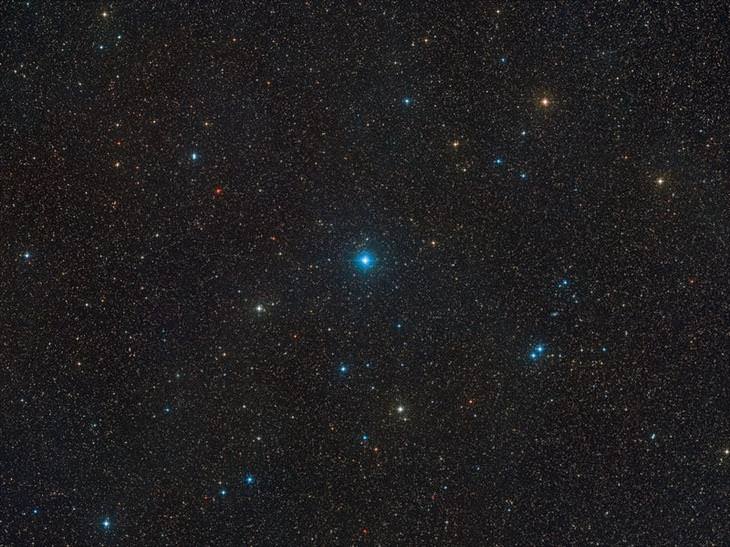
Another unusual aspect is that this star system is actually close enough for people in the southern hemisphere to actually be able to spot it on a clear night. This is the first-ever stellar system containing a black hole that can be seen with an unaided eye.
The video below shows what the astronomers saw: a star (blue) orbiting an invisible black hole (red), with another star (also blue) orbiting the inner pair. That makes this star system, called HR 6819, a triple system, and not double-system, as was believed thus far.
This discovery could help scientists progress and expand the knowledge of black holes immensely. "There must be hundreds of millions of black holes out there, but we know about only very few. Knowing what to look for should put us in a better position to find them," Rivinius said. Dietrich Baade, another astronomer on the research team called it “the tip of an exiting iceberg”.
The more we learn about the universe surrounding us, the more we realize how vast and mysterious it is, and despite being difficult, the process of studying it is certainly gratifying.

4:58
An Astronomical Event That TRULLY Won't Happen Again
This comet will only pass the Earth once. See it now before it's too late!
13:13
The Most Incredible Inhabitable Planets
Learn about the most lethal and terrifying planets in outer space. We're lucky they're that far out!
15 Beautiful Carl Sagan Quotes on the Stars and the Cosmos
A look at some profound quotes on the universe by famous astronomer and cosmologist Carl Sagan.
10:02
All the Fascinating Space Discoveries Made in 2019
2019 has seen quite a few eye-opening discoveries about space and astronomy. Learn about 26 of them in this video.
2:17:01
Astronomy: What is Beyond the Edge of the Universe?
In this video, we explore what modern astronomy reveals about the universe’s boundaries—if they even exist.
1:14:42
Documentary: How Did Our Universe Come From Nothing?
Can “nothing” truly become “something”? In this video, we’ll dig into this mind-bending question.
Is Microsoft's "AI Doctor" Better Than a Real Doctor?
A new study presents a committee of digital doctors achieving approximately 80% accuracy in complex medical diagnoses – far beyond the average of general practitioners.
Remembering the Life and Wisdom of Stephen Hawking
Stephen Hawking possessed one of the greatest minds the world has ever seen, but was also impaired by a debilitating disease. Here are his life ant times.
22:52
Will AI Take Your Jobs? An Expert Explains the Future
Gonzaga University's AI professor Graham Morehead some of our most pertinent questions related to AI.
11:43
Learn While Laughing: The Incredible Tardigrade
If you love nature and you love laughing, this incredible series of nature videos are a great way to spend a few minutes.
38:55
What Happens the Deeper You Go Underground?
What happens when pressure pushes matter beyond the limits of what we thought possible?
21:25
How Every Nuclear Power Got Its Atomics
This video will explain how each nation earned the complex and controversial title of nuclear power.
6 Signs That Someone is Listening on Your Cellphone Calls!
With technology advancing all the time, there is the ever-increasing chance of our phones being tapped. Here are 6 signs that your phone could be tapped.
5:50
The Rise of the Machines: Can Humanoid Robots Help Us?
Will humanoid robots change the way we work forever?
5:01
The Truth About Folding Phones You Need to Know
Don’t buy a foldable without knowing this first.
2024's Biggest Breakthroughs in Science We Must Celebrate
These recent scientific breakthroughs could change the world.
50:02
Take a Trip Through the Universe and Witness its Beauty
Since its launch, the Hubble Telescope returned images of unprecedented beauty of a dynamic and changing universe. Take a look!
4:52
Neon Lights: a Beautiful Union of Science and Art
Neon signs are a beautiful blend or artistry and science, and knowing the history and the science behind them make them even more exciting
Superwood: A New Material That Could Replace Steel
After decades of relying on steel—a material that produces nearly two tons of CO2 for every ton manufactured—builders may soon have access to something far more sustainable and surprisingly stronger: Superwood.
6:25
Do You Like the Smell of Rain? This Is Why
One of the best things about rain and thunderstorms is that clean fresh smell afterward. But what actually causes that distinct scent?
0:55
China's G1 Robot is Showing Some Incredible Moves
The G1 is a new robot developed in China and in this video shows some amazing moves.
9 of the Greatest Unsolved Mysteries About the Universe!
The universe has been around for close to 14 billion years, but it still holds many mysteries that continue to perplex scientists. Here's 9 of them!
20:04
Emotions Explained: The Science Behind How We Feel
Neuroscientist and psychologist Dr. Richard J. Davidson answers some fascinating questions about emotions you would never expect.
9:09
Protective Measures: How Our Body Reacts to a Tattoo
In this video, we’ll explore the microscopic war raging beneath your skin, where millions of your cells make the ultimate sacrifice to lock that ink in place, turning a defense mechanism into lifelong art.
8:11
Fascinating: What is the Deepest Hole Humanity Has Dug?
This video explains how low humanity has dug down so far.
12 Bizarre Scientific Facts You Never Learned at School
The scientific facts we collected in this list aren't the kind of stuff you'll see in a school curriculum.
14 Retro Inventions That Stunned Crowds Back in the Day
These inventions were the talk of the town back in the day.
3:02:59
Like Science Mysteries? Enjoy This Giant Compilation!
In this video, we unravel the greatest unsolved mysteries of physics.
7 Discoveries of Albert Einstein that Changed the World
The 7 biggest discoveries of Albert Einstein and how they changed the world forever.
Alzheimer's: What Recent Breakthroughs Have Taught Us
Now, you can discover 4 new studies that show how to do this in ways you haven’t heard of.
27:48
Fascinating: How are CPU Chips Made?
This is a comprehensive look at both the fabrication process and the workings of a microchip plant that makes CPUs for computers.
7:21
Science: 20 Mechanical Principles Demonstrated Using Lego
In this video, we'll explore a variety of fascinating mechanical mechanisms, all demonstrated using Lego models.
Space Looks Breathtaking in These Amazing Photographs
There are some absolutely stunning photographs of space out there today, You won't believe how incredible it is!
7 Air Pollution Solutions That Will Help Us Breathe Easy
Let's take a look at some global initiatives that have been launched to reduce air pollution levels.
5:39
Why Are Your Ears Ringing? The Causes Explained
Nearly 15% of the human population worldwide are plagued by this strange sensation, but most people don't know the causes behind ringing in the ears...
15:30
Experts Are Still Baffled by These Ancient Artifacts
These mysterious relics have left experts puzzled.
11:05
Science: Can AI Preserve Our Most Precious Memories?
Technologist Pau Aleikum Garcia talks about synthetic memories.
What Your Phone Habits Say About Your Mental Health
These phone habits might indicate underlying anxiety—and paying attention to them could help you better understand your mental health.
42:14
Physicist Michio Kaku: The Universe in a Nutshell...
Physicist Michio Kaku explains the fundamental nature of our universe
5:17
How Exactly Do We Hear? All is Revealed Here!
In this informative TED-Ed video, Douglas L. Oliver explains the complete science behind hearing.

5:22
Why Do You See Colors When You Rub Your Eyes?
Explore the science of afterimages, the visual illusions that linger in your vision following exposure to bright lights or images.

21:51
What Will the Universe Look Like in 10 Quintillion Years?
These questions take us beyond science into the realm of imagination, as we contemplate the ultimate fate of our Universe and everything within it.
Chronically Late? What Science Has to Say About You
There are 8 positive things that science says about late people that we all need to know.
8:12
The Tallest Statues Compared, Even Those Not Built Yet...
In this 3D animated size comparison, we showcase the tallest statues in the world alongside ambitious future projects.
33:02
The Entire Story of Earth in 30 Minutes!
The story of our planet, from birth to the adult, ancient planet we see before us today - all in just half an hour.
5:47
This Genius Child is a Better Calculator than a Computer
This ‘human calculator’ could likely outpace you entering the numbers into a calculator.
10 Fascinating Facts About the Subconscious Mind
10 facts about the way the subconscious mind works
To enable your Ad-Free Subscription, please fill the fields below
Your subscription was successful, now you can enjoy an ad-free experience!! Note: To make sure you get no ads, please make sure to log in to your account. If you are logged in already, then refresh the page. The subscription can be cancelled at any time.