
Some poems are meant to be admired. This one is meant to be lived by. Rudyard Kipling's "If—" has been voted Britain's favorite poem, memorized by generations of schoolchildren, and framed on office walls around the world. But strip away its familiarity for a moment and what you find underneath is something remarkable: a complete guide to staying steady through life's ups and downs, written more than a century ago and still striking a nerve today.
If you can keep your head when all about you
Are losing theirs and blaming it on you,
If you can trust yourself when all men doubt you,
But make allowance for their doubting too;
If you can wait and not be tired by waiting,
Or being lied about, don’t deal in lies,
Or being hated, don’t give way to hating,
And yet don’t look too good, nor talk too wise:
If you can dream—and not make dreams your master;
If you can think—and not make thoughts your aim;
If you can meet with Triumph and Disaster
And treat those two impostors just the same;
If you can bear to hear the truth you’ve spoken
Twisted by knaves to make a trap for fools,
Or watch the things you gave your life to, broken,
And stoop and build ’em up with worn-out tools:
If you can make one heap of all your winnings
And risk it on one turn of pitch-and-toss,
And lose, and start again at your beginnings
And never breathe a word about your loss;
If you can force your heart and nerve and sinew
To serve your turn long after they are gone,
And so hold on when there is nothing in you
Except the Will which says to them: ‘Hold on!’
If you can talk with crowds and keep your virtue,
Or walk with Kings—nor lose the common touch,
If neither foes nor loving friends can hurt you,
If all men count with you, but none too much;
If you can fill the unforgiving minute
With sixty seconds’ worth of distance run,
Yours is the Earth and everything that’s in it,
And—which is more—you’ll be a Man, my son!
Source: A Choice of Kipling's Verse (1943)
"If—" is built as one long sentence of conditions, each describing a different kind of emotional discipline.
Its core message mirrors modern ideas about resilience and emotional balance, centuries before those terms existed.
Kipling wrote it as advice to his own son, which gives the poem an added, poignant layer of meaning.
Structurally, "If—" is a single sentence stretched across four stanzas and thirty-two lines. Every stanza opens with "If," piling condition upon condition, until the final two lines deliver the payoff: if you can do all of this, the world is yours. That structure is part of why the poem works so well as a piece of practical philosophy. It doesn't lecture. It simply lays out one test after another, the way life actually does, and lets the reader measure themselves against it.
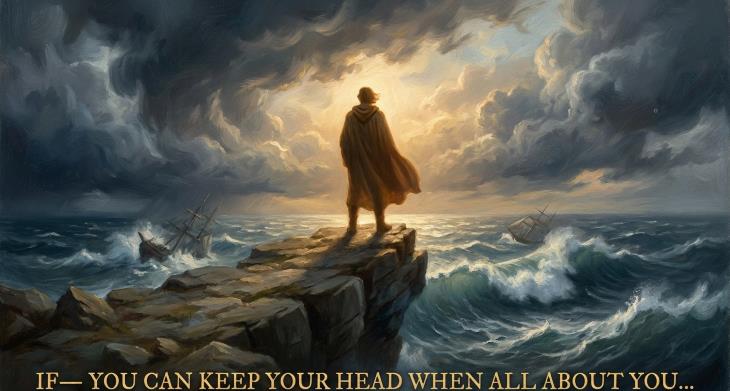
The poem opens with a scene many of us know all too well: everyone around you is panicking, and somehow it becomes your fault. Kipling's first piece of advice is to stay level-headed anyway, while still leaving room to question yourself honestly rather than assuming you're always right. He follows with a call to patience that doesn't curdle into resentment, and to a kind of integrity that holds even when others don't return the favor. If someone lies about you, don't lie back. If someone hates you, don't let it turn you into someone who hates. And notably, he adds a caution against smugness. Handling all of this well is not an excuse to look superior about it.

This is the stanza most people quote without realizing where it comes from. Kipling describes meeting with "Triumph and Disaster" and treating them as equally unreliable narrators, imposters neither of which deserves to define you. It's a strikingly modern idea. Long before anyone talked about emotional regulation, Kipling was describing the same skill: not getting swept away by either your best days or your worst ones.
The stanza continues with two harder tests still, watching your own honest words get twisted by people acting in bad faith, and watching something you devoted your life to get torn down, then finding the strength to rebuild it with whatever worn-out tools you have left. That image, rebuilding with tools that are already worn out, is one of the most quietly powerful lines in the poem. It doesn't promise you'll have fresh resources when disaster strikes. It only asks that you use what's left.

Here Kipling raises the stakes further. He describes risking everything you've built on a single roll of the dice, losing it, and starting completely over without complaint. Then comes a line often cited by athletes and anyone who has pushed through a hard recovery: forcing your body and your nerve to keep serving you long after they've naturally run out, holding on when there's nothing left except sheer will insisting that you continue. It's not a poem about avoiding hardship. It's a poem about what to do once you're already in it.
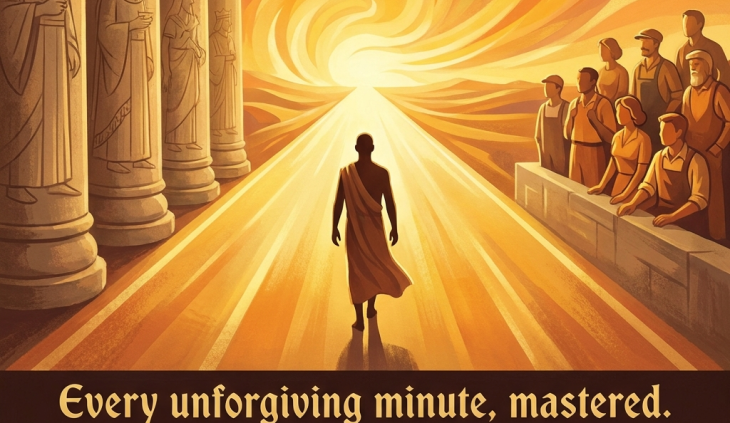
The final stanza turns to relationships and self-worth. Kipling asks whether you can move comfortably among ordinary people without losing your values, and among the powerful without losing your humility. He asks whether you can stop enemies and even well-meaning friends from having outsized power over your sense of self, valuing everyone appropriately, but no one, and no one's opinion, too much. The poem closes with a call to fill each minute with real effort and presence, "the unforgiving minute," before delivering its famous final promise: do all this, and the world is yours, and more importantly, you'll have become who you were meant to be.
Kipling wrote "If—" around 1895, though it wasn't published until 1910. By his own account, the poem was inspired by Leander Starr Jameson, a colonial administrator who led a failed and disgraced military raid in South Africa, then bore the public humiliation and imprisonment that followed with a composure Kipling deeply admired. In other words, the poem grew out of watching someone survive a very public failure with dignity intact.
There's a second layer that gives the poem even more weight. It's written in the voice of a father addressing "my son," and it was, in fact, addressed to Kipling's own son, John, who was about twelve years old when the poem was published. Five years later, John was killed in battle during the First World War at just eighteen. Kipling had used his own connections to help secure his son a military commission despite John's poor eyesight, a decision that would shape the rest of Kipling's life. Knowing this, the poem's counsel to endure devastating loss and rebuild anyway, using worn-out tools, reads very differently. It stops being an abstract lesson in composure and becomes something closer to a father hoping he had given his son enough strength to survive whatever came.
Strip away the Victorian language and "If—" holds up remarkably well against what we now understand about emotional resilience. Its central idea, that both success and failure are temporary and shouldn't be allowed to define your identity, is close to what modern therapists describe when they talk about not over-identifying with any single outcome, good or bad. Its emphasis on rebuilding after loss, rather than avoiding loss altogether, matches what we know about genuine resilience: it isn't about never being knocked down, it's about what you do afterward.
The poem is also, quietly, a guide to healthy relationships. Its instruction to value everyone appropriately but no one excessively is a fair description of secure self-esteem, the kind that doesn't collapse when someone is unkind to you and doesn't inflate when someone praises you.
"If—" endures not because it offers easy comfort, but because it doesn't pretend life will be easy in the first place. It assumes you will face doubt, betrayal, loss, and exhaustion, and it offers something more useful than sympathy: a way to meet all of it without losing yourself. More than a hundred years after Kipling wrote it for his own son, that's still a philosophy worth carrying with you.