Your cat strolls into the room, tail held high with a little hook at the tip, and gives you a long, sleepy blink. Most of us would simply call that cute. To a cat, it is a clear message: I feel safe here, and I like you.
Cats have a reputation for being hard to read. They don't wag their tails the way dogs do, and most of them won't jump for joy when you pick up the car keys. But once you know what to look for, a contented cat tells you exactly how it feels, through its tail, its eyes, its voice, and its daily habits. Here are 11 signs that your feline friend is happy, healthy, and satisfied with life at home.
1. The Tail Goes Up
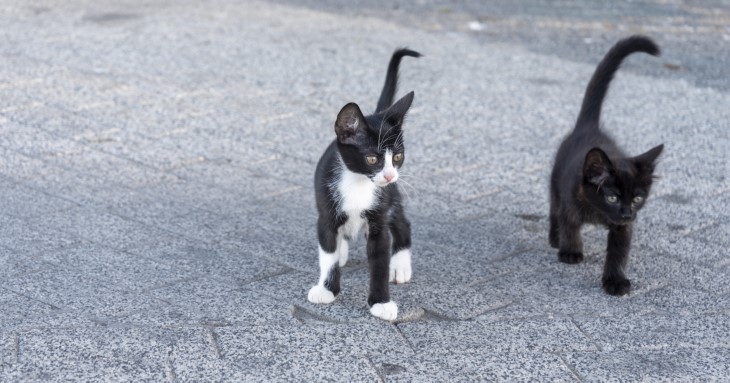
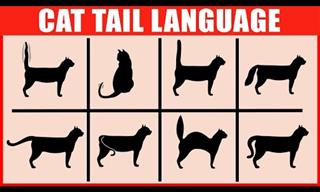
A tail pointing straight up is one of the friendliest things a cat can show you. Often the tip curls over slightly, like a question mark or a shepherd's crook. Kittens greet their mothers this way, and adult cats carry the habit into grown-up life, using it with other cats they like and with the people they trust.
Science backs this up. In a 1997 experiment at the University of Southampton in England, cats were shown cat-shaped silhouettes. They approached the silhouette with a raised tail quickly and readily, but hesitated in front of the one with a lowered tail. The upright tail, it seems, is the feline way of saying "I come in peace."
If your cat trots toward you with a raised tail that quivers a little, that's an especially enthusiastic hello. It's a perfect moment for a gentle scratch behind the ears or a few minutes of play.
2. The Slow Blink, or "Cat Kiss"
Your cat looks at you, narrows its eyes, closes them slowly, and then opens them again as if half asleep. Cat lovers call this a "cat kiss," and it turns out to be a genuine form of communication.
In a 2020 study, psychologists at the Universities of Sussex and Portsmouth in the UK asked cat owners to sit about three feet from their cats and blink slowly at them. The cats blinked back far more often than when their owners simply sat there without interacting. In a second experiment, a stranger slow blinked at cats and then held out a hand. The cats were more likely to approach the stranger after a slow blink than after a neutral expression.
The reason is simple. Among cats, a hard, unbroken stare can feel like a threat. Soft, slow eyes signal the opposite: you are safe, and so am I. Related research on shelter cats even found that the ones who returned a person's slow blink with a full eye closure were adopted faster.
Try it yourself. The next time your cat looks your way, relax your face, narrow your eyes, and blink slowly. Don't be surprised if you get a blink back.
3. Purring (With One Important Caveat)
The gentle rumble of a purr is the sound most people link with a happy cat, and a cat curled up on your lap, purring away, is almost certainly content. The purr comes from rapid vibrations of the muscles in the voice box and diaphragm, typically at somewhere between 25 and 150 vibrations per second.
Here is what many owners don't realize: cats also purr when they are frightened, stressed, or in pain. Anyone who has taken a cat to the vet may have heard it purring through the entire examination. Experts believe purring helps cats soothe and calm themselves in difficult moments.
So judge a purr by its surroundings. Purring while relaxed, eyes half closed, body soft and stretched out? That's contentment. Purring while hiding, hunched up, or refusing food is a reason to call the vet.
4. Making Biscuits
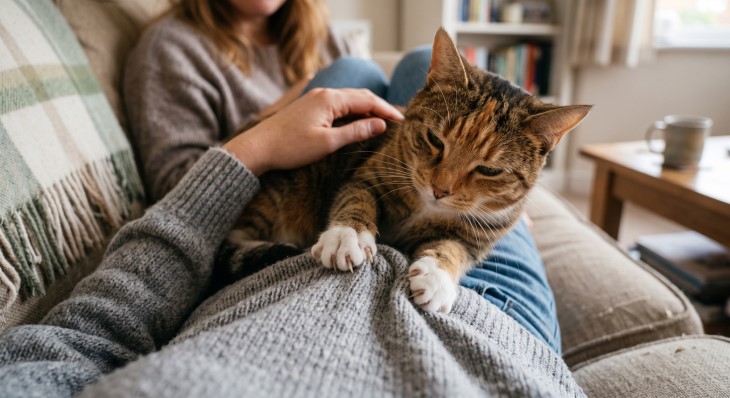
When your cat settles onto a soft blanket or your lap and starts pressing its front paws in and out, one after the other, it looks as if it's kneading dough. That's why cat owners fondly call it "making biscuits."
The habit begins in the first weeks of life, when kittens knead their mother's belly to get the milk flowing. Adult cats keep doing it when they feel safe and cozy, the same feeling they had snuggled up against their mother. Some cats even drool a little while they knead, a leftover from their nursing days, and many purr at the same time.
There's a practical side for the cat as well. Scent glands in the paw pads leave its smell behind, quietly marking the blanket, or your lap, as its own. If your cat's claws come out during the process, don't scold it. Kneading is a compliment. Simply place a thick blanket or towel on your lap before the next cuddle session.
5. Head Bumps and Cheek Rubs
A cat that walks up and bumps its forehead against your hand, leg, or face is paying you a real compliment. This behavior is called bunting. Cats have scent glands on their foreheads, cheeks, chins, and around the mouth, and when they rub against you, they leave behind a scent that marks you as familiar and safe. In cat terms, you've been officially adopted into the family.
Cats that live together do the same thing to one another. They also rub their cheeks on furniture, doorways, and food bowls, especially in the parts of the home where they feel most comfortable.
One important distinction: brief, gentle bumping is affection. A cat that stands and presses its head against a wall or a piece of furniture for long periods is doing something very different. Head pressing can be a sign of a neurological problem, and it calls for a prompt visit to the vet.
6. Belly Up and Sprawled Out
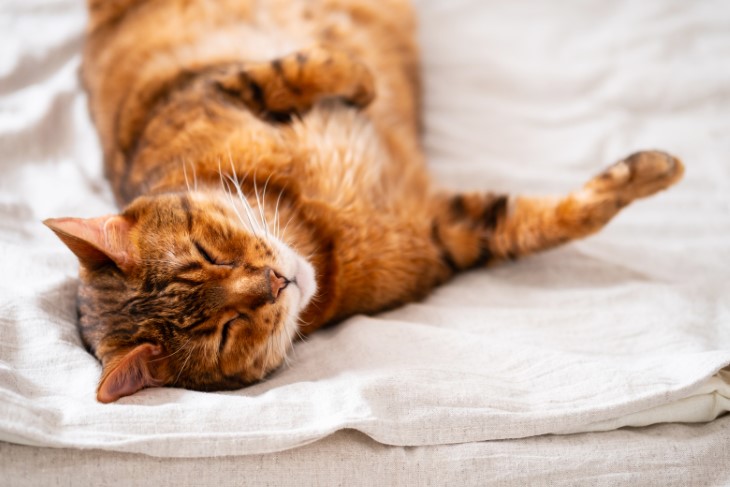
A cat's belly protects its vital organs, so in the wild, exposing it is risky. When your cat rolls onto its back in front of you, or sleeps stretched out in the middle of the living room floor, it's telling you that it feels completely secure in your home.
The same goes for other relaxed postures: lounging on its side, sitting in the "loaf" position with its paws tucked neatly underneath, or dozing in a patch of sunshine with its whiskers softly fanned out. A calm cat looks loose, not tense.
A word of warning, though. A belly on display is usually a sign of trust, not an invitation for a belly rub. Many cats find their tummies highly sensitive, and reaching for one can earn you a swat or a nip. Some cats do enjoy a good belly rub, but let your cat be the one to tell you so. If its body stiffens or its tail starts to flick, stop and stroke its head or cheeks instead.
7. Play and Curiosity
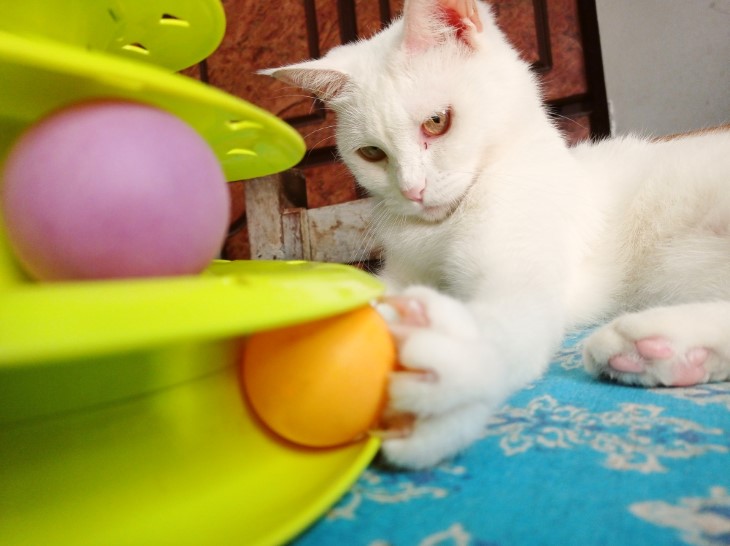
Happy cats play. They stalk toy mice, pounce on feathers, chase a ball across the kitchen floor, and inspect every new cardboard box that comes into the house. Watching birds from the windowsill, climbing a cat tree, and scratching a post are all signs of a cat that is engaged with the world around it.
When your cat "hunts" your feet under the blanket or ambushes you from behind the sofa, take it as flattery. A cat that doesn't feel safe with a person won't try to play with them.
Older cats play less often and for shorter spells than kittens, and that's perfectly normal. Even a senior cat that bats at a dangling string for a couple of minutes is showing that it still enjoys life.
8. A Healthy Appetite and a Well-Kept Coat
A contented cat looks forward to mealtime, eats with interest, and keeps a steady weight. It also spends a good part of its waking hours grooming. Cats are famously tidy, and a shiny, smooth coat without mats or greasy patches belongs to a cat that feels well and has the energy to look after itself. A cat that grooms itself right in front of you is showing that it feels relaxed in your company.
Changes in either direction deserve attention. A cat that stops grooming may be unwell, or may have arthritis that makes it painful to reach certain spots. Excessive grooming, especially to the point of bald patches, can signal stress, allergies, or skin trouble. And a sudden loss of appetite is always worth a call to the vet.
9. Chirps, Trills, and Friendly Chatter
Besides purring, happy cats have a whole vocabulary of cheerful sounds. The trill, a short, rolling, high-pitched sound that falls somewhere between a meow and a purr, is one of the most endearing. Mother cats use it to call their kittens, and grown cats often use it to greet their favorite people. You may hear it when you walk through the front door, or when your cat wants you to follow it to the food bowl.
Interestingly, adult cats rarely meow at each other. The meow is largely reserved for talking to humans. A cat that greets you with soft trills and chirps and "chats" with you throughout the day is a cat that genuinely enjoys your company.
10. Following You Around and Greeting You at the Door
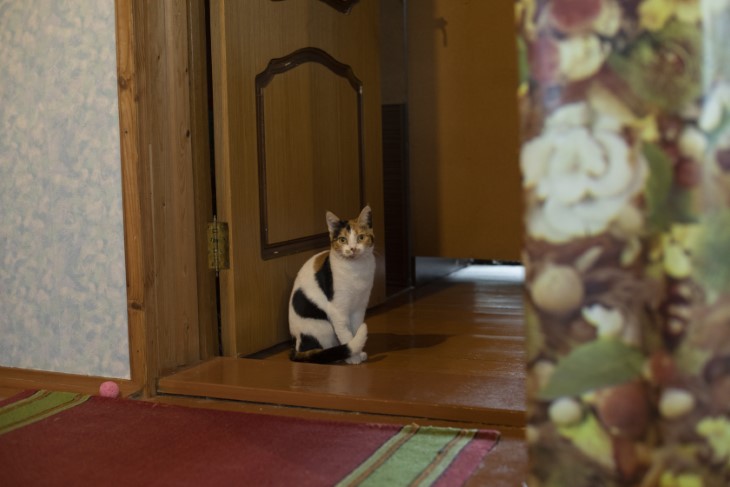
Cats are often described as aloof, but many are quite the opposite. A cat that meets you at the door when you come home, follows you from room to room, or settles down nearby while you read or watch television is choosing to be with you. Some cats become little shadows, supervising while you cook dinner or fold the laundry.
Not every happy cat is a lap cat, though. Some prefer the far end of the sofa, or the chair across the room where they can keep an eye on you. Simply being in the same room, relaxed and unbothered, is its own quiet sign of affection.
11. Sound Sleep and Steady Habits
If your cat seems to sleep most of the day, you're not imagining it. Healthy adult cats typically sleep 12 to 16 hours a day, and senior cats often sleep even more. What matters is where and how. A cat that dozes out in the open, on the sofa or in the middle of your bed, feels secure. A cat that spends most of its time hidden under the bed or at the back of a closet may be anxious or unwell.
Reliable litter box use is another quiet sign of contentment that many owners overlook. A cat that suddenly starts going outside the box isn't being spiteful. It may be stressed, unhappy with the box itself, or dealing with a medical problem such as a urinary infection, so it's worth checking with your vet.
When the Signs Change
Every cat has its own personality. A shy cat may never trill or knead, and a dignified old tomcat may never roll over for anyone. That doesn't mean they're unhappy. The best guide is your own cat's normal behavior.
What matters most is change. If a cat that always greeted you with a raised tail stops coming to the door, if a playful cat loses interest in its toys, or if a good eater starts leaving food in the bowl, it's time to pay attention. Cats are experts at hiding pain and illness, and a shift in behavior is often the first, and sometimes the only, clue. A checkup with your veterinarian is the best way to rule out a health problem.
Simple Ways to Keep Your Cat Content
Play together for a few short sessions each day, using wand toys that let your cat stalk and pounce.
Give it high places to climb and perch, such as a cat tree or a cleared shelf near a sunny window.
Keep meals, playtime, and bedtime on a predictable schedule. Cats love routine.
Provide a quiet hiding spot where it can retreat when visitors arrive.
Keep the litter box clean and in a calm, private spot.
Let your cat decide when and how to be touched. Most prefer gentle strokes on the head, cheeks, and chin.
Return the slow blink. It costs you nothing, and your cat will understand.
Learn to read these signals, and you may discover that your cat has been telling you how it feels all along.