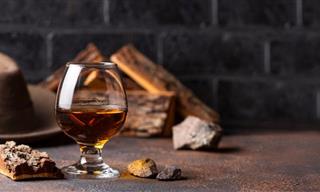

Whiskey is definitely an acquired taste. Those of us who like the taste of it, though, know that it has undeniable charm as a drink. The golden liquid pours warming fire down your throat and warm your belly, while not requiring imbibing much of it to get a little buzzed. But do you know the complicated and incredible history that this drink has behind it?
Long before whiskey filled duty free shelves or sold for a small fortune at charity auctions, it was medicine, made quietly by monks who had sworn a vow of poverty but somehow found the ingredients for something extraordinary. Today whiskey is a global industry worth tens of billions of dollars. It has toppled tax collectors, survived a nationwide ban, and turned a handful of Kentucky counties into a tourist destination. Here is how a monastery experiment became one of the most storied, and most political, drinks in the world.
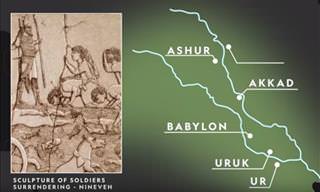
The technique behind whiskey, distillation, is far older than whiskey itself. Sometime around the second millennium BC, the Babylonians of Mesopotamia were already distilling perfumes and aromatics. Centuries later, Arab scholars refined the process and passed it along to medieval Europe, where the earliest confirmed records of distilling alcohol come from Italy in the 13th century. From there, the practice spread through monasteries, largely for medicinal purposes such as treating colic and even smallpox.
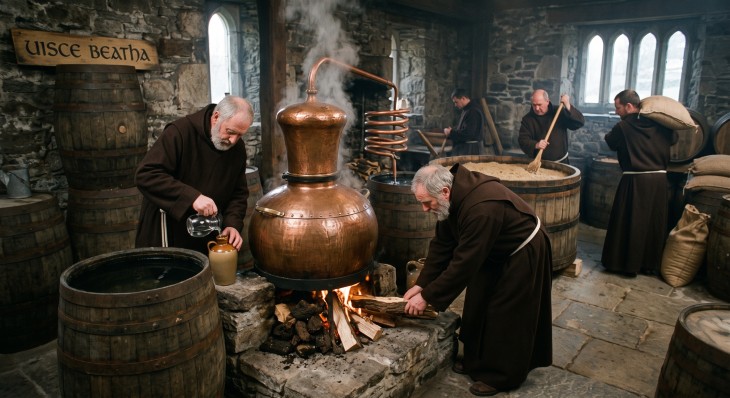
Distilling reached Ireland by around the 12th century and Scotland by the 15th, carried, according to tradition, by monks returning from pilgrimages to the Mediterranean. Without vineyards to make wine or brandy, Irish and Scottish monks turned to fermented grain mash instead, and modern whiskey was born. They called it uisce beatha in Gaelic, meaning "water of life," a name English speakers eventually shortened and respelled into whiskey.
The oldest surviving written proof of whiskey production in Scotland comes from the Exchequer Rolls of 1494, which record eight bolls of malt given "to Friar John Cor, by order of the King, to make aqua vitae." Cor was a monk at Lindores Abbey in Fife, and that single tax entry is, in effect, whiskey's birth certificate.
For decades, whiskey stayed inside monastery walls, but that changed in the 1530s when King Henry VIII dissolved England's monasteries, seizing their land and turning out the monks who lived there. Suddenly a large number of skilled distillers needed a new way to make a living, and they took their knowledge straight to the public. Whiskey stopped being a monk's remedy and became a trade, then a business, then eventually something close to a national obsession in Scotland and Ireland alike.
European colonists, many of them Scots Irish, carried the practice of distilling to North America in the 1600s and 1700s. On the frontier, barley gave way to corn, which grew abundantly and cheaply, and a new style of whiskey was born: bourbon. Aging the spirit in new, charred oak barrels, a requirement that later became written into law, gave bourbon its amber color and its notes of vanilla and caramel. Kentucky's limestone filtered water, naturally low in iron and rich in calcium, made the region especially well suited to whiskey making. Kentucky now produces roughly 95 percent of the world's bourbon supply, a dominance built on that 18th century foundation.
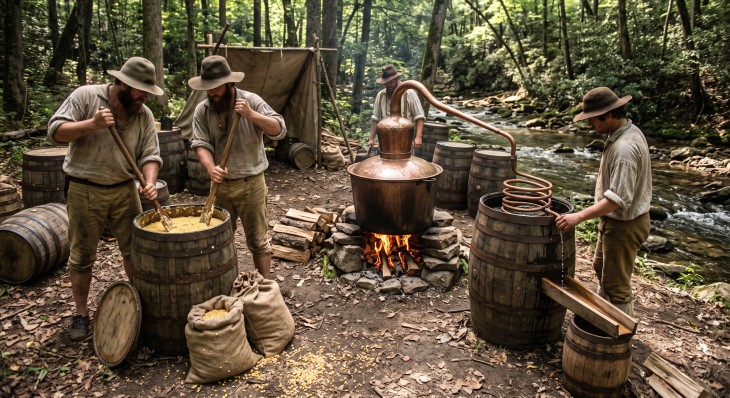
Whiskey's political history begins almost as early as the United States itself. In 1791, Treasury Secretary Alexander Hamilton pushed through the first tax Congress ever levied on a domestic product: an excise tax on distilled spirits, meant to help pay off debt from the Revolutionary War. For farmers on the western frontier, whiskey was not a luxury but an economic lifeline. Grain was heavy, perishable, and expensive to haul over the mountains to eastern markets, but distilled into whiskey it became compact, durable, and easy to sell, functioning almost like a currency in cash poor frontier communities.
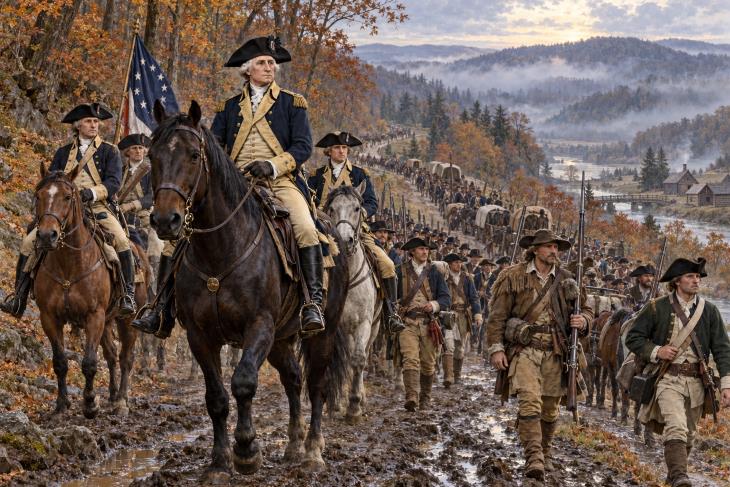
The new tax hit those farmers hard, and by the summer of 1794 in western Pennsylvania, resistance turned violent. Farmers tarred and feathered federal tax collectors, and that July roughly 400 armed rebels burned down the home of the regional tax supervisor. President George Washington personally led a militia of nearly 13,000 men westward to end the uprising, the only time a sitting American president has commanded troops in the field. The Whiskey Rebellion collapsed without a major battle, but its real significance was constitutional. It proved that the young federal government could enforce a law within its own states, and it remains one of the first true tests of American federal authority.
By the late 1800s, an entirely different problem threatened whiskey's reputation: fraud. Producers routinely watered down bottles or added coloring and other additives to fake the look of aged whiskey. Congress responded with the Bottled in Bond Act of 1897, one of the country's earliest consumer protection laws. To carry the "bottled in bond" label, whiskey had to come from a single distiller, from a single distilling season, aged at least four years in a federally supervised warehouse, and bottled at exactly 100 proof. It was a small piece of paperwork with a big effect. For the first time, the federal government became the guarantor of what was actually inside the bottle.
Whiskey's fortunes reversed dramatically in 1920, when the 18th Amendment and the Volstead Act made Prohibition the law of the land. Nearly every distillery in the country was forced to shut its doors. Only six companies received special federal licenses to keep bottling from existing stock, sold strictly as "medicinal whiskey" with a doctor's prescription. Brown Forman, maker of Old Forester, was one of them, as was the company that would later become National Distillers, home to Old Crow and Old Grand Dad.
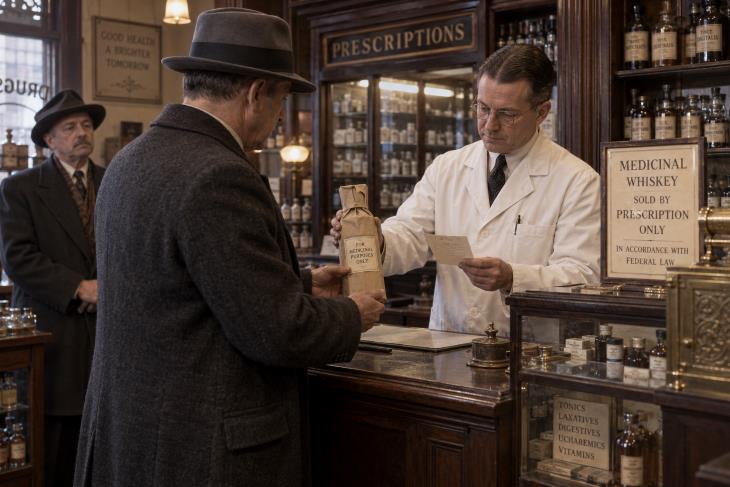
Some brands thrived under this odd arrangement. James E. Pepper whiskey was marketed directly to pharmacists and endorsed by tens of thousands of physicians, and its price climbed to roughly six times what it had been before Prohibition began. Elsewhere, the ban simply pushed the whiskey trade underground. Within an hour of Prohibition taking effect in January 1920, armed thieves in Chicago stole one hundred thousand dollars worth of "medicinal" whiskey from freight cars, an early sign of the bootlegging and organized crime that would define the next thirteen years. When Prohibition was repealed in 1933, the whiskey industry had to rebuild itself almost from scratch, and many of the distilleries lost during that period never reopened.
Today whiskey is one of the most valuable categories in the entire spirits industry. Estimates vary by research firm, but most place the global whiskey market somewhere between 77 and 93 billion dollars in 2025, with growth forecasts pushing that figure well past 100 billion dollars within the next decade.
Scotland alone exported about 5.36 billion pounds sterling worth of Scotch whisky in 2025, a figure so large that whisky regularly makes up the majority of Scotland's food and drink exports. In the United States, Kentucky's bourbon industry uses billions of pounds of grain a year and ships whiskey to dozens of countries. Trade politics still shapes the numbers directly. When India lowered its steep bourbon tariff from 150 percent to 100 percent in 2025, bottled bourbon exports to the country jumped by nearly 22 percent within the year, a reminder that whiskey remains as tangled up in tariffs and treaties today as it was in Hamilton's time.
Ask most people to name the world's best selling whiskey and they will likely say Jack Daniel's or Johnnie Walker. Both answers miss the mark, at least by volume. Indian whisky brands dominate global sales by a wide margin, even though the vast majority of those bottles are consumed at home rather than exported. McDowell's No. 1 alone sold more than 30 million nine liter cases in a recent year, more than double the roughly 14 to 15 million cases Jack Daniel's sells annually worldwide. Royal Stag, Officer's Choice, and Imperial Blue round out a top group so dominant that eight of the world's twenty best selling whiskey brands come from India.
Among the more internationally familiar names, Johnnie Walker remains the world's top selling Scotch, moving more than 20 million cases a year across some 180 countries, and Jameson holds the equivalent title for Irish whiskey. In the United States, Jim Beam and Jack Daniel's remain household names, while a growing appetite for small batch and aged expressions has fueled strong growth for more premium labels such as Maker's Mark.
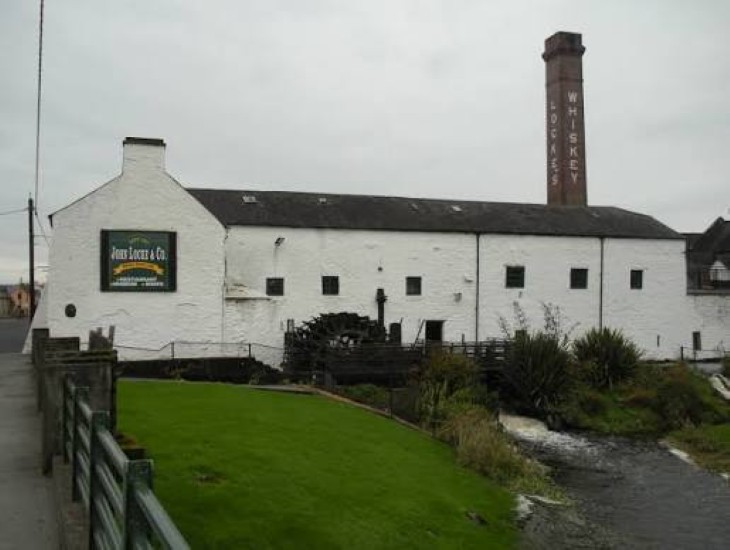
A handful of distilleries have been making whiskey, in one form or another, for centuries. In Northern Ireland, Bushmills traces its right to distill back to a royal license granted by King James I in 1608, and while today's distillery building dates only to 1784, Bushmills is widely regarded as the oldest licensed whiskey distillery in the world. Not far away, in Ireland's County Westmeath, Kilbeggan holds a license dating to 1757 and calls itself the oldest continually licensed distillery on earth, even though the site sat idle for much of the 20th century before whiskey making resumed there in the 2000s.
Scotland has its own long lived contenders. Glenturret has operated, with interruptions, since 1775 and calls itself the oldest working distillery in Scotland, while Bowmore on the island of Islay has been distilling since 1779. Across the Atlantic, Buffalo Trace in Frankfort, Kentucky has been making whiskey since 1773 and is generally recognized as the oldest continuously operating distillery in the United States, a distinction it earned partly by staying open, in a limited capacity, through Prohibition.
Whiskey's cultural life is every bit as rich as its business history. In Scotland, offering a guest a dram is still considered basic hospitality, a small gesture that welcomes visitors and opens the door to conversation. Every January 25th, Scots around the world gather for Burns Night suppers honoring the poet Robert Burns, complete with haggis, poetry, and a string of formal toasts, always finishing with a hearty "slàinte mhath," meaning good health. Weddings have their own whiskey ritual too. Couples in Scotland sometimes drink from a quaich, a shallow, two handled cup meant to be shared, a custom recorded as far back as the 1589 wedding of King James VI, symbolizing a couple's willingness to share whatever life brings them, sweet or bitter.
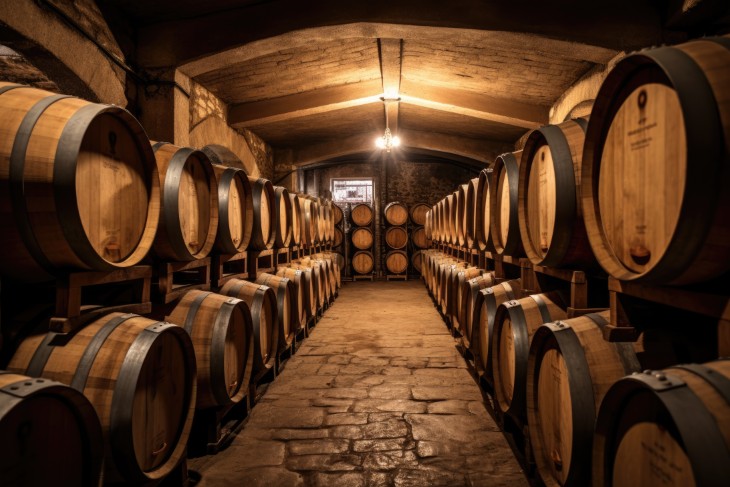
Distillers have their own bit of folklore as well. Every year, roughly two percent of the whiskey aging in an oak barrel simply evaporates through the wood, a loss distillers have long called the "angel's share," as if spirits above were collecting a small toll on the way to bottling. In Kentucky, that same reverence for aging and craftsmanship shows up in the mint julep served at the Kentucky Derby and in the Kentucky Bourbon Trail, where working distilleries welcome visitors much like vineyards do in wine country. In Japan, whiskey culture built its own signature ritual around the highball, a simple, slow sipping mix of whisky and soda water meant to be enjoyed alongside a meal rather than as a nightcap.
From a monk's still in a medieval abbey to a nearly hundred billion dollar global industry, whiskey has survived kings, wars, a tax it helped provoke, and a ban that tried to erase it altogether. Brands rise and fall, tariffs go up and down, and new distilleries open every year, yet the basic pleasure at whiskey's center, a shared dram, a toast, a slow sip with good company, has changed remarkably little in five hundred years.