
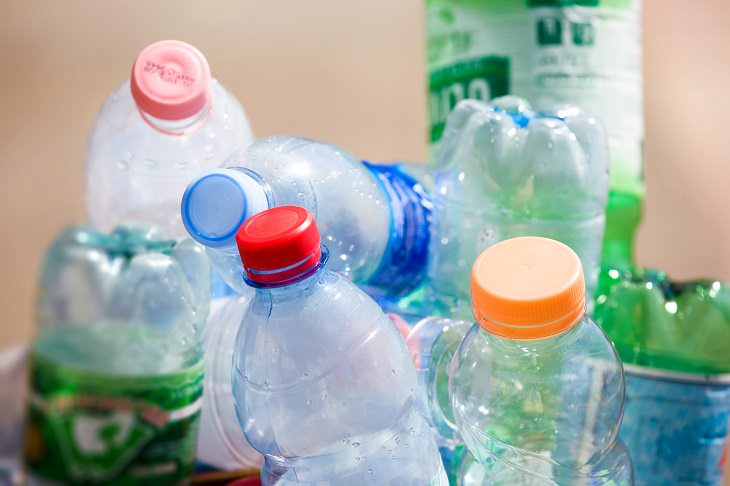
Scientists have accidentally created a mutant enzyme that breaks down plastic bottles. This major breakthrough could help solve the global plastic pollution crisis by enabling the full recycling of bottles for the first time.
This new research was spurred by the discovery in 2016 of bacterium at a waste dump in Japan that had naturally evolved to eat plastic. Scientists have now revealed the detailed structure of the crucial enzyme produced by the bug.
The international team then tweaked the enzyme to see how it had evolved, but tests showed that they had inadvertently made the molecule even better at breaking down the PET plastic used to make soft drink bottles.
The mutant enzyme takes a couple of days to start breaking down the plastic – far quicker than the centuries it takes in the oceans. However, the researchers are very optimistic that this can be speeded up even further to become a viable large-scale process.
Prof. John McGeehan, from the University of Portsmouth, UK, who led the research, says, “what we are hoping to do is use this enzyme to turn this plastic back into its original components, so we can literally recycle it back to plastic. It means we won’t have to dig up any more oil and, fundamentally, it should reduce the amount of plastic in the environment.”
Around 1m plastic bottles are sold every minute around the world and, with just 14% recycled, many end up in the oceans where they have polluted even the remotest parts, harming marine life and potentially those who eat seafood.
However, at the moment, even those bottles that are recycled can only be turned into opaque fibers for clothing or carpets. The new enzyme indicates a way that we can recycle clear plastic bottles back into clear plastic bottles, which would significantly reduce our need to produce new plastic.
The new research, published in the journal “Proceedings of the National Academy of Sciences”, began by determining the precise structure of the enzyme produced by the Japanese bug. They used the Diamond Light Source, near Oxford, UK, an intense beam of X-rays that is 10 billion times brighter than the sun and can reveal individual atoms.
The structure of the enzyme looked similar to the one evolved by many bacteria to break down cutin, a natural polymer used as a protective coating by plants. However, when the researchers manipulated the enzyme to explore this connection, they accidentally improved its ability to eat PET.
McGeehan says that “it’s a modest improvement – 20% better – but that’s not the point. It’s incredible because it tells us that the enzyme is not yet optimized. It gives us scope to use all the technology used in other enzyme development for years and years and make a super-fast enzyme.”
Industrial enzymes are widely used in, for example, washing powders and biofuel production. They have been modified to work up to 1,000 times faster in a few years, the same timescale Mcgeehan envisages for the plastic-eating enzyme. A patent has been filed on the specific mutant enzyme by the Portsmouth researchers and those from the US National Renewable energy Laboratory in Colorado.
One potential improvement that is being explored is to transplant the mutant enzyme into an “extremophile bacteria” that can survive temperatures above 70C – the point at which PET changes from a glassy to a viscous state, making it likely to degrade 10-100 times faster.
Earlier work has also shown that some fungi can break down PET plastic, which makes up around 20% of global plastic production, but bacteria are much easier to harness for industrial uses.
Other kinds of plastic could be broken down by bacteria currently evolving in the environment. PET sinks in seawater, but some scientists have conjectured that plastic-eating bugs might one day be sprayed on the huge plastic garbage patches that are floating in our oceans.
Oliver Jones, a chemist at RMIT University in Melbourne, Australia, and not part of the research team, says that “I think the new research is very exciting work, showing there is strong potential to use enzyme technology to help with society’s growing waste problem. Enzymes are non-toxic, biodegradable, and can be produced in large amounts by microorganisms. There is still a way to go before you could recycle large amounts of plastic with enzymes, and reducing the amount of plastic produced in the first place might, perhaps, be preferable. But this is certainly a step in the right direction.”
Researchers Have Managed to Actually Reverse Dementia...
Dementia doesn't yet have a cure, but the world is a step closer to having one after researchers managed to reverse the illness in mice. Read on to learn more.
This New Clinic is Infusing Seniors With Young Blood
Older people are getting blood transfusions from younger people in order to regain their vitality and fight aging. Find out more about this procedure.
5:03
Is It Possible to Power the Whole World with Just WIND?
IS it possible to create a world powered entirely by the wind? In this fascinating video, you will take a deep dive into the science of wind turbine technology...
Never Heard of Neural Network Art? Prepare to Be Astounded
If you've never seen neural network art before, then prepare to be utterly amazed!
39:01
What's so Exciting About James Webb Space Telescope?
Why the new James Webb space telescope is much, much better than Hubble.
9:58
Would You Live On the Moon? Discover the Possibilities...
Did you know that the human race actually has the cash and resources available to start building a base on the moon today? Find out more here.
Alzheimer's: What Recent Breakthroughs Have Taught Us
Now, you can discover 4 new studies that show how to do this in ways you havenโt heard of.
10:19
What a Bullet Blast Looks Like Underwater!
The slow motion kings are back with incredible effects.
10:30
China's Crazy Plan to Dig a Canal in the Middle of EUROPE
China is setting out a plan to dig a canal through the middle of Europe in the nearest future, but why?
2:06
Can Your Brain Get to Grips with These Weird Illusions?
I could have sworn what I was seeing in this video was real! But it wasn't. It was all just an illusion.
4:52
4 Super Technologies That Started Off as Failed Inventions
Check out how some of the great technological inventions of our time actually started off as failed projects.
19:39
Lecture: What is the Future of Humanoid Robots?
Get ready to meet the humanoid partners that will redefine how we live and work.
9:09
Protective Measures: How Our Body Reacts to a Tattoo
In this video, weโll explore the microscopic war raging beneath your skin, where millions of your cells make the ultimate sacrifice to lock that ink in place, turning a defense mechanism into lifelong art.
5:06
The Only Manmade Object That Will Last Forever
This copper discus contains 116 images we launched into space for aliens to see
I Bet You Didn't Have a Clue About These Human Body Facts!
The human body is the most complex machine known to mankind, but I bet you don't know these 10 amazing facts about it...
Six Inventions Da-Vinci Made Ahead of Their Time
He created and envisioned many inventions that were sometimes even centuries ahead of their time. Was there ever a genius as great as Da-Vinci?
Science News: AI-Designed Drugs Move to Human Trials
Isomorphic Labs, is positioning itself to begin human clinical trials of medications designed entirely through artificial intelligence, marking a potentially transformative shift in how we develop life-saving treatments.
Science First: Scientists Build a Living Cell From Scratch
For the first time ever, scientists have taken a collection of lifeless molecules, tucked them inside a tiny bubble, and watched in amazement as the whole thing began to behave like something alive.
22:52
Will AI Take Your Jobs? An Expert Explains the Future
Gonzaga University's AI professor Graham Morehead some of our most pertinent questions related to AI.
14:58
Why IS Fentanyl So Dangerously Addictive?
In this video, we break down what opioids really do to your brain and body, what using them actually feels like, and why so many people are dying from Fentanyl overdoses.
10:11
10 Smart Home Gadgets You Didnโt Know You Needed
If youโve ever wanted a smarter, more efficient home, these 10 gadgets might be exactly what you need.
These Ancient Inventions Have Got Scientists Stumped!
Here are 12 items from long ago which prove that our ancestors possessed knowledge and skills far more advanced than we once believed them to be.
12:34
The World You See Doesn't Really Exist...
his video reveals how your brain constructs reality instead of simply perceiving it.
9:03
24 Unbelievable Abilities Your Body Has
The human body is a complex and endlessly fascinating machine, and it might be even more sophisticated than you know...
The 10 Most Elaborate Scientific Hoaxes In History!
Some hoaxes throughout history have been so believable, they managed to fool the entire world. Here are 10 of the most elaborate scientific hoaxes in history.
2:01
What Does the Appendix Actually DO?
Dr. Berg explains, in this video, all about the appendix and what it actually does in our body.
5:17
How Exactly Do We Hear? All is Revealed Here!
In this informative TED-Ed video, Douglas L. Oliver explains the complete science behind hearing.
Travel From the Sun to Pluto With Our Interactive Guide!
The solar system is a fascinating place, and we wanted to bring you an interactive journey that you can use to travel through it. Enjoy the journey!
This is How to Activate Your Brain's Ability to Learn
A recent study has shown that overlearning might improve performance in a particular task by altering the chemicals in the brain that "lock" in training.
21:24
James Webb Telescope: Redefining Our View of Space
Here's a brief look at all the amazing discoveries made by the James Webb Space Telescope so far.
Hair Regeneration Could Be Possible With This New Process
Learn about an innovative new study which has revealed a novel treatment for effective hair regeneration.
3:55
50 Years Later, We're Debunking the Moon Landing "Hoax"
How do we prove to people the moon landing was real? By answering their doubtful questions in this video.
Enjoy This Fascinating Collection of NASA's Best Photos
Here are 15 of NASA's most amazing recent pictures, along with brief explanations of exactly what is going on in each one.
World-Famous Psychological Experiments That Shocked Us
The human mind is a most intricate thing. It also has some quirks and idiosyncrasies that are both incredible and a little uncomfortable. Read on for more.
25 Pics Showing How People in the Past Imagined the Future
Letโs see how the people of the past imagined the future and find out if their fun predictions came true with these 25 vintage pictures
Find Out How Some Elderly People Stay Sharp into Old Age
Some old people have better memories than people half their age. This could be the reason why...
11:40
6 Of the Earliest Known Parasites Ever Found
Get to understand and learn about the earliest parasites discovered by scientists.
Phone Overheating? Use Our Guide to End The Problem!
Is your cell phone overheating? If so, read this handy guide, which will help pinpoint the source of the problem and offer a solution for fixing it.
Study Shows Seniors Still Grow New Brain Cells Daily
A new study shows that even the elderly keep on growing new brain cells, which could be the breakthrough the scientific community was waiting for...
Why It's So Hard to Get People to Change Their Stance
You feel that your knowledge is broader because you've read and researched a lot on the topic, but the other side still isn't convinced, even when you present facts and statistics. Why isn't that enough?
17 Incredible Eye Facts You Have To See To Believe
They say the eyes are the window to the soul, and they also happen to be our windows to the world. Here are 17 insanely fascinating facts about eyes.
Meta Unveils New Glasses that May Change Sports Forever
META has revealed a new line of AI-powered smart glasses: Oakley Meta HSTN
4:51
Watch These Chinese Robots Amaze the World
In this video, you're going to see just how far these robots can go, as they've been programmed with some truly amazing dance moves,
3:02:59
Like Science Mysteries? Enjoy This Giant Compilation!
In this video, we unravel the greatest unsolved mysteries of physics.
58:37
Science: Here's Everything We Know About Pluto
Join us as we unravel the mysteries of far off Pluto, 3.7 billion miles from our Sun.
Science History: 17 Math Equations that Changed the World
In this article, we'll journey through 17 of these monumental formulas, demystifying the symbols to reveal the revolutionary ideas they contain and the immense impact they have had on the course of history.
Superwood: A New Material That Could Replace Steel
After decades of relying on steelโa material that produces nearly two tons of CO2 for every ton manufacturedโbuilders may soon have access to something far more sustainable and surprisingly stronger: Superwood.
To enable your Ad-Free Subscription, please fill the fields below
Your subscription was successful, now you can enjoy an ad-free experience!! Note: To make sure you get no ads, please make sure to log in to your account. If you are logged in already, then refresh the page. The subscription can be cancelled at any time.