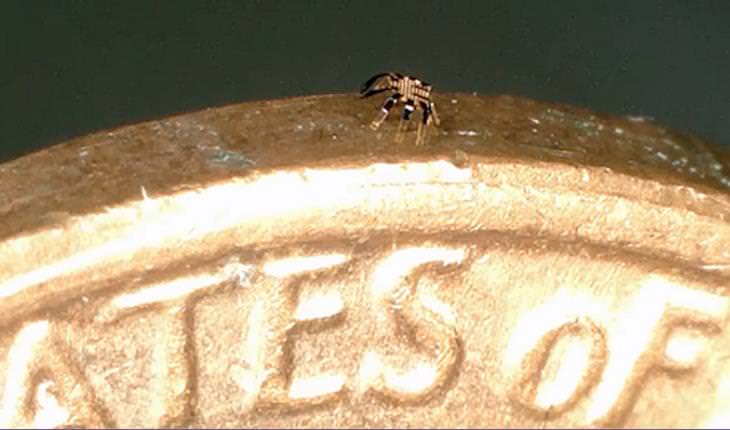

Meet the smallest ever remote-controlled walking robot. It was created by engineers at Northwestern University and resembles a tiny peekytoe crab. This crab is only half a millimeter wide and it can easily be perched on the side of a coin, but it can move and turn in every direction - bending, twisting, crawling, and even leaping. Let’s see what else it can do.
At this time, the study does not have a specific objective. It’s only experimental, but the results are already very promising and can be highly influential in many fields. The researchers propose several possible uses for their crab robot. These include repair or assembly of small structures or surgical assistance in minimally invasive procedures.
This is not the first time this team of engineers breaks records when it comes to robotics. They were also the first to create the smallest ever man-made flying structure. It was a winged microchip smaller than the head of the common ant. The main purpose of the structure is to monitor air pollution, airborne disease, and environmental contamination.
Speed
Seeing as they resemble crabs or tiny creatures, you might imagine that these robots can whizz by pretty fast, but so far, their speed is at an average of half a millimeter a second. While this may sound painfully slow, it is considered a more-than-average speed at such a small scale. You might even be shocked to discover that this robot does not use any electronic or hydraulic machinery to move. Instead, the very material from which it’s made, in combination with remote laser control, is what animates it.
Movement
The researchers used a shape-memory alloy material to build the robot. It transforms to its remembered shape when heated. When it is heated up, it contracts. When it cools down, it expands back to its original shape.
What heats the alloy is a laser beam. The direction of this beam determines the robot's direction of movement. John a. Rogers, Who lead the experimental work, explained that “because these structures are so tiny, the rate of cooling is very fast. In fact, reducing the sizes of these robots allows them to run faster.” As some wise man once said, everything is relative.
How does one come about manufacturing such little things? Well, the researchers at Northwestern will tell you it’s all child’s play. The manufacturing process is inspired by children’s pop-up books, a technique they introduced eight years ago.
First, they create the structures as flat, spread-out sheets. Then they lay these sheets onto a slightly stretched rubber layer. When this stretched rubber is relaxed, all parts are assembled, and the crabs pop into their final three-dimensional forms.
But why a crab of all things? The researchers once again show us their playful side, admitting that this was a creative whim: "With these assembly techniques and materials concepts, we can build walking robots of almost any size or 3D shape, but the students felt inspired and amused by the sideways crawling motions of tiny crabs."
They also created millimeter-sized robots that resemble inchworms, crickets, and beetles. I don’t know about you, but I wouldn’t mind letting this tiny crab join in as an assistant if I ever need surgery. And if you’re not convinced yet, try watching it in action:

5:50
The Rise of the Machines: Can Humanoid Robots Help Us?
Will humanoid robots change the way we work forever?
Scientists Develop 'Flying Dragon' Robot to Fight Fires
Scientists in Japan have created a water-spitting 'flying dragon' robot to fight fires.
5:34
Medical Lesson: What ARE Enzymes?

This handy animated video is perfect for the job of explaining what enzymes are.
These 11 Brain Facts Are Enough to Boggle Your Mind
When you consider the sheer complexity of the human brain, it's difficult to wrap your head around it. Learn these 11 fascinating facts about the human brain.
2:52
New Robots: This Robot Uses Both Wheels AND Legs
This robot can get just about anywhere in little time because it uses both wheels and legs to get over most hurdles.
1:17
The Age of the Affordable Android Robots is Here...
Meet the Unitree R1 – the game-changing humanoid robot that just shattered every price expectation in robotics.
7 Discoveries of Albert Einstein that Changed the World
The 7 biggest discoveries of Albert Einstein and how they changed the world forever.
Remembering the Life and Wisdom of Stephen Hawking
Stephen Hawking possessed one of the greatest minds the world has ever seen, but was also impaired by a debilitating disease. Here are his life ant times.
11:28
India Built a Monster Dam That Controls the Weather!
The Polavaram Dam doesn't just control floods - it moves water between regions and much more!
7:56
These 6 Chemical Reactions Changed the Course of History
Although we rarely pay much attention to the chemistry that constantly surrounds us, these 6 reactions changed history.
8:11
Fascinating: What is the Deepest Hole Humanity Has Dug?
This video explains how low humanity has dug down so far.
Chronically Late? What Science Has to Say About You
There are 8 positive things that science says about late people that we all need to know.
9:09
Protective Measures: How Our Body Reacts to a Tattoo
In this video, we’ll explore the microscopic war raging beneath your skin, where millions of your cells make the ultimate sacrifice to lock that ink in place, turning a defense mechanism into lifelong art.
14 Times Nature Inspired Groundbreaking Technology
Let’s explore 14 remarkable examples of how nature has shaped modern technology.
13 Forgotten Phone Designs That Were Too Odd to Survive
From pen-shaped dialers to phones that clipped onto your clothes, here’s a look at the most unusual phones ever made.
9 of the Greatest Unsolved Mysteries About the Universe!
The universe has been around for close to 14 billion years, but it still holds many mysteries that continue to perplex scientists. Here's 9 of them!
5:47
This Genius Child is a Better Calculator than a Computer
This ‘human calculator’ could likely outpace you entering the numbers into a calculator.
Science News: AI-Designed Drugs Move to Human Trials
Isomorphic Labs, is positioning itself to begin human clinical trials of medications designed entirely through artificial intelligence, marking a potentially transformative shift in how we develop life-saving treatments.
17 Incredible Eye Facts You Have To See To Believe
They say the eyes are the window to the soul, and they also happen to be our windows to the world. Here are 17 insanely fascinating facts about eyes.
4:13
What Does Medicine ACTUALLY Do In the Body? Fascinating.
What really happens in our bodies when we take medicine, have you ever wondered? This video will answer your question.
10 Declassified U.S. Military Secrets That'll Astound You
Government military secrets can range from amusing to absurd to downright terrifying, but they are all extremely intriguing. Here are 10 such secrets.
Six Inventions Da-Vinci Made Ahead of Their Time
He created and envisioned many inventions that were sometimes even centuries ahead of their time. Was there ever a genius as great as Da-Vinci?
8:48
Fascinating: What Around Us is Invisible?
The Invisible Things that Turn the World...
A Quantum Leap? Revolutionary Technique Discovered
Scientists at Singapore University have developed a groundbreaking manufacturing method powered by artificial intelligence that may revolutionize how we understand and create quantum materials at the atomic level.
Phone Overheating? Use Our Guide to End The Problem!
Is your cell phone overheating? If so, read this handy guide, which will help pinpoint the source of the problem and offer a solution for fixing it.
10:48
Cutting Edge: Translating Thought to Speech is Here!
As a pioneer in Neuralink’s VOICE clinical trial, Kenneth is testing a breakthrough brain-computer interface designed to translate thoughts directly into speech.
The Newest Innovations in Brain Surgery and the Near Future
Here is a clear, friendly look at the most exciting recent breakthroughs, followed by what experts expect in the decade ahead.
20:32
History: Did the Trojan War REALLY Happen?
The Trojan War, the most famous of the ancient wars, fought by thousands of men for ten long years on the beaches of the famed city of Troy. Was all that real?
Science: Can Plants That Come Back From the Dead Save Us?
These extraordinary organisms may hold the key to solving one of the world's most urgent problems: feeding a growing population on a warming, drying planet.
New Study: Dopamine Does Way More Than We Thought!
How the brain's reward system physically rewires the motor cortex during skill learning — and what happens when that reward signal gets cut off.
Science in 2025: 8 Developments That Could Change it All
Here are some of the most exciting trends in science and healthcare to keep an eye on.
4:26
Despite Looking Similar, Cats Are MORE Diverse Than Dogs!
Who's more diverse, cats or dogs? This video answers this question once and for all, the it might surprise you...
14:21
Mark Rober’s $60 Million Science Experiment
YouTube’s favorite mad scientist is launching his biggest mission yet: a $60 million reimagining of STEM education
Meta Unveils New Glasses that May Change Sports Forever
META has revealed a new line of AI-powered smart glasses: Oakley Meta HSTN
World-Famous Psychological Experiments That Shocked Us
The human mind is a most intricate thing. It also has some quirks and idiosyncrasies that are both incredible and a little uncomfortable. Read on for more.
Superwood: A New Material That Could Replace Steel
After decades of relying on steel—a material that produces nearly two tons of CO2 for every ton manufactured—builders may soon have access to something far more sustainable and surprisingly stronger: Superwood.
16:31
Why Building a Perpetual Motion Machine Is Impossible
Since the Middle Ages, scholars have been trying to build the mythical perpetual motion machine. Was it all in vain? Is it even possible to build such a machine?
22:35
Neuralink Update 2025: The Most Incredible Moments
Welcome to our 2025 Neuralink update, where we’ll take you through the most incredible and groundbreaking moments from the past year.
These Underwater Craft Are Changing Marine Science
Here's a look at the most remarkable machines currently expanding our understanding of the underwater world.
0:55
China's G1 Robot is Showing Some Incredible Moves
The G1 is a new robot developed in China and in this video shows some amazing moves.
13:55
WATCH: What Is the Fingerprint of God's Creation?
The golden pattern, describes the mathematical code of the universe. Is this the scientific evidence of God's will and plan?
20 Incredible Inventions That We Have Completely Lost
Here are some of the most amazing ideas and inventions we have ever seen. But, sadly, all of them have been lost to science in the mysterious mists of history.
10:30
China's Crazy Plan to Dig a Canal in the Middle of EUROPE
China is setting out a plan to dig a canal through the middle of Europe in the nearest future, but why?
Enjoy This Fascinating Collection of NASA's Best Photos!
Here are 15 of NASA's most amazing recent pictures, along with brief explanations of exactly what is going on in each one.
5:16
How The Brooklyn Bridge Narrowly Escaped Never Being Built
Learn about the fascinating, but equally tragic history of the construction of Brooklyn Bridge in this engaging and educational video
Science Lesson: 10 Fiery Facts About the Sun You Must Know

Learn some fascinating and little-known facts about the Sun in this article.
7 Little-Known Body Parts We Never Knew About
Here's a look at some of the weird and little-known body parts that you didn’t know you had.
To enable your Ad-Free Subscription, please fill the fields below
Your subscription was successful, now you can enjoy an ad-free experience!! Note: To make sure you get no ads, please make sure to log in to your account. If you are logged in already, then refresh the page. The subscription can be cancelled at any time.