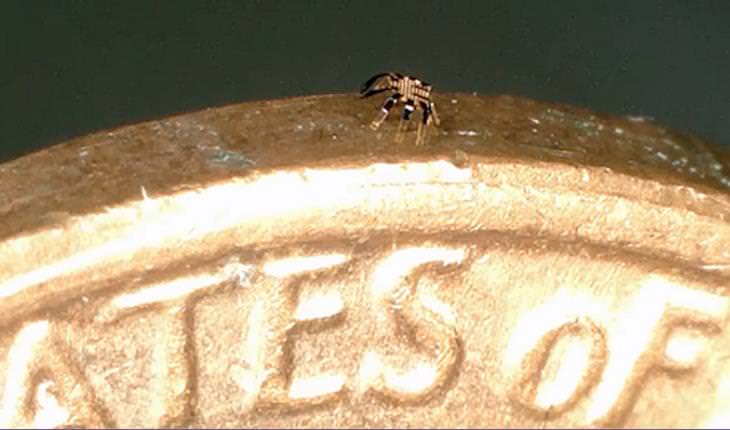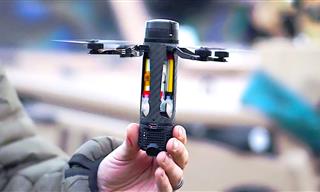

Meet the smallest ever remote-controlled walking robot. It was created by engineers at Northwestern University and resembles a tiny peekytoe crab. This crab is only half a millimeter wide and it can easily be perched on the side of a coin, but it can move and turn in every direction - bending, twisting, crawling, and even leaping. Let’s see what else it can do.
At this time, the study does not have a specific objective. It’s only experimental, but the results are already very promising and can be highly influential in many fields. The researchers propose several possible uses for their crab robot. These include repair or assembly of small structures or surgical assistance in minimally invasive procedures.
This is not the first time this team of engineers breaks records when it comes to robotics. They were also the first to create the smallest ever man-made flying structure. It was a winged microchip smaller than the head of the common ant. The main purpose of the structure is to monitor air pollution, airborne disease, and environmental contamination.
Speed
Seeing as they resemble crabs or tiny creatures, you might imagine that these robots can whizz by pretty fast, but so far, their speed is at an average of half a millimeter a second. While this may sound painfully slow, it is considered a more-than-average speed at such a small scale. You might even be shocked to discover that this robot does not use any electronic or hydraulic machinery to move. Instead, the very material from which it’s made, in combination with remote laser control, is what animates it.
Movement
The researchers used a shape-memory alloy material to build the robot. It transforms to its remembered shape when heated. When it is heated up, it contracts. When it cools down, it expands back to its original shape.
What heats the alloy is a laser beam. The direction of this beam determines the robot's direction of movement. John a. Rogers, Who lead the experimental work, explained that “because these structures are so tiny, the rate of cooling is very fast. In fact, reducing the sizes of these robots allows them to run faster.” As some wise man once said, everything is relative.
How does one come about manufacturing such little things? Well, the researchers at Northwestern will tell you it’s all child’s play. The manufacturing process is inspired by children’s pop-up books, a technique they introduced eight years ago.
First, they create the structures as flat, spread-out sheets. Then they lay these sheets onto a slightly stretched rubber layer. When this stretched rubber is relaxed, all parts are assembled, and the crabs pop into their final three-dimensional forms.
But why a crab of all things? The researchers once again show us their playful side, admitting that this was a creative whim: "With these assembly techniques and materials concepts, we can build walking robots of almost any size or 3D shape, but the students felt inspired and amused by the sideways crawling motions of tiny crabs."
They also created millimeter-sized robots that resemble inchworms, crickets, and beetles. I don’t know about you, but I wouldn’t mind letting this tiny crab join in as an assistant if I ever need surgery. And if you’re not convinced yet, try watching it in action:

5:34
Medical Lesson: What ARE Enzymes?
This handy animated video is perfect for the job of explaining what enzymes are.
7:17
Vaccinations SHOULD Trigger Side Effects, Here’s Why
Once you watch this video and understand why vaccine side effects happen, you may even be happy to get that headache.
21:13
The Future is Made of Self Healing Concrete
Keep tabs on the most recent technological advancements we're likely to see in the near future.
4:28
Fascinating History - Why We Wash Our Hands
Until the 18th-century doctors didn’t wash their hands. Everything changed thanks to a man named Dr. Ignaz Semmelweis. This is his tragic story.
2:49
What is E-ink and What Does it Have to Do With Cars?
See for yourself! The new electric vehicle from BMW can change color with a push of a button.
Scientists Develop 'Flying Dragon' Robot to Fight Fires
Scientists in Japan have created a water-spitting 'flying dragon' robot to fight fires.
4:26
Despite Looking Similar, Cats Are MORE Diverse Than Dogs!
Who's more diverse, cats or dogs? This video answers this question once and for all, the it might surprise you...
9:34
Was Roman Concrete Really Superior to Our Own?
How did Ancient Romans make such durable concrete that it still lasts today?
4:11
This Video Will Show You Where We Are in the Universe!
Where is our galaxy in the known universe? This video will fly with you to ever-larger destinations, showing you our little planet's cosmic address from a very large viewpoint.
15:34
This Stunning Video Visualizes the Size of the Universe
This video visualizes the number of galaxies in the world, giving you a look into the true size of our enormous universe.
5:47
This Genius Child is a Better Calculator than a Computer
This ‘human calculator’ could likely outpace you entering the numbers into a calculator.
Superwood: A New Material That Could Replace Steel
After decades of relying on steel—a material that produces nearly two tons of CO2 for every ton manufactured—builders may soon have access to something far more sustainable and surprisingly stronger: Superwood.
Earth Is So Incredible: I Was Stunned by These 50 Facts
Here's a post that will explain to you just what's truly, scientifically amazing about our planet Earth. I'm gobsmacked.
21:24
James Webb Telescope: Redefining Our View of Space
Here's a brief look at all the amazing discoveries made by the James Webb Space Telescope so far.
13:21
The Race to Complete the World's Second-Tallest Skyscraper
Malaysia is all set to unveil the world’s second tallest skyscraper.
12 Earliest Versions of Tech Inventions We Use Every Day
Witness the evolution of 11 popular devices we use all the time by looking at how they all started...
3:07
The Speed of Light Visualized in a Magnificent Video
Have you got the patience? Watch, in scale, just how long it takes light to travel from Earth to Mars
12 Bizarre Scientific Facts You Never Learned at School
The scientific facts we collected in this list aren't the kind of stuff you'll see in a school curriculum.
14 Times Nature Inspired Groundbreaking Technology
Let’s explore 14 remarkable examples of how nature has shaped modern technology.
4:45
Woah! Learning to Play Music Has This Effect on Your Brain
Learning how to play an instrument can do wonders for our brain...here's how!
10 Tech Products You Must Double-Check Before Buying
Beware! These tech products are most commonly faked.
33:02
The Entire Story of Earth in 30 Minutes!
The story of our planet, from birth to the adult, ancient planet we see before us today - all in just half an hour.
7:56
These 6 Chemical Reactions Changed the Course of History
Although we rarely pay much attention to the chemistry that constantly surrounds us, these 6 reactions changed history.
12:34
The World You See Doesn't Really Exist...
his video reveals how your brain constructs reality instead of simply perceiving it.
Enjoy This Fascinating Collection of NASA's Best Photos
Here are 15 of NASA's most amazing recent pictures, along with brief explanations of exactly what is going on in each one.
Science News: New Wonder Mushroom Cleans the Air
Let's learn about a magical new mushroom that is not only enriching the soil for farmers but also capturing CO2 from the air!
The Wildest Meteorites Ever Found on Our Planet - 15 Pics
Check out 15 of the most fascinating meteorites ever found on earth.
15:41
Keep Your Home Safe with These Handy Gadgets
These 13 devices will transform your home security.
Learn Chemistry Easily with This Interactive Periodic Table
This interactive table of elements has video lectures about every element, including experiments
8:11
Fascinating: What is the Deepest Hole Humanity Has Dug?
This video explains how low humanity has dug down so far.
10 Fascinating Facts About the Subconscious Mind
10 facts about the way the subconscious mind works
1:48
Boston Dynamic's Robot Does Some Incredible Things...
Boston Dynamics shows us again what her lead robot can do.
Is Weekend Sleep as Good as Regular Sleep? Let's Check
If you thought sleeping in on the weekend was a bad habit, you're about to find out that it's quite the opposite.
8:48
Fascinating: What Around Us is Invisible?
The Invisible Things that Turn the World...
24:11
25 Game-Changing Megaprojects That Will Change Our World
These incredible megaprojects that are set to redefine our world in 2025.
4:49
This Video Shows You a Different Way to Look at the World
You’ve heard of the fourth dimension but do you know what it is? This TED-Ed video helps uncover a bit of the mystery.
These Materials are Strange Enough to Boggle Your Mind...
There are some materials in this world that totally defy scientific convention. From metals that melt in your hand, to a solid lighter than air, take a look.
8 Jaw-Dropping Black Hole Facts to Warp Your Mind
These black hole facts will bend your mind!
4:57
Fascinating: How Does Our Digestive System Work?
This video explains how the human digestive system does its daily.
2024's Biggest Breakthroughs in Science We Must Celebrate
These recent scientific breakthroughs could change the world.
Why It's So Hard to Get People to Change Their Stance
You feel that your knowledge is broader because you've read and researched a lot on the topic, but the other side still isn't convinced, even when you present facts and statistics. Why isn't that enough?
A Quantum Leap? Revolutionary Technique Discovered
Scientists at Singapore University have developed a groundbreaking manufacturing method powered by artificial intelligence that may revolutionize how we understand and create quantum materials at the atomic level.
1:17
The Age of the Affordable Android Robots is Here...
Meet the Unitree R1 – the game-changing humanoid robot that just shattered every price expectation in robotics.
Alzheimer's: What Recent Breakthroughs Have Taught Us
Now, you can discover 4 new studies that show how to do this in ways you haven’t heard of.
NVIDIA CEO Reveals Which Degree Is Worth Studying
Electrical Engineering, Computer Science, or Physics? Nvidia's CEO has a surprising answer to which area should be studied nowdays.
8 Ancient Greek Scholars & Their Life-Changing Inventions
The foundations of modern medicine, engineering, biology, and astronomy were set up by these 8 stellar minds more than two thousand years ago.
18:14
Are These Vintage Kitchen Gadgets Any Good?
Will any of the vintage kitchen gadgets stand the test of time or outperform their contemporary alternatives?
To enable your Ad-Free Subscription, please fill the fields below
Your subscription was successful, now you can enjoy an ad-free experience!! Note: To make sure you get no ads, please make sure to log in to your account. If you are logged in already, then refresh the page. The subscription can be cancelled at any time.