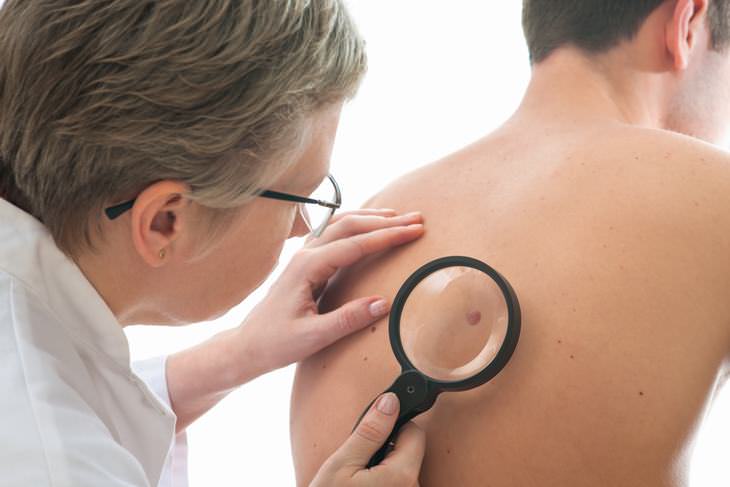
So how does this new device work? Cancer affects the metabolic rate of skin cells, with cancerous cells heating up faster than their healthy counterparts following a shock of cold temperature.
To make identifying these cells easier, the McMaster University team comprised of Michael Takla, Rotimi Fadiya, Prateek Mathur and Shivad Bhavsar, built a skin cancer detector with 16 thermistors that can track the rate of temperature increase following a cold shock from an ice pack. The thermistors are simply placed on the potentially cancerous area of skin, and the device produces a heat map that can be used to determine the presence of melanoma.
The team used widely available and inexpensive components, which allows for melanoma skin cancer detection to be readily accessible to many. It is, undoubtedly, a very clever device that has the potential to save lives around the world. Alongside the Dyson Award, the team also received a cash prize of $40,000 to advance their research and they also received $10,000 at the Forge's Student Start-Up Pitch competition in March.
The team was inspired to create sKan after realizing technology hadn't had the same impact on skin cancer diagnosis as it had on other medical fields. They found research that used the thermal properties of cancerous skin tissue as a means of detecting melanoma. But this was done using expensive lab equipment. So they set out to invent a way of performing the same assessment using a more cost-effective solution.
This will be a big leap forward in the area of detecting skin cancer. As the Guardian reported, nearly 39 people are diagnosed with skin cancer every day in the U.K., and the American Cancer Society estimates 87,110 new cases of melanoma will be diagnosed in the U.S. by the end of 2017, with 9,730 people dying from the condition. So, early detection is key to cancer survival - let's hope that sKan succeeds in significantly reducing that number.
Going forward the sKan team hopes to create a more advanced prototype that will allow them to begin pre-clinical testing. “Our aspirations have become a reality,” said Mathur. “Skin cancers are the most common form of cancer worldwide, and the potential to positively impact the lives of those affected is both humbling and motivating.”
Discover more about sKan in the video below:

Science Breakthrough: An Immunization Against Skin Cancer?

This scientific breakthrough offers hope for those who are struggling with skin cancer. You are now invited to discover more about this revolutionary vaccine.
The Spleen – A Guide to a Little-Known Organ
The spleen is an oft-ignored organ of our body. However, it serves an important function and needs to be taken care of properly.
This Study Shows Where People Need to Be Touched
Touching is vital for human development in children, and it's also vital for the strength of familial and romantic relationships. Learn more here.
Bet You Never Knew How Beneficial These Foods Are
Include these 12 foods in your diet to reduce the effects of arthritis - they have been shown to fight inflammation, strengthen bones and boost the immune system.
8:10
Winter Hikers, Gather Round for the Best Tip of the Season
Here's how advanced snow hikers layer clothing in the winter.
Minute Clinic: Healthy Habits That Take Under 60 Seconds
These healthy habits all take less than a minute to perform, yet have significant benefits for your well being.
A 'Brain Fog' Epidemic? Study Shows a Worrying Trend
Analysis of over 4.5 million U.S. survey responses spanning a decade (2013–2023) shows a rise from 5.3% to 7.4% in reported cognitive disability nationwide, with an exceptional surge in the 18–39 age group and a clear influence of income and educatio
10:50
Remarkable! This Is How the Universe Developed...
Watch this time lapse of the entire universe - starting with the big bang and culminating in the appearance of homo sapiens.
50:02
Take a Trip Through the Universe and Witness its Beauty
Since its launch, the Hubble Telescope returned images of unprecedented beauty of a dynamic and changing universe. Take a look!
Has Modern Technology Changed Our Cognitive Abilities?
Modern digital technology is everywhere and it’s changing how we think, how we behave and even how we feel about things.
Superwood: A New Material That Could Replace Steel
After decades of relying on steel—a material that produces nearly two tons of CO2 for every ton manufactured—builders may soon have access to something far more sustainable and surprisingly stronger: Superwood.
Chronically Late? What Science Has to Say About You
There are 8 positive things that science says about late people that we all need to know.
4:22
eSIM vs Traditional SIM: What’s the Big Difference?
Are eSIMs and iSIMs the future of connectivity?
27:48
Fascinating: How are CPU Chips Made?
This is a comprehensive look at both the fabrication process and the workings of a microchip plant that makes CPUs for computers.
15:41
Keep Your Home Safe with These Handy Gadgets
These 13 devices will transform your home security.
8:19
You Won't Believe What Passes for a Phone in North Korea
You won't believe what phones look like in North Korea!
1:48
Boston Dynamic's Robot Does Some Incredible Things...
Boston Dynamics shows us again what her lead robot can do.
4:40
How to Make a Floating Chair
If you have some rope and wood - you too can build this floating chair!
Extraordinary Inventions By Tesla That Were Never Built!
Nikola Tesla was a scientist too advanced for his time. Here are some of the inventions he never had a chance to build.
8 Ancient Greek Scholars & Their Life-Changing Inventions
The foundations of modern medicine, engineering, biology, and astronomy were set up by these 8 stellar minds more than two thousand years ago.
Study: New Link Found Between Parkinson's and the Gut
A recent study has identified gut microbes likely involved and linked them to decreased riboflavin (vitamin B2) and biotin (vitamin B7), suggesting a potential treatment
4:57
The First 3D-Printed Hotel is Already Being Built!
s evidence of this, a groundbreaking project is nearing completion, in which a hotel is being printed, and tourists will soon be able to visit it. Curious to see what it looks like?
5:14
Earth 2125: A Vision of the Future of Our Planet
Exploring what Earth could look like in 2125 reveals exciting potential.
Science Proves: These 10 Bible Stories Probably Did Happen
The Bible describes many seemingly supernatural cases, but today, science can show that they might have indeed happened.
36:24
Ever Wonder How a Steel Locomotor Works?
Let’s take a closer look at the engineering behind these compact workhorses.
These Theories About Reality & the Universe Will Stun You
You will be shocked to discover these 10 surprising theories of the universe and reality.
Alzheimer's: What Recent Breakthroughs Have Taught Us
Now, you can discover 4 new studies that show how to do this in ways you haven’t heard of.
15:30
Experts Are Still Baffled by These Ancient Artifacts
These mysterious relics have left experts puzzled.
NVIDIA CEO Reveals Which Degree Is Worth Studying
Electrical Engineering, Computer Science, or Physics? Nvidia's CEO has a surprising answer to which area should be studied nowdays.
5:39
Why Are Your Ears Ringing? The Causes Explained
Nearly 15% of the human population worldwide are plagued by this strange sensation, but most people don't know the causes behind ringing in the ears...
5:28
Just How Small is an Atom? - Fascinating!
Just how small are atoms? And what's inside them? The answers turn out to be astounding...
12:34
The World You See Doesn't Really Exist...
his video reveals how your brain constructs reality instead of simply perceiving it.
What is the Troxler Effect and How Does it Affect You?
Learn about Troxler's effect and the optical illusions it creates in life.
Is Microsoft's "AI Doctor" Better Than a Real Doctor?
A new study presents a committee of digital doctors achieving approximately 80% accuracy in complex medical diagnoses – far beyond the average of general practitioners.
20:04
Emotions Explained: The Science Behind How We Feel
Neuroscientist and psychologist Dr. Richard J. Davidson answers some fascinating questions about emotions you would never expect.
16:31
Why Building a Perpetual Motion Machine Is Impossible
Since the Middle Ages, scholars have been trying to build the mythical perpetual motion machine. Was it all in vain? Is it even possible to build such a machine?
4:49
This Video Shows You a Different Way to Look at the World
You’ve heard of the fourth dimension but do you know what it is? This TED-Ed video helps uncover a bit of the mystery.
Learn Chemistry Easily with This Interactive Periodic Table
This interactive table of elements has video lectures about every element, including experiments
0:55
China's G1 Robot is Showing Some Incredible Moves
The G1 is a new robot developed in China and in this video shows some amazing moves.
42:14
Physicist Michio Kaku: The Universe in a Nutshell...
Physicist Michio Kaku explains the fundamental nature of our universe
1:17
The Age of the Affordable Android Robots is Here...
Meet the Unitree R1 – the game-changing humanoid robot that just shattered every price expectation in robotics.
5:17
How Exactly Do We Hear? All is Revealed Here!
In this informative TED-Ed video, Douglas L. Oliver explains the complete science behind hearing.
4:45
Woah! Learning to Play Music Has This Effect on Your Brain
Learning how to play an instrument can do wonders for our brain...here's how!
9 Great NASA Inventions That Took the World By Storm!
For around six decades, NASA have been inventing top-notch products. Here are nine great examples!
These Underwater Craft Are Changing Marine Science
Here's a look at the most remarkable machines currently expanding our understanding of the underwater world.
1:14:42
Documentary: How Did Our Universe Come From Nothing?
Can “nothing” truly become “something”? In this video, we’ll dig into this mind-bending question.
6:15
K2-18b: The Exoplanet That Might Host Alien Life
Astronomers have detected signs of posisble life in the atmosphere of exoplanet K2-18b.
I Bet You Didn't Have a Clue About These Human Body Facts!
The human body is the most complex machine known to mankind, but I bet you don't know these 10 amazing facts about it...
To enable your Ad-Free Subscription, please fill the fields below
Your subscription was successful, now you can enjoy an ad-free experience!! Note: To make sure you get no ads, please make sure to log in to your account. If you are logged in already, then refresh the page. The subscription can be cancelled at any time.