
Miniscule single cells of bacteria are the masters of our world. They play many different roles in life on earth, with one of the most surprising being that some of them can actually purify precious metals.
An international team of researchers have discovered that a particular species of bacteria, Cupriavidus metallidurans, can actually ingest toxic metallic compounds and still thrive. What’s more is that the bacteria can actually produce tiny gold nuggets as a side-effect.
Gold moves through a process that’s called the biogeochemical cycle, just as many other earth elements do. This process sees elements being dissolved, shifted around and eventually re-concentrated in the Earth’s sediment.
Seeing as microbes are involved at every step of this process, scientists have long wondered how the microbes don’t get poisoned by the highly toxic compounds formed by gold ions in the soil.
Cupriavidus metallidurans, which is a rod-shaped bacteria species, was first found to excrete gold nuggets back in 2009 when scientists discovered that it’s capable of ingesting toxic gold compounds and converting them into the element’s metallic form without endangering or harming itself.
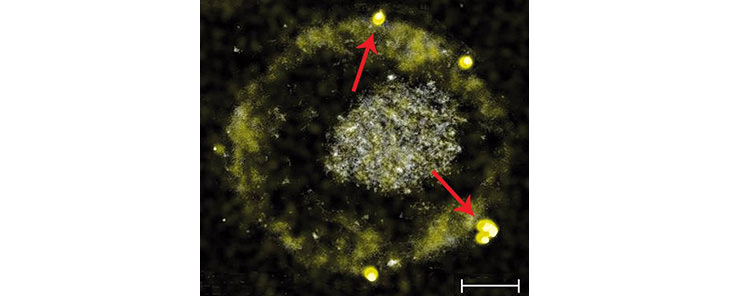
After many years of investigation, scientists now know how the bacteria are capable of this amazing feat. It thrives in soils containing both hydrogen and a range of toxic heavy metals, meaning that it has little to no competition from other organisms that would easily be poisoned in such an environment.
This means that any organism choosing to live in such an environment has to have a way of protecting itself from all of the toxicity surrounding it. It turns out that this particular bacterium has an ingenious protective mechanism that involves both gold and copper.
Compounds containing both of these elements can easily be ingested by the bacteria, and copper ions and gold complexes get transported deep inside. Then, the bacteria use enzymes to shift offending metals out of their cells, allowing them to dispose of them unimpeded. Not only does this process allow the bacteria to shed all of the unwanted copper – It also results in tiny gold nugget nanoparticles on its surface.
The new research that has resulted in these findings builds on previous research conducted by the same team is a fascinating insight into the weird talents of this particular bacteria, which could potentially be put to good use.
The significance of the findings is that scientists are now a huge step closer to unlocking the biogeochemical cycle of gold. Understanding this process could lead to gold refining from ores that only contain very small amounts of the precious metal, which is something that’s extremely tricky to do at present.

This New Blood Pressure Drug Could Be a Game-Changer
Zilebesiran, an investigational drug that is showing profound success in late-stage clinical trials is offering hope for millions who struggle to keep their blood pressure in check.
Alcohol Linked To More Cancer Types Than Previously Known
A new study found a clear correlation between alcohol consumption and more types of cancer than previously known.
Ancient People Knew About Astronomy Some 40,000 Years Ago!
A pair of British researchers recently decided to turn their attention to ancient art. What they found was remarkable - 40,000-year-old astronomical knowledge!
3 Robots that Are Already Scary Advanced...
You'll be amazed to see how human (or animal)-like these robots are. They are all by Boston Dynamics, a robotics company at the forefront of its sector.
This Study Shows Where People Need to Be Touched
Touching is vital for human development in children, and it's also vital for the strength of familial and romantic relationships. Learn more here.
Red Meat Allergens Can Increase Heart Disease Risk
Red meat has long been linked to heart disease, but a new study marks the first time that the allergens it contains can increase the risk of contracting it.
Supplement Linked to Dramatic Increase in Heart Failure
The research found that prolonged melatonin use is linked to a 90% increase in heart failure risk, a 3.5-fold higher risk of heart failure hospitalization.
A 'Brain Fog' Epidemic? Study Shows a Worrying Trend
Analysis of over 4.5 million U.S. survey responses spanning a decade (2013–2023) shows a rise from 5.3% to 7.4% in reported cognitive disability nationwide, with an exceptional surge in the 18–39 age group and a clear influence of income and educatio
34:33
Is China Number 1 in Global Technology?
In this video, we’ll take a closer look at the new developments hitting the market — and what they could mean for the future of transportation.
3:39
Magic is Only A Vibration Away With This Great Experiment
All it takes is some sand, a metal plate and carefully toned vibrations from a speaker to create stunning and complex patterns. This video shows you the amazing results!
20:04
Emotions Explained: The Science Behind How We Feel
Neuroscientist and psychologist Dr. Richard J. Davidson answers some fascinating questions about emotions you would never expect.
13 Forgotten Phone Designs That Were Too Odd to Survive
From pen-shaped dialers to phones that clipped onto your clothes, here’s a look at the most unusual phones ever made.
3:07
The Speed of Light Visualized in a Magnificent Video
Have you got the patience? Watch, in scale, just how long it takes light to travel from Earth to Mars
Are You Ready to Learn About the Expanse of the Universe?
If you have an interest in the unknown, then look no further than these 15 unbelievably facts discovered about space
17:03
What is a Ballistic Missile and is Its Purpose?
Why is the ballistic missile so feared, and what exactly qualifies it as such - will all be explained in this informative video.
1:14:42
Documentary: How Did Our Universe Come From Nothing?
Can “nothing” truly become “something”? In this video, we’ll dig into this mind-bending question.
Is Microsoft's "AI Doctor" Better Than a Real Doctor?
A new study presents a committee of digital doctors achieving approximately 80% accuracy in complex medical diagnoses – far beyond the average of general practitioners.
11:43
Learn While Laughing: The Incredible Tardigrade
If you love nature and you love laughing, this incredible series of nature videos are a great way to spend a few minutes.
Hubble Telescope: 35 Years of Incredible Photos
Exploring 35 years of reality-changing, universe-enhancing photos that opened the sights of outer space to us all.
Do You Have One Of These RARE Genetic Traits?
How unique are you? You might have several rare genetic traits that make you unlike most of the world's population!
24:11
25 Game-Changing Megaprojects That Will Change Our World
These incredible megaprojects that are set to redefine our world in 2025.
7 Discoveries of Albert Einstein that Changed the World
The 7 biggest discoveries of Albert Einstein and how they changed the world forever.
8:48
Fascinating: What Around Us is Invisible?
The Invisible Things that Turn the World...
12:34
The World You See Doesn't Really Exist...
his video reveals how your brain constructs reality instead of simply perceiving it.
7 Air Pollution Solutions That Will Help Us Breathe Easy
Let's take a look at some global initiatives that have been launched to reduce air pollution levels.
11:05
Science: Can AI Preserve Our Most Precious Memories?
Technologist Pau Aleikum Garcia talks about synthetic memories.
4:57
Mjøstårnet - The World’s First Wooden Skyscraper
Mjøstårnet is an 18 story tall skyscraper towering over the Norwegian countryside. What makes it so special is that it's made entirely out of wood...
PayPal Versus Credit Cards: Here's the Lowdown!
Just how safe is PayPal? Should you have a PayPal account or should you pay for all online purchases using a credit card? All is revealed here!
Space Looks Breathtaking in These Amazing Photographs
There are some absolutely stunning photographs of space out there today, You won't believe how incredible it is!
These 18 Photos Capture the Universe Like Never Before!
See the universe in a new light with these astonishing photos.
8 Ancient Greek Scholars & Their Life-Changing Inventions
The foundations of modern medicine, engineering, biology, and astronomy were set up by these 8 stellar minds more than two thousand years ago.
20 Peculiar Microscope Photos That You Really Must See
An unseen world exists at our fingers, and thanks to these wonderful micrographs, we can get a glimpse into that dimension.
A Quantum Leap? Revolutionary Technique Discovered
Scientists at Singapore University have developed a groundbreaking manufacturing method powered by artificial intelligence that may revolutionize how we understand and create quantum materials at the atomic level.
11:28
India Built a Monster Dam That Controls the Weather!
The Polavaram Dam doesn't just control floods - it moves water between regions and much more!
Why It's So Hard to Get People to Change Their Stance
You feel that your knowledge is broader because you've read and researched a lot on the topic, but the other side still isn't convinced, even when you present facts and statistics. Why isn't that enough?
6:25
Do You Like the Smell of Rain? This Is Why
One of the best things about rain and thunderstorms is that clean fresh smell afterward. But what actually causes that distinct scent?
15:41
Keep Your Home Safe with These Handy Gadgets
These 13 devices will transform your home security.
The First Valentine's Day Was Not That Long Ago...
Let us take you on a fun history lesson with these 10 first-ever things that started way back in history and remain to this day.
3:02:59
Like Science Mysteries? Enjoy This Giant Compilation!
In this video, we unravel the greatest unsolved mysteries of physics.
5:22
Why Do You See Colors When You Rub Your Eyes?
Explore the science of afterimages, the visual illusions that linger in your vision following exposure to bright lights or images.
9 of the Greatest Unsolved Mysteries About the Universe!
The universe has been around for close to 14 billion years, but it still holds many mysteries that continue to perplex scientists. Here's 9 of them!
1:08
Boston Dynamics New Robot Can Move Almost Like a Human
Watch the latest in robotics in this video.
8:11
Fascinating: What is the Deepest Hole Humanity Has Dug?
This video explains how low humanity has dug down so far.
1:44
You Won't Believe What the Human Body Does in One Minute
How much do you think it is capable of doing in a single minute? Watch this video and you'll have your answer!
13 Astonishing Things You Never Thought You'd See
Here are 13 photos of rare phenomena you never thought you'd see!
14:34
What to Do (and Avoid) When Setting Up a Smart Home
Here's how you can set up a family-friendly smart home that will last long.
7:21
Science: 20 Mechanical Principles Demonstrated Using Lego
In this video, we'll explore a variety of fascinating mechanical mechanisms, all demonstrated using Lego models.
4:40
How to Make a Floating Chair
If you have some rope and wood - you too can build this floating chair!
4:49
This Video Shows You a Different Way to Look at the World
You’ve heard of the fourth dimension but do you know what it is? This TED-Ed video helps uncover a bit of the mystery.
To enable your Ad-Free Subscription, please fill the fields below
Your subscription was successful, now you can enjoy an ad-free experience!! Note: To make sure you get no ads, please make sure to log in to your account. If you are logged in already, then refresh the page. The subscription can be cancelled at any time.