
Miniscule single cells of bacteria are the masters of our world. They play many different roles in life on earth, with one of the most surprising being that some of them can actually purify precious metals.
An international team of researchers have discovered that a particular species of bacteria, Cupriavidus metallidurans, can actually ingest toxic metallic compounds and still thrive. What’s more is that the bacteria can actually produce tiny gold nuggets as a side-effect.
Gold moves through a process that’s called the biogeochemical cycle, just as many other earth elements do. This process sees elements being dissolved, shifted around and eventually re-concentrated in the Earth’s sediment.
Seeing as microbes are involved at every step of this process, scientists have long wondered how the microbes don’t get poisoned by the highly toxic compounds formed by gold ions in the soil.
Cupriavidus metallidurans, which is a rod-shaped bacteria species, was first found to excrete gold nuggets back in 2009 when scientists discovered that it’s capable of ingesting toxic gold compounds and converting them into the element’s metallic form without endangering or harming itself.
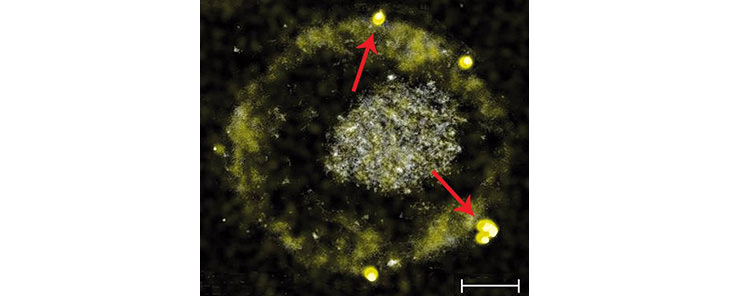
After many years of investigation, scientists now know how the bacteria are capable of this amazing feat. It thrives in soils containing both hydrogen and a range of toxic heavy metals, meaning that it has little to no competition from other organisms that would easily be poisoned in such an environment.
This means that any organism choosing to live in such an environment has to have a way of protecting itself from all of the toxicity surrounding it. It turns out that this particular bacterium has an ingenious protective mechanism that involves both gold and copper.
Compounds containing both of these elements can easily be ingested by the bacteria, and copper ions and gold complexes get transported deep inside. Then, the bacteria use enzymes to shift offending metals out of their cells, allowing them to dispose of them unimpeded. Not only does this process allow the bacteria to shed all of the unwanted copper – It also results in tiny gold nugget nanoparticles on its surface.
The new research that has resulted in these findings builds on previous research conducted by the same team is a fascinating insight into the weird talents of this particular bacteria, which could potentially be put to good use.
The significance of the findings is that scientists are now a huge step closer to unlocking the biogeochemical cycle of gold. Understanding this process could lead to gold refining from ores that only contain very small amounts of the precious metal, which is something that’s extremely tricky to do at present.

New Research Shows Eating Sweets Won't Make You Crave More
A groundbreaking new study challenges conventional wisdom, suggesting our preference for sweet tastes may be more stable than we think.
Can We PREVENT Type 1 Diabetes?
The study's findings point toward developing a simple blood test that could detect the immune failure leading to type 1 diabetes before insulin-producing cells are permanently lost.
This New Blood Pressure Drug Could Be a Game-Changer
Zilebesiran, an investigational drug that is showing profound success in late-stage clinical trials is offering hope for millions who struggle to keep their blood pressure in check.
Scientists Have Found a 1.5-Million-Strong Penguin Colony
It's not a regular occurrence for a 1.5-million strong penguin colony to be discovered, but that's exactly what happened in Antarctica...
This Study Shows Where People Need to Be Touched
Touching is vital for human development in children, and it's also vital for the strength of familial and romantic relationships. Learn more here.
Ancient People Knew About Astronomy Some 40,000 Years Ago!
A pair of British researchers recently decided to turn their attention to ancient art. What they found was remarkable - 40,000-year-old astronomical knowledge!
34:33
Is China Number 1 in Global Technology?
In this video, we’ll take a closer look at the new developments hitting the market — and what they could mean for the future of transportation.
5:41
Witness the Leading New Electronic Devices of 2026
The experts at CNET and PCMag were on the floor, and they've got their favorites. Let's dive in.
These Underwater Craft Are Changing Marine Science
Here's a look at the most remarkable machines currently expanding our understanding of the underwater world.
12 Earliest Versions of Tech Inventions We Use Every Day
Witness the evolution of 11 popular devices we use all the time by looking at how they all started...
11:02
Ever Wonder What Ancient Egyptian Sounded Like?
Researchers have used all the information we know to create what they think it may have sounded like.
19:39
Lecture: What is the Future of Humanoid Robots?
Get ready to meet the humanoid partners that will redefine how we live and work.
33:00
Like Clockwork: A Guide to Watches for Rookies
This is the complete beginner's guide to watches - the vocabulary, how these tiny machines actually work, the centuries of history that got us here.
2:03:03
Full Documentary: From First to Last Dinosaur
With stunning visuals and cutting-edge science, we’ll bring their story to life—from their very first day to their last, a saga of survival, adaptation, and mystery.
7 Air Pollution Solutions That Will Help Us Breathe Easy
Let's take a look at some global initiatives that have been launched to reduce air pollution levels.
10:46
12 SUPER COOL Military Inventions You’ve Never Seen
Check out this list of amazing new military innovations. They will transform warfare in the near future!
16 Interesting Things We Bet You've Never Seen Before
Once we have finished school and learned all the necessary skills at work, it may seem that no further studying is necessary. 16 interesting photos you wish you had seen in textbooks at school.
0:55
China's G1 Robot is Showing Some Incredible Moves
The G1 is a new robot developed in China and in this video shows some amazing moves.
10:30
China's Crazy Plan to Dig a Canal in the Middle of EUROPE
China is setting out a plan to dig a canal through the middle of Europe in the nearest future, but why?
2:56
Watch as a Fun-Filled Day of Balloons Turns to Disaster!
The 1986 Cleveland Balloon Festival was meant to be a truly joyous occasion but instead quickly turned into a grave tragedy
Science FIRST: A Fully Created Brain Inside a Computer?
Could a Computer Ever "Run" a Human Brain? Scientists Just Took a Big Step
1:17
The Age of the Affordable Android Robots is Here...
Meet the Unitree R1 – the game-changing humanoid robot that just shattered every price expectation in robotics.
11:40
6 Of the Earliest Known Parasites Ever Found
Get to understand and learn about the earliest parasites discovered by scientists.
3:55
50 Years Later, We're Debunking the Moon Landing "Hoax"
How do we prove to people the moon landing was real? By answering their doubtful questions in this video.
38:55
What Happens the Deeper You Go Underground?
What happens when pressure pushes matter beyond the limits of what we thought possible?
Travel From the Sun to Pluto With Our Interactive Guide!
The solar system is a fascinating place, and we wanted to bring you an interactive journey that you can use to travel through it. Enjoy the journey!
2:41
Trick-Mousing is Such Adorable Entertainment...
Mice are much cleverer than most people believe, and they easily respond to training, as long as you use positive reinforcement, or in other words - reward them frequently for their behavior with food.
22:52
Will AI Take Your Jobs? An Expert Explains the Future
Gonzaga University's AI professor Graham Morehead some of our most pertinent questions related to AI.
These Optical Illusions Will Shock Your Mind!
Optical illusions create miscommunication between our eyes and brain making, us see things that are not really there or not see things that are right in front of us. See for yourself.
9:03
24 Unbelievable Abilities Your Body Has
The human body is a complex and endlessly fascinating machine, and it might be even more sophisticated than you know...
5:17
How Exactly Do We Hear? All is Revealed Here!
In this informative TED-Ed video, Douglas L. Oliver explains the complete science behind hearing.
5:14
Earth 2125: A Vision of the Future of Our Planet
Exploring what Earth could look like in 2125 reveals exciting potential.
Remembering the Life and Wisdom of Stephen Hawking
Stephen Hawking possessed one of the greatest minds the world has ever seen, but was also impaired by a debilitating disease. Here are his life ant times.
Explore the Most Bizarre Planets We've Discovered So Far
The search for stars, planets, and extraterrestrial life has led to quite a number of extraordinary discoveries, and here are 10 of the strangest!
These Are the Miracles That Happen in Our Bodies Every Day
There is a lot that happens inside our bodies every single day. Did you know any of these facts?
2:06
Can Your Brain Get to Grips with These Weird Illusions?
I could have sworn what I was seeing in this video was real! But it wasn't. It was all just an illusion.
How AI Is Fixing Problems Humans Struggle With
Here’s how AI is quietly reshaping the world in ways that actually matter.
9 of the Greatest Unsolved Mysteries About the Universe!
The universe has been around for close to 14 billion years, but it still holds many mysteries that continue to perplex scientists. Here's 9 of them!
Meta Unveils New Glasses that May Change Sports Forever
META has revealed a new line of AI-powered smart glasses: Oakley Meta HSTN
4:01
What Lies Within the Planet's Deepest Hole? Find Out Here
Learn all about Russia's Kola Superdeep Borehole, which at a depth of around 12km, makes it the deepest hole that mankind has ever dug into our planet.
7:56
These 6 Chemical Reactions Changed the Course of History
Although we rarely pay much attention to the chemistry that constantly surrounds us, these 6 reactions changed history.
New Study: Dopamine Does Way More Than We Thought!
How the brain's reward system physically rewires the motor cortex during skill learning — and what happens when that reward signal gets cut off.
4:49
This Video Shows You a Different Way to Look at the World
You’ve heard of the fourth dimension but do you know what it is? This TED-Ed video helps uncover a bit of the mystery.
Superwood: A New Material That Could Replace Steel
After decades of relying on steel—a material that produces nearly two tons of CO2 for every ton manufactured—builders may soon have access to something far more sustainable and surprisingly stronger: Superwood.
7 Little-Known Body Parts We Never Knew About
Here's a look at some of the weird and little-known body parts that you didn’t know you had.
21:25
How Every Nuclear Power Got Its Atomics
This video will explain how each nation earned the complex and controversial title of nuclear power.
4:26
Despite Looking Similar, Cats Are MORE Diverse Than Dogs!
Who's more diverse, cats or dogs? This video answers this question once and for all, the it might surprise you...
To enable your Ad-Free Subscription, please fill the fields below
Your subscription was successful, now you can enjoy an ad-free experience!! Note: To make sure you get no ads, please make sure to log in to your account. If you are logged in already, then refresh the page. The subscription can be cancelled at any time.