
Here's a bit of news you probably weren't expecting to hear today: After more than 100 years of X-rays being flat and monochrome, they may very soon finally take the leap into the 21st Century and start being displayed as full-color 3D models.
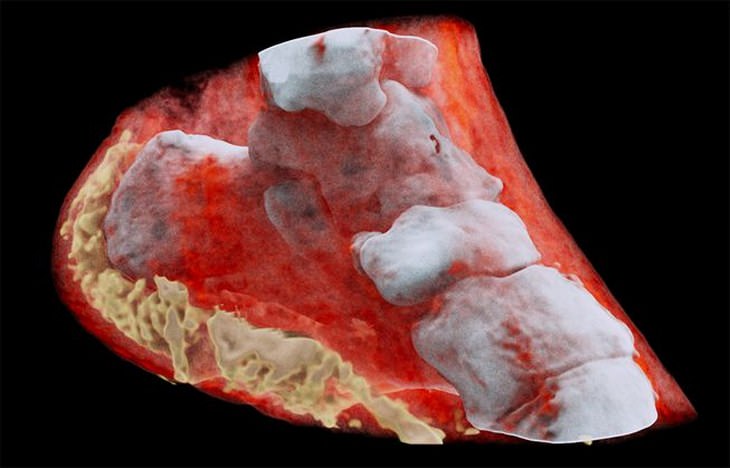
Phil and Anthony Butler, father and son scientists from the universities of New Zealand's Canterbury and Otago have created the world's first ever 3D color medical scanner. They named it the MARS spectral X-ray scanner, and it is able to capture internal images of both bone as well as all of its surrounding tissue.
According to Anthony Butler, "X-ray spectral information allows health professionals to measure the different components of body parts such as fat, water, calcium, and disease markers," and that "traditional black-and-white X-rays only allow measurement of the density and shape of an object."
As you can see from the video below, the scanner will also allow doctors to see the inner structure of a target area layer by layer:
Whereas regular X-rays use film or a sensor to record radiation levels, the MARS scanner actually measures the whole X-ray spectrum, and even goes as far as to detect and count the many particles as they collide with the pixels. This means that the MARS scanner works in a similar way to a camera, providing an HD image that is in color and fully 3D.
The technology used in the MARS scanner comes straight from CERN's Large Hadron Collider, which is the biggest and most powerful particle accelerator in the world. In fact, a chip which was designed for particle detection and imaging in the collider, known as Medipix3, was actually adapted by Phil and Anthony Butler's team so that it could be used in the MARS scanner.
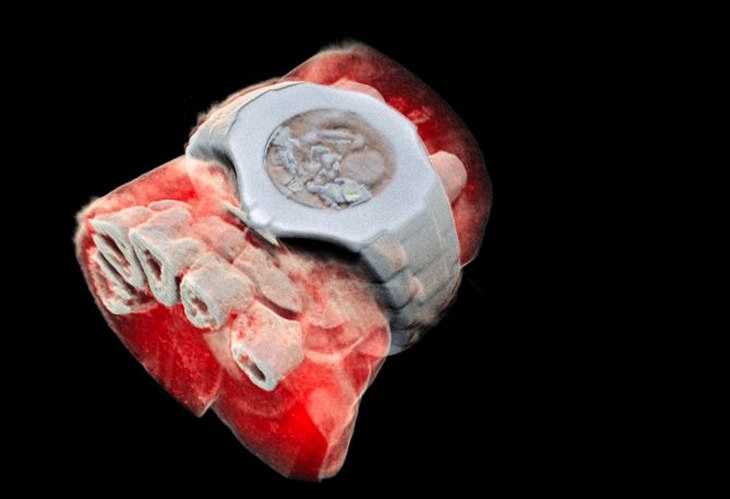
According to Phil Butler, "this technology sets the machine apart diagnostically because its small pixels and accurate energy resolution mean that this new imaging tool is able to get images that no other imaging tool can achieve."
While the MARS scanner has been under development for close to ten years, clinical trials have only begun very recently. However, all results so far are showing that the MARS scanner will very likely become one of the medical community's most indispensable tools in the near future.
"So far researchers have been using a small version of the MARS scanner to study cancer, bone, and joint health, and vascular diseases that cause heart attacks and strokes," Butler said. "In all of these studies, promising early results suggest that when spectral imaging is routinely used in clinics it will enable more accurate diagnosis and personalization of treatment."
Don't forget to share this exciting news with your friends and family, too!
Source: mnn
Images: marsbioimaging
Related Articles:
Bone Spurs: What They are and How to Treat Them

12:14
What Drinking Whiskey Actually Does to Your Body
While we now know that whiskey isn't the cure-all medicine people once though it was, it does have a few proven health benefits.
3 Inventions that Improve Upon Our Regular Senses
Check out these impressive artificial organs which are completely changing the worlds of science and medicine for good.
7:17
Vaccinations SHOULD Trigger Side Effects, Here’s Why
Once you watch this video and understand why vaccine side effects happen, you may even be happy to get that headache.
Viagra May Hold the Key to Preventing Colorectal Cancer...
A new study shows that Viagra may be able to help prevent the onset of colorectal cancer. Find out all about it here.
5:14
Studying Dolphins May Be Key to Advancing Medicine
Scientists have noticed a strange behavior in red sea dolphins, and they believe this is a form of self-medication. Learn why this discovery is so important.
3:16
Discover How Anesthesia Affects Your Body and Mind
If you were ever curious about how exactly anesthesia works, then this video has all the answers!
11:02
Ever Wonder What Ancient Egyptian Sounded Like?
Researchers have used all the information we know to create what they think it may have sounded like.
Absolute Zero: The AI that Doesn't Need People to Develop
Imagine an AI that doesn’t need humans to teach it how to code—it creates its own coding challenges, solves them, and gets smarter all on its own. This isn’t science fiction; it’s a groundbreaking development called Absolute Zero
The Most Remarkable Medical Breakthroughs of 2024
Here’s a look at some breakthroughs in medical innovation this year.
27:48
Fascinating: How are CPU Chips Made?
This is a comprehensive look at both the fabrication process and the workings of a microchip plant that makes CPUs for computers.
9:15
These Bizarre Mysteries Continue to Stump Scientists!
The world of science hasn't been able to explain several bizarre phenomenon yet. Let's take a look at a few of them.
8:12
How Humans Helped Cats Take Over the World
The relationship between humans and cats goes back as far as 9,500 years. How did it al start? And how did humans help cats essentially take over the world?
10 Declassified U.S. Military Secrets That'll Astound You
Government military secrets can range from amusing to absurd to downright terrifying, but they are all extremely intriguing. Here are 10 such secrets.
7 Discoveries of Albert Einstein that Changed the World
The 7 biggest discoveries of Albert Einstein and how they changed the world forever.
10:04
11 Practical Technologies That Will Help Fight Flooding
These amazing innovations will be real handy during a flood.
2:03:03
Full Documentary: From First to Last Dinosaur
With stunning visuals and cutting-edge science, we’ll bring their story to life—from their very first day to their last, a saga of survival, adaptation, and mystery.
1:08
Boston Dynamics New Robot Can Move Almost Like a Human
Watch the latest in robotics in this video.
10:30
China's Crazy Plan to Dig a Canal in the Middle of EUROPE
China is setting out a plan to dig a canal through the middle of Europe in the nearest future, but why?
10 Fascinating Facts About the Subconscious Mind
10 facts about the way the subconscious mind works
What is the Troxler Effect and How Does it Affect You?
Learn about Troxler's effect and the optical illusions it creates in life.
Superwood: A New Material That Could Replace Steel
After decades of relying on steel—a material that produces nearly two tons of CO2 for every ton manufactured—builders may soon have access to something far more sustainable and surprisingly stronger: Superwood.
14:58
Why IS Fentanyl So Dangerously Addictive?
In this video, we break down what opioids really do to your brain and body, what using them actually feels like, and why so many people are dying from Fentanyl overdoses.

14:34
What to Do (and Avoid) When Setting Up a Smart Home
Here's how you can set up a family-friendly smart home that will last long.
7 Air Pollution Solutions That Will Help Us Breathe Easy
Let's take a look at some global initiatives that have been launched to reduce air pollution levels.
Extraordinary Inventions By Tesla That Were Never Built!
Nikola Tesla was a scientist too advanced for his time. Here are some of the inventions he never had a chance to build.
5:47
This Genius Child is a Better Calculator than a Computer
This ‘human calculator’ could likely outpace you entering the numbers into a calculator.
12 Bizarre Scientific Facts You Never Learned at School
The scientific facts we collected in this list aren't the kind of stuff you'll see in a school curriculum.
4:40
How to Make a Floating Chair
If you have some rope and wood - you too can build this floating chair!
3:39
Magic is Only A Vibration Away With This Great Experiment
All it takes is some sand, a metal plate and carefully toned vibrations from a speaker to create stunning and complex patterns. This video shows you the amazing results!
2:41
Trick-Mousing is Such Adorable Entertainment...
Mice are much cleverer than most people believe, and they easily respond to training, as long as you use positive reinforcement, or in other words - reward them frequently for their behavior with food.

20:32
History: Did the Trojan War REALLY Happen?
The Trojan War, the most famous of the ancient wars, fought by thousands of men for ten long years on the beaches of the famed city of Troy. Was all that real?
Science in 2025: 8 Developments That Could Change it All
Here are some of the most exciting trends in science and healthcare to keep an eye on.
7 Mind Blowing Science Facts School Left Out
Put on your learning caps! We rounded up 7 surprising scientific facts you probably didn't learn at school.
8 Important Inventions That Were a Complete Accident
It might be interesting for you to learn that some very important scientific innovations were born as a result of an accident.
15:34
This Stunning Video Visualizes the Size of the Universe
This video visualizes the number of galaxies in the world, giving you a look into the true size of our enormous universe.
11:15
These Paradoxes Continue to Mystify Scientists
Take a look at 7 scientific paradoxes that may never get solved.
34:33
Is China Number 1 in Global Technology?
In this video, we’ll take a closer look at the new developments hitting the market — and what they could mean for the future of transportation.
5:16
Fascinating: How Fast Does Our Brain Operate?
Ever wonder at what speeds our thoughts move?
How AI Is Fixing Problems Humans Struggle With
Here’s how AI is quietly reshaping the world in ways that actually matter.
Hubble Telescope: 35 Years of Incredible Photos
Exploring 35 years of reality-changing, universe-enhancing photos that opened the sights of outer space to us all.
Why It's So Hard to Get People to Change Their Stance
You feel that your knowledge is broader because you've read and researched a lot on the topic, but the other side still isn't convinced, even when you present facts and statistics. Why isn't that enough?
Hair Regeneration Could Be Possible With This New Process
Learn about an innovative new study which has revealed a novel treatment for effective hair regeneration.
9:09
Protective Measures: How Our Body Reacts to a Tattoo
In this video, we’ll explore the microscopic war raging beneath your skin, where millions of your cells make the ultimate sacrifice to lock that ink in place, turning a defense mechanism into lifelong art.

Are You Ready to Learn About the Expanse of the Universe?
If you have an interest in the unknown, then look no further than these 15 unbelievably facts discovered about space
Has Modern Technology Changed Our Cognitive Abilities?
Modern digital technology is everywhere and it’s changing how we think, how we behave and even how we feel about things.
4:05
Kirobo: First Robot in Space!
It was one small step for robot and another giant leap for mankind...
4:49
This Video Shows You a Different Way to Look at the World
You’ve heard of the fourth dimension but do you know what it is? This TED-Ed video helps uncover a bit of the mystery.
To enable your Ad-Free Subscription, please fill the fields below
Your subscription was successful, now you can enjoy an ad-free experience!! Note: To make sure you get no ads, please make sure to log in to your account. If you are logged in already, then refresh the page. The subscription can be cancelled at any time.