
Although the founding of modern astronomy is often attributed to the great Greek scholars, Plato and Aristotle, European researchers now believe that humans that lived thousands of years earlier than they did already have a nuanced understanding of the stars.
The researchers studied cave drawings spanning Spain, France, Turkey, and Germany, and realized that what they were looking at was more than just mere depictions of nearby wildlife. It turns out that the bulls, rams, leopards, scorpions, and fish that they saw in the drawings are actually representations of constellations in the night sky.
Martin Sweatman and Alistair Coombs, from the Universities of Edinburgh and Kent respectively, published their findings in the Athens Journal of History last month. They undertook a chemical analysis of the paint used in the cave drawings and managed to date all of them back to between 12,000 and 40,000 years ago.
Furthermore, the researchers also used advanced software to calculate where the stars were positioned during the time that the cave drawings were drawn. To their astonishment, the researchers found that the cave drawings actually marked the dates of significant comet sightings, and were also correlated with star constellations visible at the time they were painted.
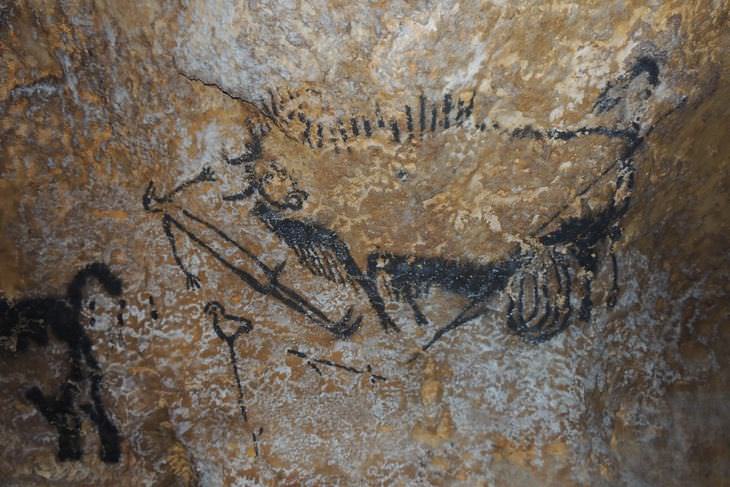
The world-famous Lascaux Shaft Scene, which was studied by the researchers, was found to depict a comet strike that occurred circa 15,200 BC. It’s hypothesized that the rhinoceros imagery contained in the painting signifies the constellation of Taurus, whereas the horse symbolizes the stars in the constellation of Leo.
Another finding that the researchers made was that a pillar in Gobeki Tepe, Turkey’s ancient archeological site, depicts a catastrophic comet strike that took place circa 11,000 BC. It features etched designs of a scorpion, bear, and bird, and the researchers were able to determine that the carvings represented the constellations that were in view at the time they were carved. More specifically, the carvings represented the Scorpius, Virgo and Pisces constellations.

As a result of all of the above, archeologists now believe that humans were keeping track of time via the stars up to 40,000 years ago. It’s also evident that ancient peoples had an understanding of the equinoxes, which occur due to the gradual shift of Earth’s rotational axis as it orbits the sun.
This notion disputes the fact that astronomer Hipparchus discovered equinoxes in 129 BC. "Early cave art shows that people had advanced knowledge of the night sky within the last ice age. Intellectually, they were hardly any different to us today," Sweatman said in a press release.
Many pieces of prehistoric art were cited in the study, not least the painting in Lascaux, France, but it also suggested that certain ancient relics were also used for recording time. For instance, The Lion-Man of Hohlenstein-Stadel Cave, the oldest known sculpture, dates back to 38,000 BCE. It is now believed to symbolize the star constellation Leo.


These Bacteria Can Turn Toxic Metal Compounds Into Gold
Scientists have discovered the process that a bacteria uses to change toxic metals into gold nanoparticles. Discover the amazing findings here.
Age-Related Cognitive Decline Might Be a Reversible Thing!
Age-related cognitive decline is something we've all come to accept, but a new study has shown that the process might just be reversible. Read on for more.
Did You Know You're Intelligent If You Have These Traits?
There are certain signs of intelligence that are actually quite subtle. Here are 10 subtle signs that are hallmarks of intelligence.
15 Beautiful Carl Sagan Quotes on the Stars and the Cosmos
A look at some profound quotes on the universe by famous astronomer and cosmologist Carl Sagan.
Depression Can Be Eased By Taking a Hot Bath, Study Finds
A small study conducted at the University of Freiburg has found that taking a daily bath might be good for depression. Read more about the study here.
Study Finds a Painless Way to Monitor Blood Sugar Levels
A new study found that continuous glucose monitors improve blood sugar control and quality of life in diabetes patients - pain-free.
21:51
What Will the Universe Look Like in 10 Quintillion Years?
These questions take us beyond science into the realm of imagination, as we contemplate the ultimate fate of our Universe and everything within it.
These Materials are Strange Enough to Boggle Your Mind...
There are some materials in this world that totally defy scientific convention. From metals that melt in your hand, to a solid lighter than air, take a look.
14 Times Nature Inspired Groundbreaking Technology
Let’s explore 14 remarkable examples of how nature has shaped modern technology.
22:52
Will AI Take Your Jobs? An Expert Explains the Future
Gonzaga University's AI professor Graham Morehead some of our most pertinent questions related to AI.
20:04
Emotions Explained: The Science Behind How We Feel
Neuroscientist and psychologist Dr. Richard J. Davidson answers some fascinating questions about emotions you would never expect.
Are You Ready to Learn About the Expanse of the Universe?
If you have an interest in the unknown, then look no further than these 15 unbelievably facts discovered about space
4:45
Woah! Learning to Play Music Has This Effect on Your Brain
Learning how to play an instrument can do wonders for our brain...here's how!
4:57
Mjøstårnet - The World’s First Wooden Skyscraper
Mjøstårnet is an 18 story tall skyscraper towering over the Norwegian countryside. What makes it so special is that it's made entirely out of wood...
I Never Knew These Stunning Facts About Our Universe
If you thought you understood the universe, you'll be completely floored by this insane facts.
4:51
Watch These Chinese Robots Amaze the World
In this video, you're going to see just how far these robots can go, as they've been programmed with some truly amazing dance moves,
4:11
This Video Will Show You Where We Are in the Universe!
Where is our galaxy in the known universe? This video will fly with you to ever-larger destinations, showing you our little planet's cosmic address from a very large viewpoint.
19:27
20 of the Most Infamous Tech Product Flops In History
Here's a look at some of the most infamous and biggest technology failures in recent history.
11:05
Science: Can AI Preserve Our Most Precious Memories?
Technologist Pau Aleikum Garcia talks about synthetic memories.
5:41
Witness the Leading New Electronic Devices of 2026
The experts at CNET and PCMag were on the floor, and they've got their favorites. Let's dive in.
5:28
Just How Small is an Atom? - Fascinating!
Just how small are atoms? And what's inside them? The answers turn out to be astounding...
Travel From the Sun to Pluto With Our Interactive Guide!
The solar system is a fascinating place, and we wanted to bring you an interactive journey that you can use to travel through it. Enjoy the journey!
Whoa! Who Knew the Human Body Was Capable of So Much?
Have a look at these 17 intriguing facts about the human body that we can practically guarantee will leave you in awe.
14:34
What to Do (and Avoid) When Setting Up a Smart Home
Here's how you can set up a family-friendly smart home that will last long.
Science History: 17 Math Equations that Changed the World
In this article, we'll journey through 17 of these monumental formulas, demystifying the symbols to reveal the revolutionary ideas they contain and the immense impact they have had on the course of history.
13 Forgotten Phone Designs That Were Too Odd to Survive
From pen-shaped dialers to phones that clipped onto your clothes, here’s a look at the most unusual phones ever made.
5:47
This Genius Child is a Better Calculator than a Computer
This ‘human calculator’ could likely outpace you entering the numbers into a calculator.
10 Declassified U.S. Military Secrets That'll Astound You
Government military secrets can range from amusing to absurd to downright terrifying, but they are all extremely intriguing. Here are 10 such secrets.
Science in 2025: 8 Developments That Could Change it All
Here are some of the most exciting trends in science and healthcare to keep an eye on.
11:28
India Built a Monster Dam That Controls the Weather!
The Polavaram Dam doesn't just control floods - it moves water between regions and much more!
Enjoy This Fascinating Collection of NASA's Best Photos
Here are 15 of NASA's most amazing recent pictures, along with brief explanations of exactly what is going on in each one.
4:20
Ever Wondered About How Our Minds Retain and Lose Memories?
Ever wondered why you can remember something from 20 years ago, but have difficulty remembering what you had for lunch the other day? Learn why here.
7 Mind Blowing Science Facts School Left Out
Put on your learning caps! We rounded up 7 surprising scientific facts you probably didn't learn at school.
2:17:01
Astronomy: What is Beyond the Edge of the Universe?
In this video, we explore what modern astronomy reveals about the universe’s boundaries—if they even exist.
24:11
25 Game-Changing Megaprojects That Will Change Our World
These incredible megaprojects that are set to redefine our world in 2025.
3:07
The Speed of Light Visualized in a Magnificent Video
Have you got the patience? Watch, in scale, just how long it takes light to travel from Earth to Mars
5:50
Why Do We Sometimes Hallucinate? Find Out Here!
In this informative TED-Ed video, Elizabeth Cox details the science of hallucinations.
Find Out How Some Elderly People Stay Sharp into Old Age
Some old people have better memories than people half their age. This could be the reason why...
2:01
What Does the Appendix Actually DO?
Dr. Berg explains, in this video, all about the appendix and what it actually does in our body.
11:15
These Paradoxes Continue to Mystify Scientists
Take a look at 7 scientific paradoxes that may never get solved.
20 Useful Facts About the Science of Cooking
The science behind cooking is not often thought of, but it plays a crucial role in a dish turning out right. Here are 20 facts on the science of cooking.
2:41
Trick-Mousing is Such Adorable Entertainment...
Mice are much cleverer than most people believe, and they easily respond to training, as long as you use positive reinforcement, or in other words - reward them frequently for their behavior with food.
4:26
Despite Looking Similar, Cats Are MORE Diverse Than Dogs!
Who's more diverse, cats or dogs? This video answers this question once and for all, the it might surprise you...
Hair Regeneration Could Be Possible With This New Process
Learn about an innovative new study which has revealed a novel treatment for effective hair regeneration.
I Bet You Didn't Have a Clue About These Human Body Facts!
The human body is the most complex machine known to mankind, but I bet you don't know these 10 amazing facts about it...
17:03
What is a Ballistic Missile and is Its Purpose?
Why is the ballistic missile so feared, and what exactly qualifies it as such - will all be explained in this informative video.
8:11
Fascinating: What is the Deepest Hole Humanity Has Dug?
This video explains how low humanity has dug down so far.
To enable your Ad-Free Subscription, please fill the fields below
Your subscription was successful, now you can enjoy an ad-free experience!! Note: To make sure you get no ads, please make sure to log in to your account. If you are logged in already, then refresh the page. The subscription can be cancelled at any time.