Sourdough holds the title of the oldest leavened bread known to history, savored by generations for millennia. Its creation is deceptively simple: just flour and water. These basic ingredients, when combined, foster a thriving culture of yeast and bacteria that ferments the sugars present in flour. This fermentation process releases byproducts that not only contribute to sourdough's unique flavor and aroma but also enable it to rise without any additional leavening agents.
I have a personal connection to a particular sourdough starter, which I fondly refer to as the "Fosters" starter. This special starter was originally given to my grandparents by my grandmother’s college roommate and has accompanied me throughout my academic journey—from my undergraduate studies in New Mexico, through to my graduate studies in Pennsylvania, and later during my postdoctoral work in Washington.
Today, the starter resides with me in the Midwest, where I am employed as a senior research associate at The Ohio State University. Here, I collaborate with fellow researchers on a diverse array of subjects, from food science to material science.
In one of the microscopy courses that I teach at the university, I took the opportunity to examine the microbial community within my family’s sourdough starter under the microscope that I use regularly in my research.
Sourdough starters are a hotbed for microbial activity, with potentially over 20 different yeast species and 50 different bacterial species thriving within them. The most resilient species naturally dominate the culture. Through microscopy, we can observe the varied shapes and sizes of these microorganisms, though a complete understanding of this microbial diversity would require comprehensive gene sequencing.
The starch grains from the flour, integral to the texture of the starter, are visible as large, globular structures about 8 micrometers across. In a specific false-colored microscopy image, these grains are depicted in green.
Yeast, illustrated in red, play a crucial role in the starter. As yeast cells grow, they ferment the sugars derived from starch grains, producing carbon dioxide and alcohol. This fermentation causes the dough to rise. Yeast cells typically measure between 2 and 10 micrometers and vary from round to elongated shapes.
Meanwhile, bacteria, shown in blue, metabolize sugars and excrete byproducts like lactic and acetic acid. These acids not only preserve the starter but also impart its characteristic sour taste and aroma. In the image, these bacteria appear as small, pill-like entities about 2 micrometers in size.
So, next time you indulge in sourdough bread or delightful sourdough waffles, take a moment to appreciate the complex ecosystem of microorganisms that give each bite its distinctive flavor.
This New Melanoma Vaccine Just Cleared Clinical Trials
For the first time, a personalized cancer vaccine has succeeded in a large, late-stage clinical trial – and the results are giving doctors and patients real reason for hope.
How to Cook Frozen Shrimp Perfectly Every Time
Here is everything you need to cook frozen shrimp beautifully, every single time.
15 Wise Japanese Proverbs and Their Meanings
We hope you'll enjoy the following collection of Japanese proverbs and their meanings.
9:11
50 Real Photos of Old-School, Small-Town USA
These fifty photographs capture that vanishing America; not just the architecture of a bygone time, but the warmth, connection, and spirit of the places we once called home.
Keep Learning: How Novelty Keeps the Aging Brain Sharp
earning a fresh skill, one that is unfamiliar and even a little difficult, appears to be one of the most powerful things we can do for an aging brain. Here is what the science shows, and how to put it to work in your own life.
13:09
Take a 8K Tour of the Fabulous City of Bangkok
If you too would like to enjoy this experience, you're invited to sit back and enjoy a few minutes of a virtual tour through one of Asia's most intriguing and colorful cities.
12:18
Do We REALLY Have Free Will or Is It An Illusion?
When you "decide" anything, was it ever really up to you?
9 Health Benefits of Cumin Anyone Can and Should Enjoy
. These studies revealed that there is a justified basis for using cumin as a natural remedy to ease various problems, and after you read about its 9 health benefits, it's likely you too will want to eat more foods with this wonderful spice.
Is Microsoft's "AI Doctor" Better Than a Real Doctor?
A new study presents a committee of digital doctors achieving approximately 80% accuracy in complex medical diagnoses – far beyond the average of general practitioners.
World-Famous Psychological Experiments That Shocked Us
The human mind is a most intricate thing. It also has some quirks and idiosyncrasies that are both incredible and a little uncomfortable. Read on for more.
Science: Can Plants That Come Back From the Dead Save Us?
These extraordinary organisms may hold the key to solving one of the world's most urgent problems: feeding a growing population on a warming, drying planet.
Hubble Telescope: 35 Years of Incredible Photos
Exploring 35 years of reality-changing, universe-enhancing photos that opened the sights of outer space to us all.
Here Are the 16 Oldest Household Objects in the World
If you think ancient life is remote, these pre-historic household items will make you think again. Just look at how old they are!
11:40
6 Of the Earliest Known Parasites Ever Found
Get to understand and learn about the earliest parasites discovered by scientists.
38:55
What Happens the Deeper You Go Underground?
What happens when pressure pushes matter beyond the limits of what we thought possible?
8:02
The State of Robotics Today: Should We Be Worried?
The mass production of androids era is officially here. A brand new factory line just powered up to churn out 10,000 humanoid robots a year, and the competition is heating up fast.
8:12
How Humans Helped Cats Take Over the World
The relationship between humans and cats goes back as far as 9,500 years. How did it al start? And how did humans help cats essentially take over the world?
The Wildest Meteorites Ever Found on Our Planet - 15 Pics
Check out 15 of the most fascinating meteorites ever found on earth.
5:16
How The Brooklyn Bridge Narrowly Escaped Never Being Built
Learn about the fascinating, but equally tragic history of the construction of Brooklyn Bridge in this engaging and educational video
5:47
This Genius Child is a Better Calculator than a Computer
This ‘human calculator’ could likely outpace you entering the numbers into a calculator.
13:55
WATCH: What Is the Fingerprint of God's Creation?
The golden pattern, describes the mathematical code of the universe. Is this the scientific evidence of God's will and plan?
6:15
K2-18b: The Exoplanet That Might Host Alien Life
Astronomers have detected signs of posisble life in the atmosphere of exoplanet K2-18b.
TRIVIA: 25 Shocking Differences Between the Sexes
Did you know that there are some vast differences between the sexes? These 25 scientific facts will probably come as a big surprise to you, they did to me.
Superwood: A New Material That Could Replace Steel
After decades of relying on steel—a material that produces nearly two tons of CO2 for every ton manufactured—builders may soon have access to something far more sustainable and surprisingly stronger: Superwood.
21:24
James Webb Telescope: Redefining Our View of Space
Here's a brief look at all the amazing discoveries made by the James Webb Space Telescope so far.
18:14
Are These Vintage Kitchen Gadgets Any Good?
Will any of the vintage kitchen gadgets stand the test of time or outperform their contemporary alternatives?
12:34
The World You See Doesn't Really Exist...
his video reveals how your brain constructs reality instead of simply perceiving it.
Enjoy This Fascinating Collection of NASA's Best Photos!
Here are 15 of NASA's most amazing recent pictures, along with brief explanations of exactly what is going on in each one.
8:12
The Tallest Statues Compared, Even Those Not Built Yet...
In this 3D animated size comparison, we showcase the tallest statues in the world alongside ambitious future projects.
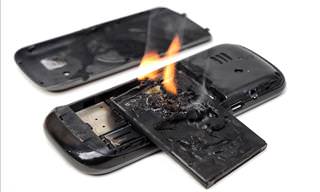
Phone Overheating? Use Our Guide to End The Problem!
Is your cell phone overheating? If so, read this handy guide, which will help pinpoint the source of the problem and offer a solution for fixing it.
5:50
Why Do We Sometimes Hallucinate? Find Out Here!
In this informative TED-Ed video, Elizabeth Cox details the science of hallucinations.
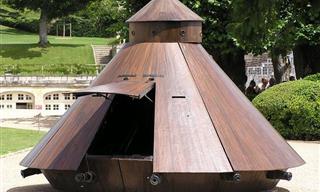
Six Inventions Da-Vinci Made Ahead of Their Time
He created and envisioned many inventions that were sometimes even centuries ahead of their time. Was there ever a genius as great as Da-Vinci?
4:20
Ever Wondered About How Our Minds Retain and Lose Memories?
Ever wondered why you can remember something from 20 years ago, but have difficulty remembering what you had for lunch the other day? Learn why here.
10:46
12 SUPER COOL Military Inventions You’ve Never Seen
Check out this list of amazing new military innovations. They will transform warfare in the near future!
8:48
Fascinating: What Around Us is Invisible?
The Invisible Things that Turn the World...
17 Incredible Eye Facts You Have To See To Believe
They say the eyes are the window to the soul, and they also happen to be our windows to the world. Here are 17 insanely fascinating facts about eyes.
4:26
Despite Looking Similar, Cats Are MORE Diverse Than Dogs!
Who's more diverse, cats or dogs? This video answers this question once and for all, the it might surprise you...
11:02
Ever Wonder What Ancient Egyptian Sounded Like?
Researchers have used all the information we know to create what they think it may have sounded like.
7 Air Pollution Solutions That Will Help Us Breathe Easy
Let's take a look at some global initiatives that have been launched to reduce air pollution levels.
Alzheimer's: What Recent Breakthroughs Have Taught Us
Now, you can discover 4 new studies that show how to do this in ways you haven’t heard of.
Anti-Aging Science in 2026: What's Real and What's Hype?
Here's an honest look at where anti-aging medicine stands in 2026 - the promising, the disappointing, and the surprisingly simple things that still beat almost everything in a pill bottle.
2:03:03
Full Documentary: From First to Last Dinosaur
With stunning visuals and cutting-edge science, we’ll bring their story to life—from their very first day to their last, a saga of survival, adaptation, and mystery.
Science History: 17 Math Equations that Changed the World
In this article, we'll journey through 17 of these monumental formulas, demystifying the symbols to reveal the revolutionary ideas they contain and the immense impact they have had on the course of history.
These Optical Illusions Will Shock Your Mind!
Optical illusions create miscommunication between our eyes and brain making, us see things that are not really there or not see things that are right in front of us. See for yourself.
7:56
These 6 Chemical Reactions Changed the Course of History
Although we rarely pay much attention to the chemistry that constantly surrounds us, these 6 reactions changed history.
Study Shows Seniors Still Grow New Brain Cells Daily
A new study shows that even the elderly keep on growing new brain cells, which could be the breakthrough the scientific community was waiting for...
Enjoy This Fascinating Collection of NASA's Best Photos
Here are 15 of NASA's most amazing recent pictures, along with brief explanations of exactly what is going on in each one.
Find Out How Some Elderly People Stay Sharp into Old Age
Some old people have better memories than people half their age. This could be the reason why...
5:56
What on Earth Is a Black Hole? This Video Explains All...
What on Earth are black holes, how do they affect us, and should we be at all worried about their existence? Find out here.
To enable your Ad-Free Subscription, please fill the fields below
Your subscription was successful, now you can enjoy an ad-free experience!! Note: To make sure you get no ads, please make sure to log in to your account. If you are logged in already, then refresh the page. The subscription can be cancelled at any time.