
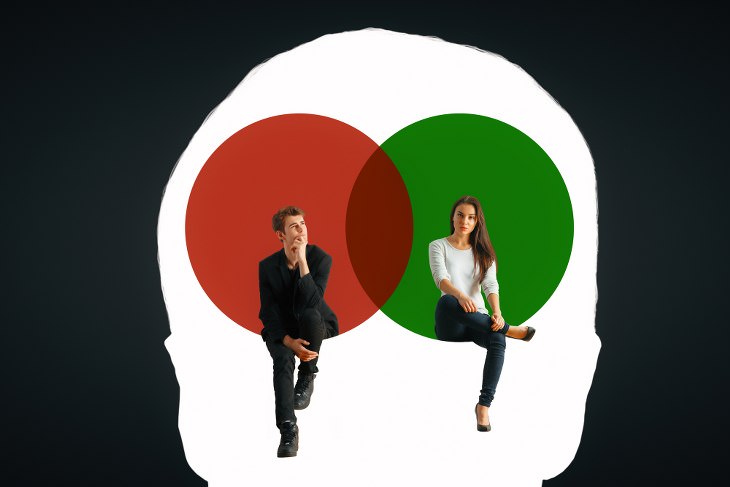
When it comes to the way they experience emotions, there appears to be a divide between men and women. Men are stereotypically seen as rational, level-headed thinkers, while women are often viewed as being more emotional. But are these assumptions entirely unfounded? Perhaps not completely.
A recent study, conducted by researchers at the University of Montreal and the Institut Universitaire en Santé Mentale de Montréal, has found that certain differences in brain functioning affect the way in which men and women respond to negative imagery.
The researchers drew their inspiration from the differences they observed in mental illness between the sexes. “Not everyone’s equal when it comes to mental illness,” said Adrianna Mendrek, one of the researchers. "Greater emotional reactivity in women may explain many things, such as their being twice as likely to suffer from depression and anxiety disorders to men.”
Earlier studies have also given credence to the theory that women and men react to emotional stimuli in different ways. Mendrek and her co-researchers had previously found that the limbic system (the brain's emotion and memory center) reacted differently for men and women, when participants were shown negative images. They decided to go a step further for this study, as they now chose to research whether hormonal levels affect this psychological processing, too.

There were 46 participants who took part in the study (25 female and 21 male), and the researchers ruled out potential contributing factors such as age, education, ethnicity, marital status, and socioeconomic status. Every volunteer was given a blood test at the start to assess their levels of testosterone and estrogen in order to see in what way they affected the results. They were then exposed to images that evoked positive, negative, or neutral emotions, while they underwent fMRI brain scans. Participants also had to review their emotional responses when looking at each image.
Overall, men seemed far less reactive to the emotional images than their female counterparts. Higher estrogen levels seemed to indicate increased sensitivity to the images, while higher testosterone levels appeared to make the subjects more desensitized.
When assessing the brain's reaction to the images, they discovered that the dorsomedial prefrontal cortex (dmPFC) and amygdala on the brain's right hemisphere were activated for both men and women. However, the connection between these two components was discovered to be more powerful in men, leading to the additional interaction between these two parts, and thus further decreased sensitivity to the stimuli.

The researchers explained that the reactions of the dmPFC and amygdala can tell us loads about how people process their emotions. The dmPFC is the part of the brain that helps process social interactions and mediates reasoning, emotions, and perception. The amygdala, on the other hand, is the part that is used to detect threats, and is often triggered when somebody experiences sadness or fear.
“A stronger connection between these areas in men suggests they have a more analytical than emotional approach when dealing with negative emotions,” said Stéphane Potvin, associate professor at the University of Montreal’s Department of Psychiatry. “It is possible that women tend to focus more on the feelings generated by these stimuli, when men remain somewhat ‘passive’ toward negative emotions, trying to analyze the stimuli and their impact.”
Mendrek's team believes that their study shows just how the male and female brains seem to function differently at a psychological level. “There are both biological and cultural factors that modulate our sensitivity to negative situations in terms of emotions,” Mendrek said. She concluded that the next step forward is to research exactly how hormones affect people's reactions to various types of emotions, such as sadness, fear, or anger.
Source
Images

The Musical Test That Could Detect Dementia Early
Researchers have developed a promising new approach: using music to detect the early signs of cognitive decline.
Can We PREVENT Type 1 Diabetes?
The study's findings point toward developing a simple blood test that could detect the immune failure leading to type 1 diabetes before insulin-producing cells are permanently lost.
Did This Woman Augment Her Memory Using Surgery?
A new study has opened the door to the possibility of creating memory-enhancing prostheses and implants following successful clinical trials. Read on for more.
This New Blood Pressure Drug Could Be a Game-Changer
Zilebesiran, an investigational drug that is showing profound success in late-stage clinical trials is offering hope for millions who struggle to keep their blood pressure in check.
This Study May One Day Help Treat Chronic Stress And PTSD
A recently discovered protein in the brain (p11) can be linked to both depression and stress and has the potential to help future treatments
New Study: There is a Sure Way to Slow Aging
This new study confirms what has long been suspected: The less calories we consume, the slower we age.
18:14
Are These Vintage Kitchen Gadgets Any Good?
Will any of the vintage kitchen gadgets stand the test of time or outperform their contemporary alternatives?
1:08
Boston Dynamics New Robot Can Move Almost Like a Human
Watch the latest in robotics in this video.
6 Signs That Someone is Listening on Your Cellphone Calls!
With technology advancing all the time, there is the ever-increasing chance of our phones being tapped. Here are 6 signs that your phone could be tapped.
15 Beautiful Carl Sagan Quotes on the Stars and the Cosmos
A look at some profound quotes on the universe by famous astronomer and cosmologist Carl Sagan.
Why It's So Hard to Get People to Change Their Stance
You feel that your knowledge is broader because you've read and researched a lot on the topic, but the other side still isn't convinced, even when you present facts and statistics. Why isn't that enough?
5:22
Why Do You See Colors When You Rub Your Eyes?
Explore the science of afterimages, the visual illusions that linger in your vision following exposure to bright lights or images.
10:50
Remarkable! This Is How the Universe Developed...
Watch this time lapse of the entire universe - starting with the big bang and culminating in the appearance of homo sapiens.
10:46
Neat Life Hacks To Help You Remember Things Better
A lot of us tend to forget the simplest things at times. This video provides some neat tips to help boost your memory.
1:44
You Won't Believe What the Human Body Does in One Minute
How much do you think it is capable of doing in a single minute? Watch this video and you'll have your answer!
The 12 Game-Changing Inventions From 2024 You Missed
2024 was a ground-breaking year in terms of innovation. Here's a look at some of the key breakthroughs from the year.
9:54
Neo: The New Tele-Robot that "Cleans" Your Home
Neo is a new robot that has great capabilities and is designed to clean your home. Sounds perfect right? Well, there's a catch.
What Your Phone Habits Say About Your Mental Health
These phone habits might indicate underlying anxiety—and paying attention to them could help you better understand your mental health.
2:39
Discover 5 Cutting Edge Humanoid Robots in 2025
Watch the video to see which robots are leading the pack in intelligence, mobility, and impact.
20 Peculiar Microscope Photos That You Really Must See
An unseen world exists at our fingers, and thanks to these wonderful micrographs, we can get a glimpse into that dimension.
9 Great NASA Inventions That Took the World By Storm!
For around six decades, NASA have been inventing top-notch products. Here are nine great examples!
PayPal Versus Credit Cards: Here's the Lowdown!
Just how safe is PayPal? Should you have a PayPal account or should you pay for all online purchases using a credit card? All is revealed here!
9:15
These Bizarre Mysteries Continue to Stump Scientists!
The world of science hasn't been able to explain several bizarre phenomenon yet. Let's take a look at a few of them.
5:14
Earth 2125: A Vision of the Future of Our Planet
Exploring what Earth could look like in 2125 reveals exciting potential.
10:30
China's Crazy Plan to Dig a Canal in the Middle of EUROPE
China is setting out a plan to dig a canal through the middle of Europe in the nearest future, but why?
56:12
What's the Largest Thing in the Universe?
In this video, we look into some of the mightiest structures in the known universe.
10 Declassified U.S. Military Secrets That'll Astound You
Government military secrets can range from amusing to absurd to downright terrifying, but they are all extremely intriguing. Here are 10 such secrets.
4:05
Kirobo: First Robot in Space!
It was one small step for robot and another giant leap for mankind...
20:04
Emotions Explained: The Science Behind How We Feel
Neuroscientist and psychologist Dr. Richard J. Davidson answers some fascinating questions about emotions you would never expect.
5:06
The Only Manmade Object That Will Last Forever
This copper discus contains 116 images we launched into space for aliens to see

4:20
Ever Wondered About How Our Minds Retain and Lose Memories?
Ever wondered why you can remember something from 20 years ago, but have difficulty remembering what you had for lunch the other day? Learn why here.
20:01
Future Tech: 19 Innovations About to Change Our World
These groundbreaking new technologies will change our world.

8 Important Inventions That Were a Complete Accident

It might be interesting for you to learn that some very important scientific innovations were born as a result of an accident.
11:15
These Paradoxes Continue to Mystify Scientists
Take a look at 7 scientific paradoxes that may never get solved.
4:52
Neon Lights: a Beautiful Union of Science and Art
Neon signs are a beautiful blend or artistry and science, and knowing the history and the science behind them make them even more exciting
1:48
Boston Dynamic's Robot Does Some Incredible Things...
Boston Dynamics shows us again what her lead robot can do.
Chronically Late? What Science Has to Say About You
There are 8 positive things that science says about late people that we all need to know.
9:09
Protective Measures: How Our Body Reacts to a Tattoo
In this video, we’ll explore the microscopic war raging beneath your skin, where millions of your cells make the ultimate sacrifice to lock that ink in place, turning a defense mechanism into lifelong art.
Study Says: With Age, Come Certain Cognitive Abilities
a study published in August 2021 in the journal *Nature Human Behavior reveals surprising findings that challenge this assumption and may be of great interest to all of us.
3:39
Magic is Only A Vibration Away With This Great Experiment
All it takes is some sand, a metal plate and carefully toned vibrations from a speaker to create stunning and complex patterns. This video shows you the amazing results!
5 Puzzling Mysteries That Science Finally Managed to Solve
These weird occurrences have puzzled humanity for decades, if not centuries. Finally, scientists solved them & the solutions are exciting...
Superwood: A New Material That Could Replace Steel
After decades of relying on steel—a material that produces nearly two tons of CO2 for every ton manufactured—builders may soon have access to something far more sustainable and surprisingly stronger: Superwood.
7:21
Science: 20 Mechanical Principles Demonstrated Using Lego
In this video, we'll explore a variety of fascinating mechanical mechanisms, all demonstrated using Lego models.
Alzheimer's: What Recent Breakthroughs Have Taught Us
Now, you can discover 4 new studies that show how to do this in ways you haven’t heard of.
8:28
Could These Signals Be A Sign of Extraterrestrial Life?
Scientists have recently picked up on a mysterious radio signal from space, and it could mean a lot - maybe even a sign from extraterrestrial life forms.
42:14
Physicist Michio Kaku: The Universe in a Nutshell...
Physicist Michio Kaku explains the fundamental nature of our universe
10 Obscure Inventions by World Famous Inventors
We’d like to bring your attention to 10 lesser-known inventions of famous figures in history, which will reveal a new and different side of these inventors to you.
To enable your Ad-Free Subscription, please fill the fields below
Your subscription was successful, now you can enjoy an ad-free experience!! Note: To make sure you get no ads, please make sure to log in to your account. If you are logged in already, then refresh the page. The subscription can be cancelled at any time.