
Here's a bit of news you probably weren't expecting to hear today: After more than 100 years of X-rays being flat and monochrome, they may very soon finally take the leap into the 21st Century and start being displayed as full-color 3D models.
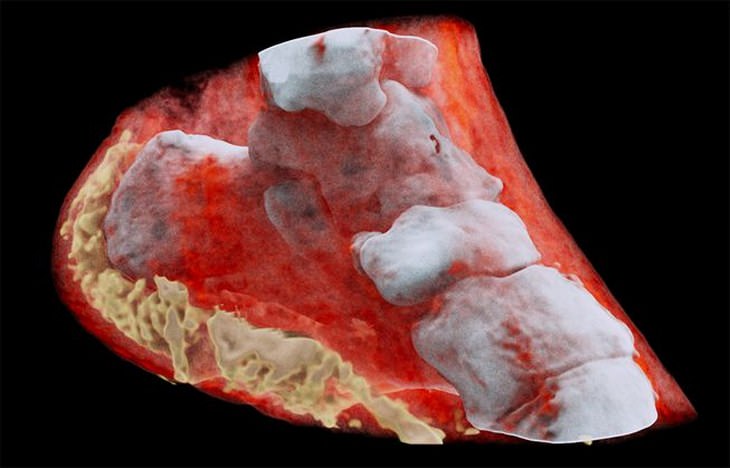
Phil and Anthony Butler, father and son scientists from the universities of New Zealand's Canterbury and Otago have created the world's first ever 3D color medical scanner. They named it the MARS spectral X-ray scanner, and it is able to capture internal images of both bone as well as all of its surrounding tissue.
According to Anthony Butler, "X-ray spectral information allows health professionals to measure the different components of body parts such as fat, water, calcium, and disease markers," and that "traditional black-and-white X-rays only allow measurement of the density and shape of an object."
As you can see from the video below, the scanner will also allow doctors to see the inner structure of a target area layer by layer:
Whereas regular X-rays use film or a sensor to record radiation levels, the MARS scanner actually measures the whole X-ray spectrum, and even goes as far as to detect and count the many particles as they collide with the pixels. This means that the MARS scanner works in a similar way to a camera, providing an HD image that is in color and fully 3D.
The technology used in the MARS scanner comes straight from CERN's Large Hadron Collider, which is the biggest and most powerful particle accelerator in the world. In fact, a chip which was designed for particle detection and imaging in the collider, known as Medipix3, was actually adapted by Phil and Anthony Butler's team so that it could be used in the MARS scanner.
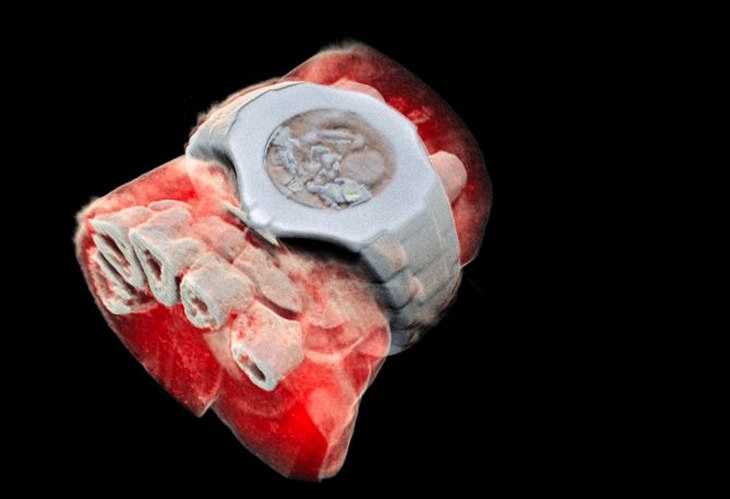
According to Phil Butler, "this technology sets the machine apart diagnostically because its small pixels and accurate energy resolution mean that this new imaging tool is able to get images that no other imaging tool can achieve."
While the MARS scanner has been under development for close to ten years, clinical trials have only begun very recently. However, all results so far are showing that the MARS scanner will very likely become one of the medical community's most indispensable tools in the near future.
"So far researchers have been using a small version of the MARS scanner to study cancer, bone, and joint health, and vascular diseases that cause heart attacks and strokes," Butler said. "In all of these studies, promising early results suggest that when spectral imaging is routinely used in clinics it will enable more accurate diagnosis and personalization of treatment."
Don't forget to share this exciting news with your friends and family, too!
Source: mnn
Images: marsbioimaging
Related Articles:
Bone Spurs: What They are and How to Treat Them

4:20
Do Cell Phones Affect Sperm Count? Find Out Here
Find out how much cell phone radiation can end up affecting men's reproductive health.
Discovery: Use of Blood Thinners May Prevent Dementia
A new study shows how blood-thinning drugs can help to prevent the onset of dementia. Find out how they work here.
Warning! Get Your Flu Shot Now Before It's Too Late...
Learn why you should get your flu shot while it's still pretty hot outside.
Researchers Have Managed to Actually Reverse Dementia...
Dementia doesn't yet have a cure, but the world is a step closer to having one after researchers managed to reverse the illness in mice. Read on to learn more.
5:47
Shocking! This Is What Chocolate Does to Your Arteries...
Can chocolate cause strokes? Find out in this informative video from Dr. Greger.
Not Only Covid-19: 5 Historically Significant Vaccines
Infectious diseases were a problem long before Covid-19. These are 5 of the most historically important vaccines that made the world safer.
Find Out How Some Elderly People Stay Sharp into Old Age
Some old people have better memories than people half their age. This could be the reason why...
A Quantum Leap? Revolutionary Technique Discovered
Scientists at Singapore University have developed a groundbreaking manufacturing method powered by artificial intelligence that may revolutionize how we understand and create quantum materials at the atomic level.
12 Bizarre Scientific Facts You Never Learned at School
The scientific facts we collected in this list aren't the kind of stuff you'll see in a school curriculum.
2:03:03
Full Documentary: From First to Last Dinosaur
With stunning visuals and cutting-edge science, we’ll bring their story to life—from their very first day to their last, a saga of survival, adaptation, and mystery.
8 Fascinating Heartbeat Facts You Never Knew Before
These heartbeat facts will leave you astounded.
TRIVIA: 25 Shocking Differences Between the Sexes
Did you know that there are some vast differences between the sexes? These 25 scientific facts will probably come as a big surprise to you, they did to me.
10:11
10 Smart Home Gadgets You Didn’t Know You Needed
If you’ve ever wanted a smarter, more efficient home, these 10 gadgets might be exactly what you need.
14:58
Why IS Fentanyl So Dangerously Addictive?
In this video, we break down what opioids really do to your brain and body, what using them actually feels like, and why so many people are dying from Fentanyl overdoses.
8 Ancient Greek Scholars & Their Life-Changing Inventions
The foundations of modern medicine, engineering, biology, and astronomy were set up by these 8 stellar minds more than two thousand years ago.
20:04
Emotions Explained: The Science Behind How We Feel
Neuroscientist and psychologist Dr. Richard J. Davidson answers some fascinating questions about emotions you would never expect.
Whoa! Who Knew the Human Body Was Capable of So Much?
Have a look at these 17 intriguing facts about the human body that we can practically guarantee will leave you in awe.
1:08
Boston Dynamics New Robot Can Move Almost Like a Human
Watch the latest in robotics in this video.
11:05
Science: Can AI Preserve Our Most Precious Memories?
Technologist Pau Aleikum Garcia talks about synthetic memories.
5:06
The Only Manmade Object That Will Last Forever
This copper discus contains 116 images we launched into space for aliens to see
The Most Remarkable Medical Breakthroughs of 2024
Here’s a look at some breakthroughs in medical innovation this year.
9:13
Want to Travel Quickly Through Space? Try Using a Wormhole
If you want to know what a wormhole is and how it is supposed to work, then you've come to the right place!
10:30
China's Crazy Plan to Dig a Canal in the Middle of EUROPE
China is setting out a plan to dig a canal through the middle of Europe in the nearest future, but why?
6:25
Do You Like the Smell of Rain? This Is Why
One of the best things about rain and thunderstorms is that clean fresh smell afterward. But what actually causes that distinct scent?
5:01
The Truth About Folding Phones You Need to Know
Don’t buy a foldable without knowing this first.
7 Air Pollution Solutions That Will Help Us Breathe Easy
Let's take a look at some global initiatives that have been launched to reduce air pollution levels.
10 Declassified U.S. Military Secrets That'll Astound You
Government military secrets can range from amusing to absurd to downright terrifying, but they are all extremely intriguing. Here are 10 such secrets.
8:46
Science: What is Reality? Dive in and Find Out!
What if everything you see, feel, and experience isn’t real? The simulation argument suggests that our reality might be nothing more than an advanced computer program.
Nobody Believed These 5 Scientists, But They Were Right
These 5 scientists were shamed and ousted, or rudely ignored, although years later, their "crazy" theories turned out to be true...
22:35
Neuralink Update 2025: The Most Incredible Moments
Welcome to our 2025 Neuralink update, where we’ll take you through the most incredible and groundbreaking moments from the past year.
13 Forgotten Phone Designs That Were Too Odd to Survive
From pen-shaped dialers to phones that clipped onto your clothes, here’s a look at the most unusual phones ever made.
13:21
The Race to Complete the World's Second-Tallest Skyscraper
Malaysia is all set to unveil the world’s second tallest skyscraper.
7 Discoveries of Albert Einstein that Changed the World
The 7 biggest discoveries of Albert Einstein and how they changed the world forever.
Study Says: With Age, Come Certain Cognitive Abilities
a study published in August 2021 in the journal *Nature Human Behavior reveals surprising findings that challenge this assumption and may be of great interest to all of us.
Why It's So Hard to Get People to Change Their Stance
You feel that your knowledge is broader because you've read and researched a lot on the topic, but the other side still isn't convinced, even when you present facts and statistics. Why isn't that enough?
The 12 Game-Changing Inventions From 2024 You Missed
2024 was a ground-breaking year in terms of innovation. Here's a look at some of the key breakthroughs from the year.
14 Retro Inventions That Stunned Crowds Back in the Day
These inventions were the talk of the town back in the day.
Do You Have One Of These RARE Genetic Traits?
How unique are you? You might have several rare genetic traits that make you unlike most of the world's population!
Alzheimer's: What Recent Breakthroughs Have Taught Us
Now, you can discover 4 new studies that show how to do this in ways you haven’t heard of.
8:19
You Won't Believe What Passes for a Phone in North Korea
You won't believe what phones look like in North Korea!
20 Peculiar Microscope Photos That You Really Must See
An unseen world exists at our fingers, and thanks to these wonderful micrographs, we can get a glimpse into that dimension.
4:52
Neon Lights: a Beautiful Union of Science and Art
Neon signs are a beautiful blend or artistry and science, and knowing the history and the science behind them make them even more exciting


3:55
50 Years Later, We're Debunking the Moon Landing "Hoax"
How do we prove to people the moon landing was real? By answering their doubtful questions in this video.
34:33
Is China Number 1 in Global Technology?
In this video, we’ll take a closer look at the new developments hitting the market — and what they could mean for the future of transportation.
16:26
Neanderthals Had Strength and Skills Beyond Our Limits
Neanderthals possessed truly exceptional, almost unbelievable, traits.
5:22
Why Do You See Colors When You Rub Your Eyes?
Explore the science of afterimages, the visual illusions that linger in your vision following exposure to bright lights or images.
22:52
Will AI Take Your Jobs? An Expert Explains the Future
Gonzaga University's AI professor Graham Morehead some of our most pertinent questions related to AI.
To enable your Ad-Free Subscription, please fill the fields below
Your subscription was successful, now you can enjoy an ad-free experience!! Note: To make sure you get no ads, please make sure to log in to your account. If you are logged in already, then refresh the page. The subscription can be cancelled at any time.