

The construction industry stands on the brink of a materials revolution. After decades of relying on steel—a material that produces nearly two tons of CO2 for every ton manufactured—builders may soon have access to something far more sustainable and surprisingly stronger: Superwood.
Developed at the University of Maryland by Dr. Liangbing Hu, Superwood represents a fundamental reimagining of what wood can be. This isn't simply treated lumber—it's ordinary wood transformed at the molecular level into a material that boasts 50% greater tensile strength than steel while maintaining a strength-to-weight ratio that's 10 times superior.
The journey began in 2016 when Dr. Hu was working on transparent wood as a glass alternative. His research evolved, leading to a 2018 Nature paper that documented a breakthrough method for transforming regular wood into a substance rivaling titanium alloys. What started as academic curiosity has now become a commercial reality through InventWood, the startup founded to bring this technology to market.
Creating Superwood requires a precisely controlled two-step process that fundamentally alters wood's structure. First, lignin—the polymer that gives wood its brown color and stiffness—is partially dissolved using food-grade chemicals. The key lies in removing just enough lignin to maximize hydrogen bonding between cellulose fibers without compromising structural integrity.
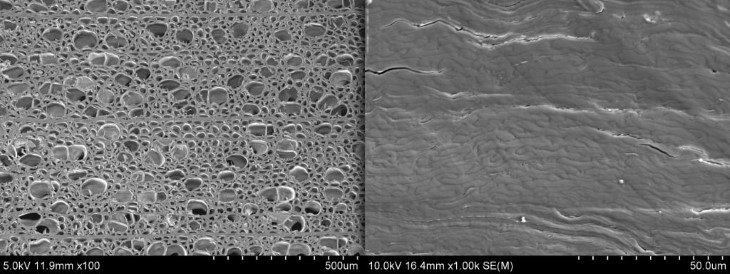
Magnified images show (left) untreated wood and (right) the same wood after a new process developed by UMD engineers. This process compresses the wood’s natural structure into a material that is five times thinner. [Images: courtesy University of Maryland]
Next comes compression. The wood is heated to 150°F and compressed, collapsing its cellular structure into a dense matrix. This transformation creates a material five times thinner than the original wood, yet 12 times stronger and 10 times tougher. The molecular reconfiguration eliminates wood's traditional weaknesses: its porous nature disappears, creating a barrier against moisture, termites, and fungi.
Watch this video to Learn more about how superwood is made and the tests it has been through.
Perhaps most remarkably, Superwood achieves a Class A fire rating without chemical flame retardants. Its density naturally starves flames of oxygen, making it inherently fire-resistant. Ballistic tests demonstrate its durability—projectiles that pierce untreated wood lodge only halfway through same-thickness Superwood blocks.
What initially took weeks to produce in small quantities has been streamlined to just hours, enabling bulk manufacturing. InventWood's first facility in Frederick, Maryland, will produce one million square feet of Superwood annually starting this summer, focusing initially on interior finishes for commercial and high-end residential projects.
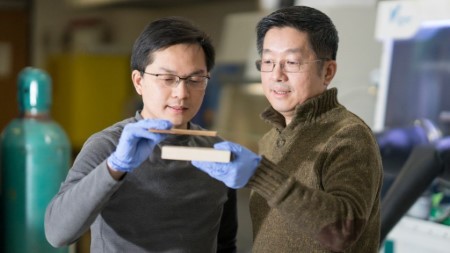
Liangbing Hu (left) holds a block of wood transformed by a new process to become stronger than rivals titanium & tougher than steel.
Teng Li (right) holds an untreated block of the same wood. [Photo: courtesy University of Maryland]
The rollout plan is methodical. Fall 2025 will introduce exterior-grade panels for siding and roofing, with structural beams and columns planned for future years pending certification. The company envisions scaling to over 30 million square feet of production capacity, enabling use in infrastructure and large developments.
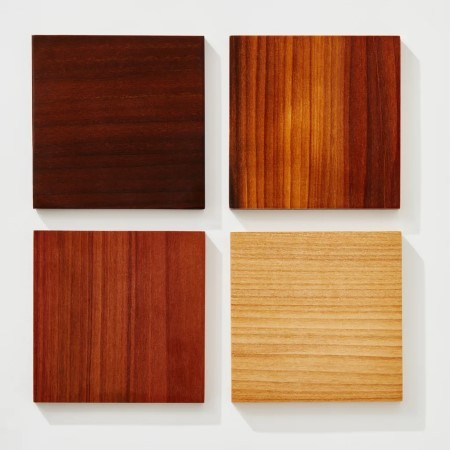
For contractors and architects, Superwood presents an intriguing proposition. Despite its superior strength, it can be cut, drilled, and fastened with standard woodworking tools, though its density may require adjusted techniques. The material's stability minimizes warping, and polymer coatings enable outdoor use while preserving aesthetics. Its compressed fibers actually enhance natural grain patterns, creating finishes comparable to tropical hardwoods.
Initially, Superwood will command premium pricing competitive with high-end tropical hardwoods and hybrid composite materials—roughly $12.50 to $25 per pound compared to steel's $1 to $2 per pound. However, this comparison oversimplifies the true cost equation.
Given Superwood's 10-to-1 strength-to-weight advantage, a 10-pound beam could theoretically match the load-bearing capacity of a 100-pound steel beam, effectively reducing its performance-adjusted cost to $1.25 to $2.50 per pound. Factor in its resistance to corrosion and rot, plus the potential to eliminate other structural elements and wall materials, and the economics become increasingly compelling.
Beyond performance metrics, Superwood offers significant environmental advantages. Unlike steel production, which generates massive CO2 emissions, Superwood actually sequesters carbon—it's made from wood sourced from sustainable tree farms. The material requires no energy-intensive smelting or synthetic resins, and its natural fire resistance eliminates the need for chemical flame retardants.
While early research suggested applications in vehicles, aircraft, and furniture, InventWood is focusing on construction, where steel and concrete account for enormous carbon footprints. The company's vision extends beyond material substitution to fundamental transformation of how buildings are constructed.
As the first commercial batches prepare for summer release, Superwood represents more than just another building material—it's a glimpse of sustainable construction's future. Whether it truly revolutionizes the industry remains to be seen, but its potential to reduce both environmental impact and construction costs while improving performance makes it one of the most promising materials innovations in decades.
The construction industry's relationship with materials is about to change dramatically, and Superwood may well be leading that transformation.