When we picture someone overcome by heat, we tend to imagine a hiker on a blazing trail or a worker on a sun-baked rooftop. Yet a great many cases of heat illness happen somewhere far more familiar: indoors, at home, to people who never set foot outside all day. A stuffy apartment with the windows shut, a house without air conditioning, an afternoon spent quietly in a warm room, and the body can slowly become overwhelmed without any dramatic warning.
Heat exhaustion is the body's way of raising a hand and saying it can no longer keep itself cool. The encouraging news is that it announces itself with clear signals, and when you catch them early and respond, the person almost always recovers fully. The danger lies in missing those signals, because heat exhaustion can progress to heat stroke, which is a true medical emergency. Here is how to recognize the warning signs in yourself and in the people you love, and exactly what to do.
Why It Can Happen Indoors, and Why Age Matters
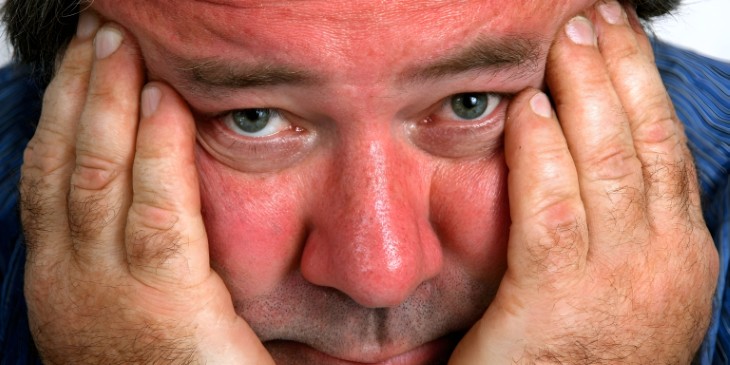
Our bodies handle heat less efficiently as the years go by. We sweat less readily, our circulation adjusts more slowly, and, importantly, our sense of thirst fades. That last point catches many people out. An older adult can be genuinely dehydrated without ever feeling thirsty, which means waiting until you want a drink is no longer a reliable guide.
Several other things quietly raise the risk, and most of them are common in any household:
- Certain medications. A number of everyday prescriptions interfere with how well the body cools itself or holds onto fluid, including water pills, some blood pressure medicines, certain antihistamines for allergies, and drugs for an overactive bladder. This is well worth a brief chat with your doctor before summer sets in.
- Chronic conditions, particularly heart, lung, and kidney problems, which make it harder for the body to cope with heat.
- A home that holds heat. Upper floors, rooms without cross-ventilation, and closed-up houses can grow far hotter than the temperature outside suggests, especially in a long spell of hot weather.
- Living alone, which is perhaps the biggest risk of all, because there is no one nearby to notice a person becoming confused or unwell.
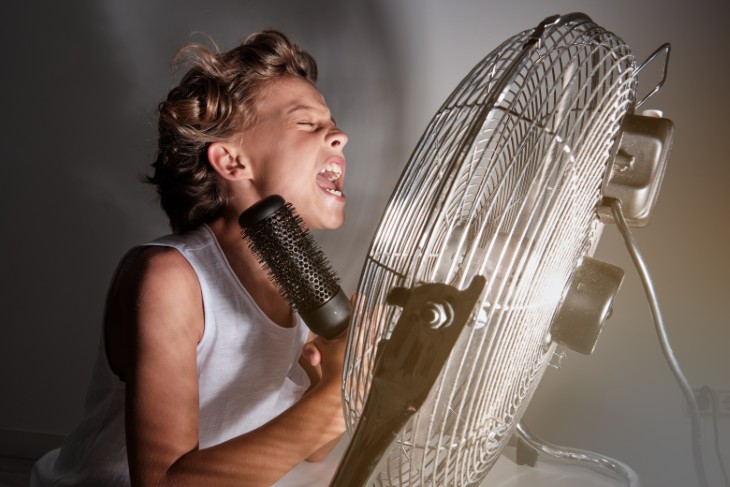
Heat exhaustion also tends to creep up gradually, sometimes building over several days of hot weather rather than striking all at once. That slow arrival is exactly what makes it easy to dismiss as simply feeling a bit off.
The Early Signs
Before the clearer signs appear, the body usually offers a few gentle hints. These are easy to shrug off, but they are worth treating as a cue to cool down and drink something:
- Feeling unusually tired, sluggish, or drained for no obvious reason.
- A headache settling in.
- Feeling slightly dizzy or unsteady when standing up.
- Muscle cramps, often in the legs, arms, or stomach.
- Dark yellow urine, or simply not needing the bathroom as often as usual, both signs of dehydration.
- A general sense of being irritable or "not quite yourself."
The Clear Warning Signs of Heat Exhaustion
When heat exhaustion has taken hold, the signs become more definite. You may notice several of these together:
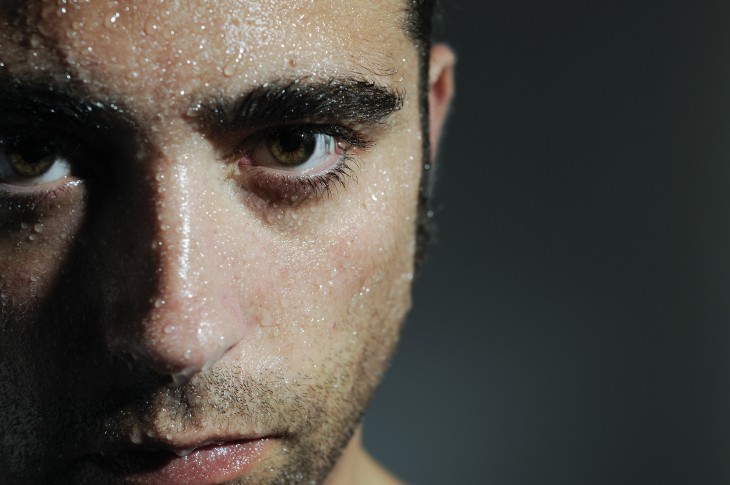
- Heavy sweating, often more than the situation seems to call for.
- Skin that is pale, cool, and clammy to the touch, and sometimes goosebumps despite the heat. This surprises people, since we expect an overheated person to feel hot. In heat exhaustion, the skin often feels cold and damp.
- Dizziness, lightheadedness, or feeling faint, especially on standing.
- Weakness and tiredness out of all proportion to the day.
- Nausea or vomiting.
- Headache.
- Muscle cramps.
- A fast, weak pulse, and breathing that is quick and shallow.
- Feeling clumsy or uncoordinated, or simply moving unsteadily.
- Intense thirst, though remember this may be absent in older adults.
One useful detail: in heat exhaustion, body temperature may still read normal or only slightly raised. So a normal thermometer reading does not mean all is well. Trust the collection of symptoms rather than the number.
What to Do Right Away
If you or someone at home shows these signs, act promptly. Most people recover well with simple, immediate care:
- Get to a cooler place. Move to an air-conditioned room if you have one, or the coolest, shadiest part of the house. Put on a fan.
- Stop what you are doing and lie down, with the feet raised slightly if that is comfortable.
- Loosen or remove heavy clothing.
- Sip cool water slowly. Small, steady sips are better than gulping. Avoid alcohol and very sugary drinks, and skip caffeine.
- Cool the skin. Apply cool, wet cloths to the neck, armpits, forehead, and wrists, sponge the skin with cool water, or take a cool shower or bath if the person is steady enough to do so safely.
- Stay with the person and keep watching. Improvement should begin within about half an hour.
When to Call for Medical Help
Call a doctor or seek medical care if:
- The symptoms do not begin to improve within about 30 minutes to an hour of cooling and drinking.
- The person is vomiting and cannot keep fluids down.
- The symptoms are getting worse rather than better.
- The person has heart, kidney, or other serious health conditions, or takes medications that affect fluid balance. In these cases it is wise to seek advice sooner rather than later.
The Signs That Mean Emergency: Heat Stroke
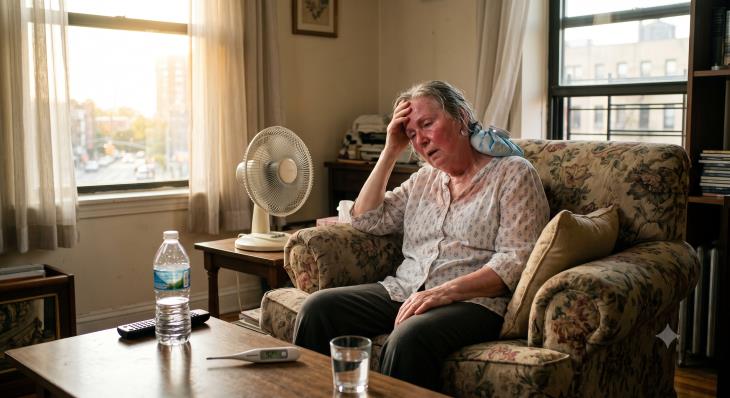
This is the most important section of the article. If heat exhaustion is not addressed, it can tip into heat stroke, where the body's cooling system fails completely. Heat stroke can damage the brain and other organs within minutes, and it can be fatal. It is a medical emergency, every single time.
Call emergency services immediately if you see any of the following:
- Confusion, disorientation, slurred speech, or strange behavior. Any sudden change in how someone is thinking or acting during hot weather should be treated as an emergency. This is often the very first and most telling sign.
- Skin that is hot, red, and dry, with sweating that has stopped. When an overheated person stops sweating, the body has lost its ability to cool itself. Note that in some cases the skin may still be damp, so do not wait for dryness to act.
- A very high body temperature, around 104 degrees Fahrenheit (40 degrees Celsius) or above.
- Fainting or loss of consciousness, or difficulty staying awake.
- Severe headache, along with rapid breathing and a strong, pounding pulse, or in some cases a slow and weak one.
- Seizures.
While waiting for help to arrive, move the person to the coolest place available, remove excess clothing, and cool them as quickly as you can with cool wet cloths, a sponge bath, or a fan. There is one crucial exception to the usual advice: do not give anything to drink to someone who is confused, drowsy, or unconscious, as they may choke.
Keeping an Eye on Someone Else
One of the cruel features of serious heat illness is that the affected person is often the last to realize something is wrong, precisely because it clouds their thinking. That is why checking on others matters so much. If you have an older neighbor, parent, or friend living alone, make a habit of calling or dropping by during hot spells, ideally twice a day.
When you do, listen for the things a person may not report themselves: confusion, unusual drowsiness, slurred or muddled speech, or simply not sounding like themselves. Notice whether the house feels stiflingly hot, whether the fans and air conditioning are actually switched on, and whether there is cool water within easy reach. Ask a friend or relative to check on you in the same way. It is a small arrangement that has saved a great many lives.
Staying Ahead of It
Prevention is far easier than treatment. A few sensible habits go a long way through a hot spell:
- Drink before you are thirsty. Keep water within reach and sip through the day, since thirst is not a reliable signal as we age.
- Close up the house in daytime. Draw curtains and blinds against the sun, and open windows in the cool of the evening and early morning.
- Find cool air somewhere. If your home has no air conditioning, spending even a couple of hours in a cooled place such as a library, shopping center, community center, or a relative's home makes a real difference.
- Save exertion for the cooler hours, and rest during the hottest part of the afternoon.
- Dress lightly in loose, light-colored clothing, and use a cool shower or damp cloth to bring your temperature down.
- Go easy on alcohol and caffeine, both of which work against you in the heat.
- Ask your doctor about your medications before the hot season, to learn whether any of them raise your risk.
Do Not Forget the Pets
Our animals are at least as vulnerable to heat as we are, and often more so. They cannot sweat the way we do. A dog cools itself mainly by panting, a cat by grooming so that saliva evaporates from its fur, and a bird by panting and holding its wings away from its body. Every one of these methods fails once the heat becomes too much. Pets also cannot open a window, pour themselves a drink, or tell you they are struggling, which makes your eyes and your judgment their only real protection.
It is worth remembering that pets overheat indoors too, particularly in a closed room, a sunny conservatory, or a crate with poor airflow. Caged animals are in the greatest danger of all, because they cannot simply walk away to a cooler spot. A cage or glass tank sitting in a patch of afternoon sun becomes a heat trap within minutes.
Some animals are at much greater risk than others: flat-faced breeds such as bulldogs, pugs, French bulldogs, boxers, Boston terriers, and Persian cats, whose narrow airways make cooling far harder, along with elderly pets, very young ones, those carrying extra weight, thick-coated breeds, and any animal with heart or breathing problems. Small pets and birds are especially fragile, because their little bodies heat up remarkably quickly and they can go downhill in a very short time.
Warning Signs in Dogs
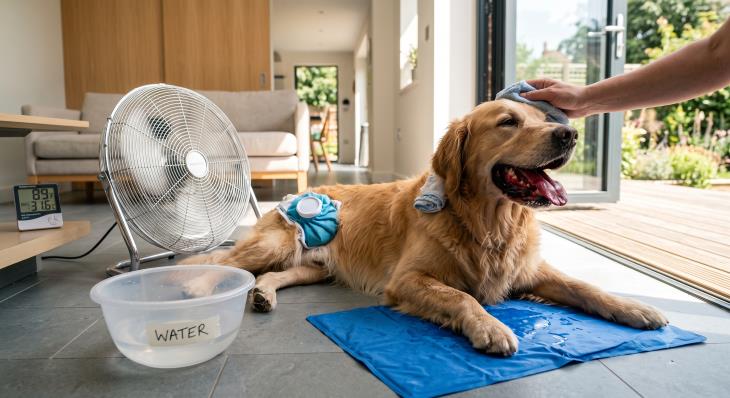
Dogs usually show their distress fairly openly, which is a small mercy. Watch for:
- Heavy, frantic panting that does not let up. Ordinary panting is normal, but panting that is rapid and continuous, with no pauses, is a warning.
- Heavy drooling, often thicker and stickier than usual.
- Bright red gums and tongue, which may later turn pale or bluish. Checking the gums is one of the quickest ways to judge how a dog is faring.
- Restlessness and pacing, or anxiously seeking out water, shade, or cool surfaces like tile.
- Weakness, lethargy, or reluctance to get up and move about.
- Stumbling, wobbling, or an unsteady, drunken-looking walk.
- Vomiting or diarrhea, sometimes with blood in serious cases.
- A rapid heartbeat, and a dry nose or sunken eyes, both signs of dehydration.
- Glazed eyes, confusion, or not responding to you as usual.
- Collapse, seizures, or unconsciousness, which mean a dire emergency.
Warning Signs in Cats
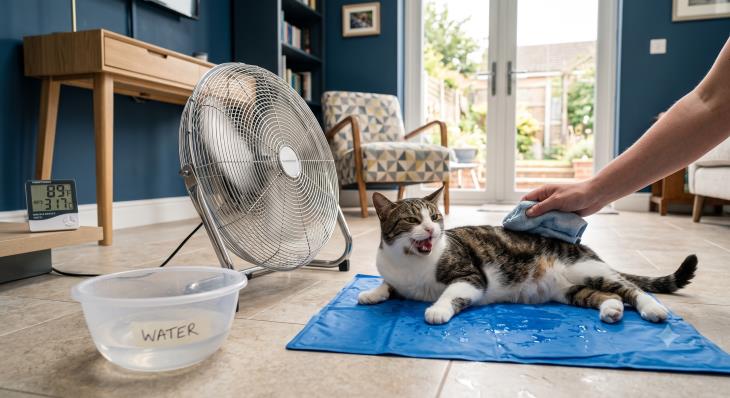
Cats are a different matter entirely, because they are experts at hiding illness. Their signs are quieter and easier to miss, so they call for closer attention. Watch for:
- Panting or open-mouthed breathing. This is the single most important sign to know. Unlike in dogs, a panting cat is never normal. A cat breathing with its mouth open is already in trouble and needs help immediately.
- Drooling, which is likewise unusual in cats and a genuine warning sign.
- Grooming far more than usual, as the cat tries desperately to cool itself.
- Seeking out cool surfaces, sprawling on tile, in the sink, or in the bathtub, or pressing against cool walls.
- Restlessness and agitation, or the opposite, hiding away in an unusual spot.
- Lethargy and little interest in food, play, or company.
- Bright red or unusually pale gums.
- Vomiting, stumbling, or an unsteady walk.
- Collapse or unresponsiveness, which is an emergency.
Warning Signs in Birds
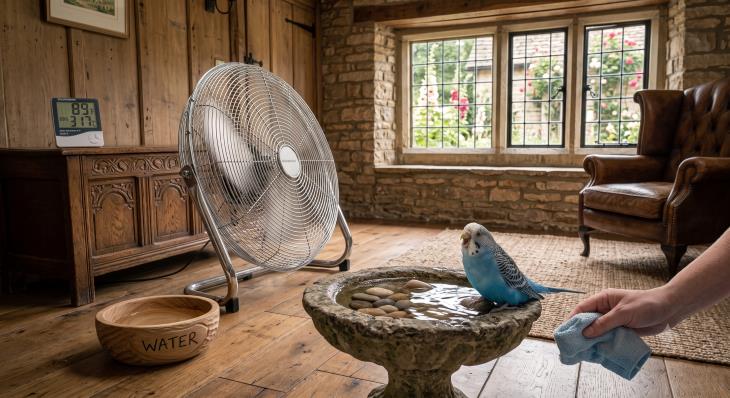
Birds are delicate creatures with sensitive breathing systems, and a small bird in trouble can decline alarmingly fast. Because they instinctively hide weakness, any visible sign should be taken seriously. Watch for:
- Open-beak breathing or panting. A bird breathing through an open beak is working hard to cool itself and is already under strain.
- Wings held away from the body, lifted and spread slightly to let heat escape. This is one of the clearest early signals.
- Rapid or heavy breathing, sometimes with a bobbing tail as the bird works to draw air.
- Sitting low on the perch, hunched and unusually still.
- Sitting on the floor of the cage, or falling from the perch. Either is always a serious concern.
- Sudden quietness, with a talkative or singing bird going silent and listless.
- Loss of interest in food, and a droopy, unresponsive posture.
- Collapse or seizures, which mean an immediate emergency.
If a bird's breathing looks at all abnormal, contact an avian veterinarian urgently. Birds rarely give you much time.
Warning Signs in Hamsters, Mice, and Other Small Pets
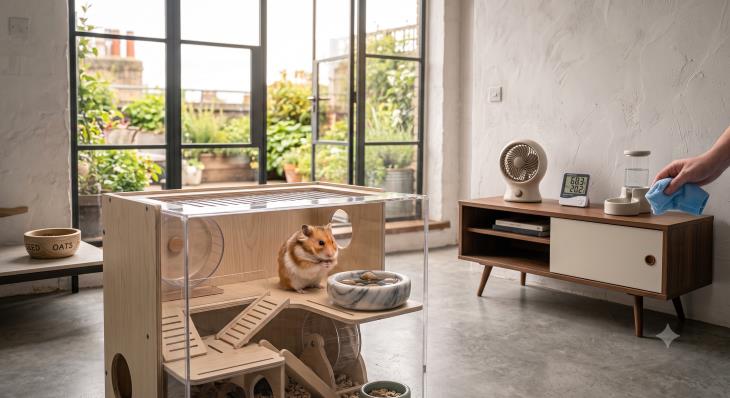
Hamsters, mice, rats, gerbils, guinea pigs, and rabbits are among the most heat-sensitive pets of all. Their small bodies gain heat quickly, and their cages, especially plastic modules and glass tanks, hold that heat like an oven. Most are happiest somewhere around 65 to 75 degrees Fahrenheit (18 to 24 degrees Celsius), cooler than many of us keep our homes in summer. Watch for:
- Lying stretched out and unusually still, flat against the floor of the cage rather than curled up in the normal way.
- Weakness and lethargy, or a general limpness and lack of response when you approach.
- Rapid, shallow breathing, or visible effort to breathe.
- Drooling or a wet chin, which is not normal in these animals.
- Trembling or twitching, particularly when touched.
- Refusing food and water, or a sudden lack of interest in the wheel and usual activity.
- Collapse, seizures, or unresponsiveness, which are grave emergencies.
Hamster keepers should know one particular warning. Heat stroke in hamsters is sometimes nicknamed sleeper disease, because the animal can appear lifeless and floppy, as though deeply asleep or even dead. It is easy to mistake for hibernation or a peaceful nap. If you find your hamster limp and unresponsive on a hot day, treat it as an emergency and act at once rather than assuming it is simply sleeping.
What to Do for an Overheated Pet
The first-aid steps are the same for dogs and cats, and speed matters:
- Move them somewhere cool at once, ideally an air-conditioned room or in front of a fan, and out of the sun at the very least.
- Cool them with cool water, never ice-cold. Pour or sponge it over the back, belly, inner thighs, paws, and behind the ears. Very cold water can constrict the blood vessels and actually slow the cooling down.
- Never place ice packs directly against the skin. Wrap them in a towel first.
- Offer small sips of cool water, but never force an animal to drink, and give nothing at all to a pet that is unconscious or barely responsive.
- Call your veterinarian and go, even if your pet seems to be recovering. This is the part people skip, and it matters enormously. Overheating can cause internal organ damage that is not visible from the outside, so a pet that appears to bounce back still needs to be checked over.
For reference, a body temperature above about 104 degrees Fahrenheit (40 degrees Celsius) in a dog or cat means heat stroke, and that is a race against the clock.
Birds and small pets need a gentler hand. These little animals can be harmed by sudden cooling, so never plunge or soak them in water. Instead, move the cage at once to the coolest, shadiest, best-ventilated room you have. For a bird, mist it lightly with cool water and offer a shallow dish for bathing, but do not aim a fan directly at it, as a strong draft does more harm than good. For a hamster, mouse, or other small pet, offer a cool ceramic tile to lie on, place a frozen water bottle wrapped in a towel beside the cage rather than in contact with the animal, and lightly dampen the fur with cool water if it is very hot. Provide fresh cool drinking water for all of them, and handle them as little as possible, since being picked up adds stress. Then call a veterinarian, ideally one who treats birds or exotic pets, straight away. With animals this small, hours matter.
Prevention is simpler still. Keep fresh water available in several places, provide shade and good airflow, and keep cages, hutches, and tanks well out of direct sunlight, moving them to the coolest room of the house during a hot spell. Walk dogs in the cool of the early morning or evening rather than the heat of the day, avoid handling small pets during the hottest hours, and never, ever leave a pet in a parked car, even briefly and even with the windows cracked, since the inside of a car can climb dozens of degrees above the outdoor temperature within minutes.