
A paralyzed man has successfully tested a robotic hand that was wired directly into his brain, allowing to him to “feel” once again. The robotic hand was developed by John Hopkins University’s Applied Physics Laboratory, and forms part of a Defense Advanced Research Projects Agency (DARPA) research project.
The man that successfully tested the robotic hand is 28 years old, and has suffered from paralysis for over a decade after sustaining a spinal cord injury. Electrodes from the hand were inserted into his brain’s sensory and motor cortexes, which allowed him to control it with thought, as well as sense when its fingers were being touched individually.
Sensors embedded into the robotic hand are able to detect any pressure applied to the fingers, which in turn create electronic signals that mimic touch sensations. To see how well this was working, researchers blindfolded the man, and a touch test determined that he was able to determine which finger was being touched with almost 100% accuracy.
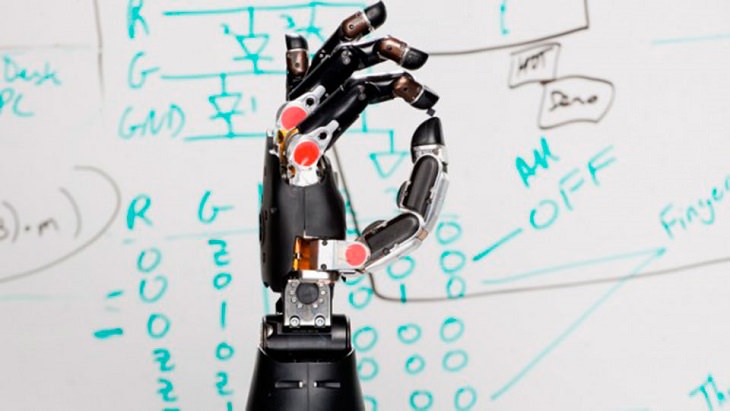
The researchers also tricked the man by pressing two fingers simultaneously. This elicited a response from him – he asked if he was being tricked. At this point, researchers knew with certainty that what the man was feeling were near-natural sensations.
Similar developments in the area of prosthetic limbs are progressing rapidly, however providing the level of control needed to perform precise movements is proving difficult. This is because they lack feedback from signals traveling back to the brain.
The potential for seamless biotechnological restoration has been amply displayed by this research, and it has been achieved by wiring a sense of touch from a mechanical hand directly into the brain.
As a result, it's hoped that those who have lost limbs will not only be able to benefit from fully-functioning replacement limbs, but also be able to regain a level of control over them that can only be achieved with sensation.
Watch the video of this amazing technological advancement below:
Content Source: The Guardian

Science FIRST: A Fully Created Brain Inside a Computer?
Could a Computer Ever "Run" a Human Brain? Scientists Just Took a Big Step
These Bacteria Can Turn Toxic Metal Compounds Into Gold
Scientists have discovered the process that a bacteria uses to change toxic metals into gold nanoparticles. Discover the amazing findings here.
The Musical Test That Could Detect Dementia Early
Researchers have developed a promising new approach: using music to detect the early signs of cognitive decline.
4:51
Watch These Chinese Robots Amaze the World
In this video, you're going to see just how far these robots can go, as they've been programmed with some truly amazing dance moves,
New Research Shows Eating Sweets Won't Make You Crave More
A groundbreaking new study challenges conventional wisdom, suggesting our preference for sweet tastes may be more stable than we think.
11 Technologies to Potentially Achieving Immortality
Scientists are hard at work developing technologies that could extend our lifespans and even make us immortal. Here are 11 of them.
2:56
Watch as a Fun-Filled Day of Balloons Turns to Disaster!
The 1986 Cleveland Balloon Festival was meant to be a truly joyous occasion but instead quickly turned into a grave tragedy
22:52
Will AI Take Your Jobs? An Expert Explains the Future
Gonzaga University's AI professor Graham Morehead some of our most pertinent questions related to AI.
I Bet You Didn't Have a Clue About These Human Body Facts!
The human body is the most complex machine known to mankind, but I bet you don't know these 10 amazing facts about it...
22:35
Neuralink Update 2025: The Most Incredible Moments
Welcome to our 2025 Neuralink update, where we’ll take you through the most incredible and groundbreaking moments from the past year.
Is Microsoft's "AI Doctor" Better Than a Real Doctor?
A new study presents a committee of digital doctors achieving approximately 80% accuracy in complex medical diagnoses – far beyond the average of general practitioners.
1:14:42
Documentary: How Did Our Universe Come From Nothing?
Can “nothing” truly become “something”? In this video, we’ll dig into this mind-bending question.
14:58
Why IS Fentanyl So Dangerously Addictive?
In this video, we break down what opioids really do to your brain and body, what using them actually feels like, and why so many people are dying from Fentanyl overdoses.
Science: Can Plants That Come Back From the Dead Save Us?
These extraordinary organisms may hold the key to solving one of the world's most urgent problems: feeding a growing population on a warming, drying planet.
Six Inventions Da-Vinci Made Ahead of Their Time
He created and envisioned many inventions that were sometimes even centuries ahead of their time. Was there ever a genius as great as Da-Vinci?
6 Signs That Someone is Listening on Your Cellphone Calls!
With technology advancing all the time, there is the ever-increasing chance of our phones being tapped. Here are 6 signs that your phone could be tapped.
Here Are the 16 Oldest Household Objects in the World
If you think ancient life is remote, these pre-historic household items will make you think again. Just look at how old they are!
Study Shows Seniors Still Grow New Brain Cells Daily
A new study shows that even the elderly keep on growing new brain cells, which could be the breakthrough the scientific community was waiting for...
2:03:03
Full Documentary: From First to Last Dinosaur
With stunning visuals and cutting-edge science, we’ll bring their story to life—from their very first day to their last, a saga of survival, adaptation, and mystery.
Enjoy This Fascinating Collection of NASA's Best Photos
Here are 15 of NASA's most amazing recent pictures, along with brief explanations of exactly what is going on in each one.
11:43
Learn While Laughing: The Incredible Tardigrade
If you love nature and you love laughing, this incredible series of nature videos are a great way to spend a few minutes.
4:20
Ever Wondered About How Our Minds Retain and Lose Memories?
Ever wondered why you can remember something from 20 years ago, but have difficulty remembering what you had for lunch the other day? Learn why here.
34:33
Is China Number 1 in Global Technology?
In this video, we’ll take a closer look at the new developments hitting the market — and what they could mean for the future of transportation.
These Underwater Craft Are Changing Marine Science
Here's a look at the most remarkable machines currently expanding our understanding of the underwater world.
Could This Popular Ingredient Be a Cause of Cancer?
The chemical triclosan began to appear in a multitude of products in the early 1970s. This ingredient, found in a multitude of products has been linked to cancer.
33:02
The Entire Story of Earth in 30 Minutes!
The story of our planet, from birth to the adult, ancient planet we see before us today - all in just half an hour.
The Wildest Meteorites Ever Found on Our Planet - 15 Pics
Check out 15 of the most fascinating meteorites ever found on earth.
2:41
Trick-Mousing is Such Adorable Entertainment...
Mice are much cleverer than most people believe, and they easily respond to training, as long as you use positive reinforcement, or in other words - reward them frequently for their behavior with food.
8 Biggest Mysteries Still Surrounding the Human Body
Although modern science has revealed much about the human body, there are some things that still remain unknown. Here are the 8 biggest mysteries about it.
1:17
The Age of the Affordable Android Robots is Here...
Meet the Unitree R1 – the game-changing humanoid robot that just shattered every price expectation in robotics.
Blood Test Breakthrough Transforms Leukemia Diagnosis
This research demonstrates that rare circulating stem cells in blood carry the same diagnostic information as bone marrow samples, enabling doctors to identify disease progression months before clinical symptoms appear.
8:48
Fascinating: What Around Us is Invisible?
The Invisible Things that Turn the World...
17:03
What is a Ballistic Missile and is Its Purpose?
Why is the ballistic missile so feared, and what exactly qualifies it as such - will all be explained in this informative video.
Let's Learn All About Your White Blood Cells
White blood cells (WBCs) are the part of your immune system which is responsible for fighting infection. Learn all about them here!
14:21
Mark Rober’s $60 Million Science Experiment
YouTube’s favorite mad scientist is launching his biggest mission yet: a $60 million reimagining of STEM education
These Materials are Strange Enough to Boggle Your Mind...
There are some materials in this world that totally defy scientific convention. From metals that melt in your hand, to a solid lighter than air, take a look.
10:46
Neat Life Hacks To Help You Remember Things Better
A lot of us tend to forget the simplest things at times. This video provides some neat tips to help boost your memory.
13:55
WATCH: What Is the Fingerprint of God's Creation?
The golden pattern, describes the mathematical code of the universe. Is this the scientific evidence of God's will and plan?
38:55
What Happens the Deeper You Go Underground?
What happens when pressure pushes matter beyond the limits of what we thought possible?
25 Pics Showing How People in the Past Imagined the Future
Let’s see how the people of the past imagined the future and find out if their fun predictions came true with these 25 vintage pictures
Extraordinary Inventions By Tesla That Were Never Built!
Nikola Tesla was a scientist too advanced for his time. Here are some of the inventions he never had a chance to build.
The Newest Innovations in Brain Surgery and the Near Future
Here is a clear, friendly look at the most exciting recent breakthroughs, followed by what experts expect in the decade ahead.
11:15
These Paradoxes Continue to Mystify Scientists
Take a look at 7 scientific paradoxes that may never get solved.
Chocolate Exposed! Here's What It Does to Your Brain!
Just what is it that makes chocolate so irresistible to so many people around the world? Find all of the answers in the article.
These 14 Forgotten Robots Promised So Much...
This collection showcases 14 cool vintage robots that were supposed to change everything.
The Tiny Antarctic Flower That Could Help Feed the World
This modest little plant, known as the Antarctic pearlwort, has just handed scientists something remarkable: a genetic blueprint that may one day help our crops survive a warming, drying world.
5:14
Earth 2125: A Vision of the Future of Our Planet
Exploring what Earth could look like in 2125 reveals exciting potential.
To enable your Ad-Free Subscription, please fill the fields below
Your subscription was successful, now you can enjoy an ad-free experience!! Note: To make sure you get no ads, please make sure to log in to your account. If you are logged in already, then refresh the page. The subscription can be cancelled at any time.