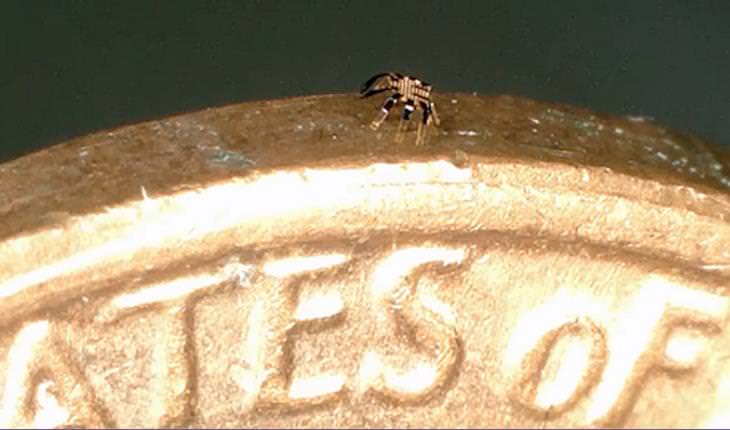

Meet the smallest ever remote-controlled walking robot. It was created by engineers at Northwestern University and resembles a tiny peekytoe crab. This crab is only half a millimeter wide and it can easily be perched on the side of a coin, but it can move and turn in every direction - bending, twisting, crawling, and even leaping. Let’s see what else it can do.
At this time, the study does not have a specific objective. It’s only experimental, but the results are already very promising and can be highly influential in many fields. The researchers propose several possible uses for their crab robot. These include repair or assembly of small structures or surgical assistance in minimally invasive procedures.
This is not the first time this team of engineers breaks records when it comes to robotics. They were also the first to create the smallest ever man-made flying structure. It was a winged microchip smaller than the head of the common ant. The main purpose of the structure is to monitor air pollution, airborne disease, and environmental contamination.
Speed
Seeing as they resemble crabs or tiny creatures, you might imagine that these robots can whizz by pretty fast, but so far, their speed is at an average of half a millimeter a second. While this may sound painfully slow, it is considered a more-than-average speed at such a small scale. You might even be shocked to discover that this robot does not use any electronic or hydraulic machinery to move. Instead, the very material from which it’s made, in combination with remote laser control, is what animates it.
Movement
The researchers used a shape-memory alloy material to build the robot. It transforms to its remembered shape when heated. When it is heated up, it contracts. When it cools down, it expands back to its original shape.
What heats the alloy is a laser beam. The direction of this beam determines the robot's direction of movement. John a. Rogers, Who lead the experimental work, explained that “because these structures are so tiny, the rate of cooling is very fast. In fact, reducing the sizes of these robots allows them to run faster.” As some wise man once said, everything is relative.
How does one come about manufacturing such little things? Well, the researchers at Northwestern will tell you it’s all child’s play. The manufacturing process is inspired by children’s pop-up books, a technique they introduced eight years ago.
First, they create the structures as flat, spread-out sheets. Then they lay these sheets onto a slightly stretched rubber layer. When this stretched rubber is relaxed, all parts are assembled, and the crabs pop into their final three-dimensional forms.
But why a crab of all things? The researchers once again show us their playful side, admitting that this was a creative whim: "With these assembly techniques and materials concepts, we can build walking robots of almost any size or 3D shape, but the students felt inspired and amused by the sideways crawling motions of tiny crabs."
They also created millimeter-sized robots that resemble inchworms, crickets, and beetles. I don’t know about you, but I wouldn’t mind letting this tiny crab join in as an assistant if I ever need surgery. And if you’re not convinced yet, try watching it in action:

5:50
The Rise of the Machines: Can Humanoid Robots Help Us?
Will humanoid robots change the way we work forever?
5:14
Studying Dolphins May Be Key to Advancing Medicine
Scientists have noticed a strange behavior in red sea dolphins, and they believe this is a form of self-medication. Learn why this discovery is so important.
2:49
What is E-ink and What Does it Have to Do With Cars?
See for yourself! The new electric vehicle from BMW can change color with a push of a button.
Scientists Develop 'Flying Dragon' Robot to Fight Fires
Scientists in Japan have created a water-spitting 'flying dragon' robot to fight fires.
Scientists Develop Ultra White Paint That Could Cool Homes
Scientists developed ultra white paint that reflects 98.1 percent of sunlight. They claim that it can be used as a substitute for air conditioning.
21:13
The Future is Made of Self Healing Concrete
Keep tabs on the most recent technological advancements we're likely to see in the near future.
Meta Unveils New Glasses that May Change Sports Forever
META has revealed a new line of AI-powered smart glasses: Oakley Meta HSTN
These Materials are Strange Enough to Boggle Your Mind...
There are some materials in this world that totally defy scientific convention. From metals that melt in your hand, to a solid lighter than air, take a look.
9:34
Was Roman Concrete Really Superior to Our Own?
How did Ancient Romans make such durable concrete that it still lasts today?
14:34
What to Do (and Avoid) When Setting Up a Smart Home
Here's how you can set up a family-friendly smart home that will last long.
11:02
Ever Wonder What Ancient Egyptian Sounded Like?
Researchers have used all the information we know to create what they think it may have sounded like.
3:07
The Speed of Light Visualized in a Magnificent Video
Have you got the patience? Watch, in scale, just how long it takes light to travel from Earth to Mars
4:57
Fascinating: How Does Our Digestive System Work?
This video explains how the human digestive system does its daily.
1:17
The Age of the Affordable Android Robots is Here...
Meet the Unitree R1 – the game-changing humanoid robot that just shattered every price expectation in robotics.
6:25
Do You Like the Smell of Rain? This Is Why
One of the best things about rain and thunderstorms is that clean fresh smell afterward. But what actually causes that distinct scent?
2:17:01
Astronomy: What is Beyond the Edge of the Universe?
In this video, we explore what modern astronomy reveals about the universe’s boundaries—if they even exist.
22:35
Neuralink Update 2025: The Most Incredible Moments
Welcome to our 2025 Neuralink update, where we’ll take you through the most incredible and groundbreaking moments from the past year.
These 14 Forgotten Robots Promised So Much...
This collection showcases 14 cool vintage robots that were supposed to change everything.
8:11
Fascinating: What is the Deepest Hole Humanity Has Dug?
This video explains how low humanity has dug down so far.
50:02
Take a Trip Through the Universe and Witness its Beauty
Since its launch, the Hubble Telescope returned images of unprecedented beauty of a dynamic and changing universe. Take a look!
Has Modern Technology Changed Our Cognitive Abilities?
Modern digital technology is everywhere and it’s changing how we think, how we behave and even how we feel about things.
Blood Test Breakthrough Transforms Leukemia Diagnosis
This research demonstrates that rare circulating stem cells in blood carry the same diagnostic information as bone marrow samples, enabling doctors to identify disease progression months before clinical symptoms appear.
14 Times Nature Inspired Groundbreaking Technology
Let’s explore 14 remarkable examples of how nature has shaped modern technology.
Science Lesson: 10 Fiery Facts About the Sun You Must Know

Learn some fascinating and little-known facts about the Sun in this article.
Science News: AI-Designed Drugs Move to Human Trials

Isomorphic Labs, is positioning itself to begin human clinical trials of medications designed entirely through artificial intelligence, marking a potentially transformative shift in how we develop life-saving treatments.
7:21
Science: 20 Mechanical Principles Demonstrated Using Lego
In this video, we'll explore a variety of fascinating mechanical mechanisms, all demonstrated using Lego models.
8:46
Science: What is Reality? Dive in and Find Out!
What if everything you see, feel, and experience isn’t real? The simulation argument suggests that our reality might be nothing more than an advanced computer program.
14 Retro Inventions That Stunned Crowds Back in the Day
These inventions were the talk of the town back in the day.
13 Astonishing Things You Never Thought You'd See
Here are 13 photos of rare phenomena you never thought you'd see!
Alzheimer's: What Recent Breakthroughs Have Taught Us
Now, you can discover 4 new studies that show how to do this in ways you haven’t heard of.
10 Declassified U.S. Military Secrets That'll Astound You
Government military secrets can range from amusing to absurd to downright terrifying, but they are all extremely intriguing. Here are 10 such secrets.
34:33
Is China Number 1 in Global Technology?
In this video, we’ll take a closer look at the new developments hitting the market — and what they could mean for the future of transportation.
10:31
Science Predicts These 10 Technologies Will Rule 2025
These upcoming tech innovations will reshape our world.
Earth Is So Incredible: I Was Stunned by These 50 Facts
Here's a post that will explain to you just what's truly, scientifically amazing about our planet Earth. I'm gobsmacked.
8:12
How Humans Helped Cats Take Over the World
The relationship between humans and cats goes back as far as 9,500 years. How did it al start? And how did humans help cats essentially take over the world?
What is the Troxler Effect and How Does it Affect You?
Learn about Troxler's effect and the optical illusions it creates in life.
5:16
Fascinating: How Fast Does Our Brain Operate?
Ever wonder at what speeds our thoughts move?
6:05
The Real Reason Companies Prevent You from Fixing Things
Ever felt like you should be able to fix that broken gadget, but something's holding you back? Watch this to know more.
6 Signs That Someone is Listening on Your Cellphone Calls!
With technology advancing all the time, there is the ever-increasing chance of our phones being tapped. Here are 6 signs that your phone could be tapped.
3:02:59
Like Science Mysteries? Enjoy This Giant Compilation!
In this video, we unravel the greatest unsolved mysteries of physics.
14:58
Why IS Fentanyl So Dangerously Addictive?
In this video, we break down what opioids really do to your brain and body, what using them actually feels like, and why so many people are dying from Fentanyl overdoses.
16:26
Neanderthals Had Strength and Skills Beyond Our Limits
Neanderthals possessed truly exceptional, almost unbelievable, traits.
Why It's So Hard to Get People to Change Their Stance
You feel that your knowledge is broader because you've read and researched a lot on the topic, but the other side still isn't convinced, even when you present facts and statistics. Why isn't that enough?
Is Weekend Sleep as Good as Regular Sleep? Let's Check
If you thought sleeping in on the weekend was a bad habit, you're about to find out that it's quite the opposite.
7:56
These 6 Chemical Reactions Changed the Course of History
Although we rarely pay much attention to the chemistry that constantly surrounds us, these 6 reactions changed history.
6:15
K2-18b: The Exoplanet That Might Host Alien Life
Astronomers have detected signs of posisble life in the atmosphere of exoplanet K2-18b.
8:48
Fascinating: What Around Us is Invisible?
The Invisible Things that Turn the World...
To enable your Ad-Free Subscription, please fill the fields below
Your subscription was successful, now you can enjoy an ad-free experience!! Note: To make sure you get no ads, please make sure to log in to your account. If you are logged in already, then refresh the page. The subscription can be cancelled at any time.