
Pull off the road south of Split on a clear afternoon and the drop is immediate: no beach, no transition, stone into water. Drivers who have done this particular stretch often describe braking before they realize they’ve done it. Croatia recorded a 9.4% jump in foreign arrivals in Q1 2026, with overland travelers from Germany, Austria, and Slovenia accounting for much of the increase. That kind of growth, via road rather than runway, doesn’t happen by accident.
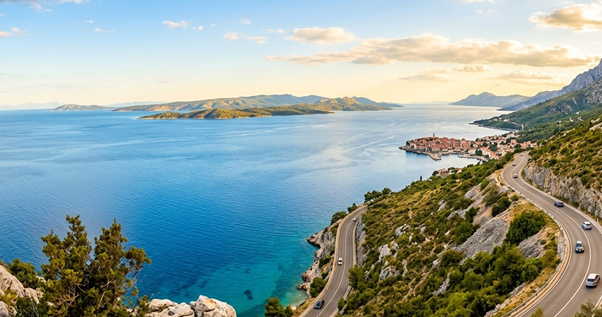
What rarely gets said about Croatian travel is how often the drive between two places ends up being the part people talk about afterward. The Adriatic coast rewards this instinct, and it does so across several hundred kilometers of road that keeps changing what’s visible every few minutes.
Here is the short answer: the road does not go straight, does not stay flat, and does not let attention wander. The Adriatic Highway - Jadranska magistrala in Croatian - covers roughly 600 kilometers from Rijeka to Dubrovnik without ever straying far from the water. Industry surveys for 2026 place the Croatian Adriatic among the most sought-after coastal driving routes in Europe, ranking ahead of comparable stretches in Greece and southern Spain.
The 2026 season opened with Easter demand up sharply across Split and Istria, and Croatia had already posted more than €15.3 billion in foreign tourism revenue the previous year. Figures like these describe volume. They say nothing about the Velebit section north of Split, where the limestone walls press close enough to the road that the car seems to fit the gap by tolerance rather than design. Drivers hold 40 km/h through this stretch not by choice but because going faster simply isn’t possible. That kind of road tends to stay with people.
Travelers who book through Localrent Croatia frequently highlight one practical detail: the rental price is confirmed at prepayment, with nothing added at vehicle handover. Booking ahead generally runs 20-30% cheaper than airport desk rates. Aggregate platform testing shows that price certainty at the start of a trip affects the quality of driving in ways that are hard to quantify but easy to feel - when the first day involves three hours on a cliff road, it’s better not to have an unresolved charge somewhere in the back of the mind.
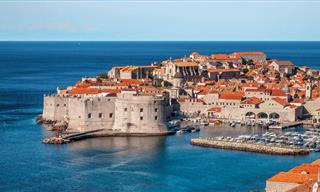
The inland motorway is faster. Most people who have driven both routes once take the coast for every subsequent trip. South from Split, through Omiš and along the Makarska Riviera, the road runs between 60 kilometers of beach towns and the Biokovo mountain range climbing steeply behind them. Sveti Jure at 1,762 meters marks the high point; when the air is clear, the island chain visible from the road sits far enough out that the horizon starts to resemble the Italian coast. A pair of travelers on this leg in spring 2025 logged eleven stops in under an hour. The schedule did not survive. The day did.
South of Ploče the route passes through the Pelješac Peninsula before the final descent into Dubrovnik. The Pelješac Bridge, completed in 2022, ended the old requirement to briefly enter Bosnia and Herzegovina at Neum - that border crossing is now simply gone, and the drive runs Croatian coast the entire way through.
Istria occupies a different mood from Dalmatia. The light is softer here, the architecture more Venetian, the roads less dramatic and more genuinely pleasant to sit in. Between Rovinj and Pula, coastal villages still run on fishing schedules rather than tourist ones - boats out, nets drying, the kind of activity that doesn’t pause for visitors. Poreč holds the Euphrasian Basilica, a sixth-century structure with Byzantine mosaics that earned UNESCO listing in 1997. It gets a fraction of the attention it deserves, which, for drivers wanting to stop without navigating a crowd, is not necessarily a problem.
Istrian roads suit travelers who prefer density of good stops over dramatic scenery. Hilltop towns, truffle producers, olive-oil estates, and small wineries appear at intervals short enough that a half-day drive covers more variety than some destinations manage in a week.
The peninsula makes a reasonable case for itself beyond being a shortcut south. Pelješac produces Dingáč and Postup on steep terraces facing the sea, and the angle at which those vines catch sun explains why both wines carry the reputation they do. The Croatian National Tourist Board recorded 31% growth in wine tourism on the peninsula between 2022 and 2025 - a shift from passing through to stopping intentionally.
High summer on the coastal route means queues that convert short drives into half-day exercises in patience. In July and August, the roads into Dubrovnik and through the Makarska Riviera towns move slowly enough that any schedule becomes theoretical. Easter weekend 2026 alone brought roughly 40,000 overnight stays to Split-Dalmatia County over a few days - a useful indicator of what the coast looks like at full capacity.
Shifting the trip to May, June, or September changes the experience significantly:
A couple completing the full coastal route from Split to Dubrovnik in early June 2025 made it in under four hours including stops. August accounts from the same road consistently describe seven to eight hours, also including stops, in considerably less pleasant circumstances.
Croatia’s mainland coastline runs close to 1,800 kilometers, with more than 1,200 islands arranged offshore. On the coastal driving route, open water is rarely far away - the road threads between mountain and sea for most of its length, and losing sight of the Adriatic for more than a few minutes tends to feel like something is off.
This is different from driving near the sea in the way most people have experienced it. The view doesn’t stay still. A headland clears and a new bay opens. An island that was in the background becomes the thing directly ahead. The Biokovo profile shifts as the road turns. Each kilometer resets the composition slightly, which is why drivers who expected to stop once end up stopping eleven times in an hour and feel entirely justified. There is no better explanation for why these routes keep drawing people back than the simple fact that the same road, driven twice, does not look identical.