
For centuries, sailors, squires, and treasure hunters have dreamed about finding the untold riches of silver, gold, and jewels that sank with the World’s most valuable shipwreck. But, when eyes were finally laid upon the “Holy Grail” of shipwrecks – the Spanish galleon San José, which capsized off the Colombian coast in 1708 – they were not human eyes.
This doomed vessel was discovered back in 2015, after more than three centuries lying at the bottom of the Caribbean Sea and, this week, for the first time, researchers have revealed how they made their famous find.
Marine scientists from the Woods Hole Oceanographic Institution (WHOI) in Massachusetts say that that ship – whose sunken riches are estimated to be worth around $17 billion – was discovered by an autonomous underwater vehicle called Remus 6000, during a survey off Colombia’s Barú Peninsula.
Rob Munier, WHOI’s vice president for marine facilities and operations, said that “we’ve been holding this under wraps out of respect for the Colombian government.” But, why the need for such secrecy? Usually, general explanations of the technology involved in the discovery of long-lost shipwrecks like this don’t take three years to come to the fore.
However, the San José is no ordinary case, due to the staggering level of riches that was estimated to have sunk with it. When the Spanish vessel sank in battle with a British squadron in 1708, it wasn’t just full of treasure: the 60-gun galleon was also armed with a large arsenal of gunpowder, which was detonated in the fray, killing almost everyone on board.
A couple of centuries later, in the 1980s, a consortium called “Sea Search Armada” (SSA) claimed to have found the wreck, but Colombia refused to grant them permission to salvage the San José, and they have, for decades, legally contested the company’s rights to any of the treasure, since it’s in Colombian waters.
However, Spain might also now want its share of the spoils since the San José was flying under the Spanish flag when it sank. Many contend that since much of the wealth aboard the ship resulted from the conquest of the Americas, it ought not leave Colombia, while others suggest that other nations might still be entitled to a share of the treasure, based on historical arguments that a lot of Spanish cargo in the late 17th century rightfully belonged to England, France, or Holland.
With these potential disputes in mind, the United Nations asked Colombia not to commercially exploit the discovered wreck and the cultural heritage it represents. So far, the Colombian government has kept the exact location a secret – not clarifying whether it’s the same site that SSA claimed decades ago – but they have said that the wreck has not been looted, meaning the full cargo is expected to be recoverable.
In terms of new details of the vessel’s discovery, WHOI – which acts in collaboration with the Colombian government, in addition to other parties – says the wreck was located more than 600 meters (around 2,000 feet) deep, in an area that the REMUS 6000 began surveying in June 2015.
Mike Purcell, the WHOI expedition leader, explains that “during a November expedition, we got the first indications of the find from side scan sonar images of the wreck. From those images, we could see strong sonar signal returns, so we sent REMUS back down for a closer look to collect camera images.
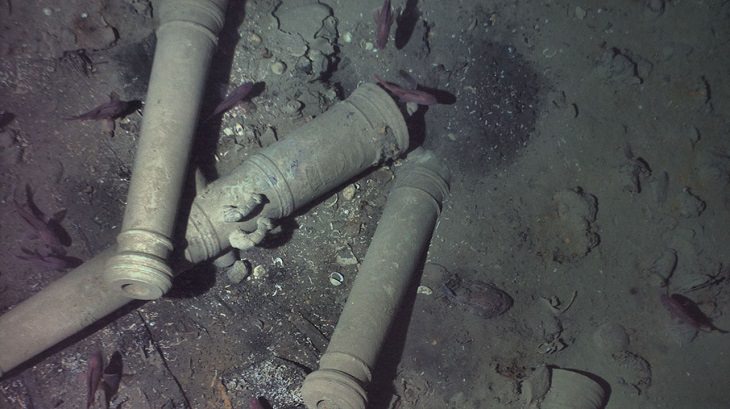
Photographs that were taken just 9 meters (30 feet) above the wreck captured the vessel’s cannons, and later dives uncovered details such as engraved dolphins carved into the cannons’ bronze, in addition to scattered teacups, ceramics, and other artifacts on the seabed.
“The wreck was partially sediment-covered, but with the camera images from the lower altitude missions, we were able to see new details in the wreckage and the resolution was good enough to make out the decorative carving on the canons,” said Purcell.
At the moment, there’s no official word on when or how these items will be recovered, but with all the violence and intrigue in the galleon’s pasts, we’re guessing that this tale of long-lost plunder is far from over.
Source: sciencealert
Images: depositphotos

COVID-19 Vaccination: Can the Second Dose Be Delayed?
Wondering whether or not you can delay your COVID-19 vaccine shot? Here are some answers.
Viagra May Hold the Key to Preventing Colorectal Cancer...
A new study shows that Viagra may be able to help prevent the onset of colorectal cancer. Find out all about it here.
21 Incredible Items Unearthed by Metal Detectors
Metal detecting is a surprisingly popular hobby. Here are some of the coolest and most valuable items found by amateur metal detector hobbyists.
12:14
Did You Know That Once Upon a Time Antarctica Was Green?
Watch this video to explore Antarctica’s little-known and green past.
5:18
The Fascinating Science of False Memories
Find out why our own memories are susceptible to false information and why they can't be trusted.
21:51
This Is How Earth Used To Be 4 BILLION Years Ago
Imagine taking a tour through Earth 4 billion years ago. Wouldn't that be fascinating?
4:57
The First 3D-Printed Hotel is Already Being Built!
s evidence of this, a groundbreaking project is nearing completion, in which a hotel is being printed, and tourists will soon be able to visit it. Curious to see what it looks like?
Earth Is So Incredible: I Was Stunned by These 50 Facts
Here's a post that will explain to you just what's truly, scientifically amazing about our planet Earth. I'm gobsmacked.
12 Earliest Versions of Tech Inventions We Use Every Day
Witness the evolution of 11 popular devices we use all the time by looking at how they all started...
8 Jaw-Dropping Black Hole Facts to Warp Your Mind
These black hole facts will bend your mind!
1:08
Boston Dynamics New Robot Can Move Almost Like a Human
Watch the latest in robotics in this video.
1:44
You Won't Believe What the Human Body Does in One Minute
How much do you think it is capable of doing in a single minute? Watch this video and you'll have your answer!
Are You Ready to Learn About the Expanse of the Universe?
If you have an interest in the unknown, then look no further than these 15 unbelievably facts discovered about space
Blood Test Breakthrough Transforms Leukemia Diagnosis
This research demonstrates that rare circulating stem cells in blood carry the same diagnostic information as bone marrow samples, enabling doctors to identify disease progression months before clinical symptoms appear.
11:28
India Built a Monster Dam That Controls the Weather!
The Polavaram Dam doesn't just control floods - it moves water between regions and much more!
18:21
Fascinating: How Do Cats TRULY See Humans?
Understanding a cat's world is the key to strengthening your bond. Let's decode your cat's mind!
2:03:03
Full Documentary: From First to Last Dinosaur
With stunning visuals and cutting-edge science, we’ll bring their story to life—from their very first day to their last, a saga of survival, adaptation, and mystery.
6:25
Do You Like the Smell of Rain? This Is Why
One of the best things about rain and thunderstorms is that clean fresh smell afterward. But what actually causes that distinct scent?
Science in 2025: 8 Developments That Could Change it All
Here are some of the most exciting trends in science and healthcare to keep an eye on.
I Bet You Didn't Have a Clue About These Human Body Facts!
The human body is the most complex machine known to mankind, but I bet you don't know these 10 amazing facts about it...
Nobody Believed These 5 Scientists, But They Were Right
These 5 scientists were shamed and ousted, or rudely ignored, although years later, their "crazy" theories turned out to be true...
6:15
K2-18b: The Exoplanet That Might Host Alien Life
Astronomers have detected signs of posisble life in the atmosphere of exoplanet K2-18b.
Is Weekend Sleep as Good as Regular Sleep? Let's Check
If you thought sleeping in on the weekend was a bad habit, you're about to find out that it's quite the opposite.
20:01
Future Tech: 19 Innovations About to Change Our World
These groundbreaking new technologies will change our world.
16:26
Neanderthals Had Strength and Skills Beyond Our Limits
Neanderthals possessed truly exceptional, almost unbelievable, traits.
4:45
Woah! Learning to Play Music Has This Effect on Your Brain
Learning how to play an instrument can do wonders for our brain...here's how!
The Wildest Meteorites Ever Found on Our Planet - 15 Pics
Check out 15 of the most fascinating meteorites ever found on earth.
15 Beautiful Carl Sagan Quotes on the Stars and the Cosmos
A look at some profound quotes on the universe by famous astronomer and cosmologist Carl Sagan.
4:52
Neon Lights: a Beautiful Union of Science and Art
Neon signs are a beautiful blend or artistry and science, and knowing the history and the science behind them make them even more exciting
18:14
Are These Vintage Kitchen Gadgets Any Good?
Will any of the vintage kitchen gadgets stand the test of time or outperform their contemporary alternatives?
2024's Biggest Breakthroughs in Science We Must Celebrate
These recent scientific breakthroughs could change the world.
7 Air Pollution Solutions That Will Help Us Breathe Easy
Let's take a look at some global initiatives that have been launched to reduce air pollution levels.
7:21
Science: 20 Mechanical Principles Demonstrated Using Lego
In this video, we'll explore a variety of fascinating mechanical mechanisms, all demonstrated using Lego models.
The 12 Game-Changing Inventions From 2024 You Missed
2024 was a ground-breaking year in terms of innovation. Here's a look at some of the key breakthroughs from the year.
17:03
What is a Ballistic Missile and is Its Purpose?
Why is the ballistic missile so feared, and what exactly qualifies it as such - will all be explained in this informative video.
4:49
This Video Shows You a Different Way to Look at the World
You’ve heard of the fourth dimension but do you know what it is? This TED-Ed video helps uncover a bit of the mystery.
Hubble Telescope: 35 Years of Incredible Photos
Exploring 35 years of reality-changing, universe-enhancing photos that opened the sights of outer space to us all.


11:15
These Paradoxes Continue to Mystify Scientists
Take a look at 7 scientific paradoxes that may never get solved.
These Underwater Craft Are Changing Marine Science
Here's a look at the most remarkable machines currently expanding our understanding of the underwater world.
4:11
This Video Will Show You Where We Are in the Universe!
Where is our galaxy in the known universe? This video will fly with you to ever-larger destinations, showing you our little planet's cosmic address from a very large viewpoint.
What Your Phone Habits Say About Your Mental Health
These phone habits might indicate underlying anxiety—and paying attention to them could help you better understand your mental health.
5:16
Fascinating: How Fast Does Our Brain Operate?
Ever wonder at what speeds our thoughts move?
These Theories About Reality & the Universe Will Stun You
You will be shocked to discover these 10 surprising theories of the universe and reality.
Find Out How Some Elderly People Stay Sharp into Old Age
Some old people have better memories than people half their age. This could be the reason why...
7:56
These 6 Chemical Reactions Changed the Course of History
Although we rarely pay much attention to the chemistry that constantly surrounds us, these 6 reactions changed history.
A Quantum Leap? Revolutionary Technique Discovered
Scientists at Singapore University have developed a groundbreaking manufacturing method powered by artificial intelligence that may revolutionize how we understand and create quantum materials at the atomic level.
13:21
The Race to Complete the World's Second-Tallest Skyscraper
Malaysia is all set to unveil the world’s second tallest skyscraper.
To enable your Ad-Free Subscription, please fill the fields below
Your subscription was successful, now you can enjoy an ad-free experience!! Note: To make sure you get no ads, please make sure to log in to your account. If you are logged in already, then refresh the page. The subscription can be cancelled at any time.