Miniscule single cells of bacteria are the masters of our world. They play many different roles in life on earth, with one of the most surprising being that some of them can actually purify precious metals.
An international team of researchers have discovered that a particular species of bacteria, Cupriavidus metallidurans, can actually ingest toxic metallic compounds and still thrive. What’s more is that the bacteria can actually produce tiny gold nuggets as a side-effect.
Gold moves through a process that’s called the biogeochemical cycle, just as many other earth elements do. This process sees elements being dissolved, shifted around and eventually re-concentrated in the Earth’s sediment.
Seeing as microbes are involved at every step of this process, scientists have long wondered how the microbes don’t get poisoned by the highly toxic compounds formed by gold ions in the soil.
Cupriavidus metallidurans, which is a rod-shaped bacteria species, was first found to excrete gold nuggets back in 2009 when scientists discovered that it’s capable of ingesting toxic gold compounds and converting them into the element’s metallic form without endangering or harming itself.
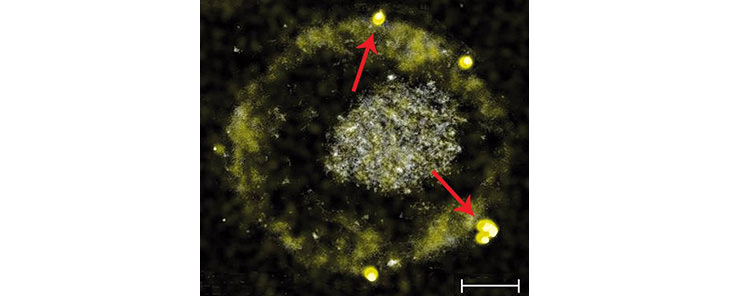
After many years of investigation, scientists now know how the bacteria are capable of this amazing feat. It thrives in soils containing both hydrogen and a range of toxic heavy metals, meaning that it has little to no competition from other organisms that would easily be poisoned in such an environment.
This means that any organism choosing to live in such an environment has to have a way of protecting itself from all of the toxicity surrounding it. It turns out that this particular bacterium has an ingenious protective mechanism that involves both gold and copper.
Compounds containing both of these elements can easily be ingested by the bacteria, and copper ions and gold complexes get transported deep inside. Then, the bacteria use enzymes to shift offending metals out of their cells, allowing them to dispose of them unimpeded. Not only does this process allow the bacteria to shed all of the unwanted copper – It also results in tiny gold nugget nanoparticles on its surface.
The new research that has resulted in these findings builds on previous research conducted by the same team is a fascinating insight into the weird talents of this particular bacteria, which could potentially be put to good use.
The significance of the findings is that scientists are now a huge step closer to unlocking the biogeochemical cycle of gold. Understanding this process could lead to gold refining from ores that only contain very small amounts of the precious metal, which is something that’s extremely tricky to do at present.

How to Maximize Productivity With Study Planner Apps
These apps are designed to help students organize their study schedules, track their progress, and ultimately achieve their academic goals with greater ease.
Breakthrough: Lion's Mane Mushrooms Boost Memory & Nerves!
Researchers have recently uncovered the mushroom's potent compounds, particularly hericene A, that could help nerve cells grow and better interact with each other.
3 Robots that Are Already Scary Advanced...
You'll be amazed to see how human (or animal)-like these robots are. They are all by Boston Dynamics, a robotics company at the forefront of its sector.
Red Meat Allergens Can Increase Heart Disease Risk
Red meat has long been linked to heart disease, but a new study marks the first time that the allergens it contains can increase the risk of contracting it.
What Did the Earliest Photographs Look Like?
Nowadays everyone has a camera, but take your mind back the time when photography was just a fantasy and imagine the thrill of seeing the first photos!
New Study: There is a Sure Way to Slow Aging
This new study confirms what has long been suspected: The less calories we consume, the slower we age.
10 Tech Products You Must Double-Check Before Buying
Beware! These tech products are most commonly faked.
4:52
Neon Lights: a Beautiful Union of Science and Art
Neon signs are a beautiful blend or artistry and science, and knowing the history and the science behind them make them even more exciting
8:10
Taller Doesn't Mean Bigger - the True Size of Skyscrapers
If you were to compare skyscrapers by area rather than height, which skyscraper would end up on top?
5:22
Why Do You See Colors When You Rub Your Eyes?
Explore the science of afterimages, the visual illusions that linger in your vision following exposure to bright lights or images.
21:24
James Webb Telescope: Redefining Our View of Space
Here's a brief look at all the amazing discoveries made by the James Webb Space Telescope so far.
9 of the Greatest Unsolved Mysteries About the Universe!
The universe has been around for close to 14 billion years, but it still holds many mysteries that continue to perplex scientists. Here's 9 of them!
Study Says: With Age, Come Certain Cognitive Abilities
a study published in August 2021 in the journal *Nature Human Behavior reveals surprising findings that challenge this assumption and may be of great interest to all of us.
11:15
These Paradoxes Continue to Mystify Scientists
Take a look at 7 scientific paradoxes that may never get solved.
10 Declassified U.S. Military Secrets That'll Astound You
Government military secrets can range from amusing to absurd to downright terrifying, but they are all extremely intriguing. Here are 10 such secrets.
16:31
Why Building a Perpetual Motion Machine Is Impossible
Since the Middle Ages, scholars have been trying to build the mythical perpetual motion machine. Was it all in vain? Is it even possible to build such a machine?
21:25
How Every Nuclear Power Got Its Atomics
This video will explain how each nation earned the complex and controversial title of nuclear power.
Whoa! Who Knew the Human Body Was Capable of So Much?
Have a look at these 17 intriguing facts about the human body that we can practically guarantee will leave you in awe.
56:12
What's the Largest Thing in the Universe?
In this video, we look into some of the mightiest structures in the known universe.
12:34
The World You See Doesn't Really Exist...
his video reveals how your brain constructs reality instead of simply perceiving it.
8:19
You Won't Believe What Passes for a Phone in North Korea
You won't believe what phones look like in North Korea!
4:57
Fascinating: How Does Our Digestive System Work?
This video explains how the human digestive system does its daily.
11:05
Science: Can AI Preserve Our Most Precious Memories?
Technologist Pau Aleikum Garcia talks about synthetic memories.
1:29
A Must See: White Cells Devouring Bad Bacteria!
A real look at how white cells identify and consume harmful bacteria.
10:46
Neat Life Hacks To Help You Remember Things Better
A lot of us tend to forget the simplest things at times. This video provides some neat tips to help boost your memory.
14 Retro Inventions That Stunned Crowds Back in the Day
These inventions were the talk of the town back in the day.
8:11
Fascinating: What is the Deepest Hole Humanity Has Dug?
This video explains how low humanity has dug down so far.
12 Earliest Versions of Tech Inventions We Use Every Day
Witness the evolution of 11 popular devices we use all the time by looking at how they all started...
50:02
Take a Trip Through the Universe and Witness its Beauty
Since its launch, the Hubble Telescope returned images of unprecedented beauty of a dynamic and changing universe. Take a look!
7 Overlooked Scientists Who Should Be Household Names
Meet seven scientists who never got the credit they deserved.
9 Great NASA Inventions That Took the World By Storm!
For around six decades, NASA have been inventing top-notch products. Here are nine great examples!
Meta Unveils New Glasses that May Change Sports Forever
META has revealed a new line of AI-powered smart glasses: Oakley Meta HSTN
5:50
Why Do We Sometimes Hallucinate? Find Out Here!
In this informative TED-Ed video, Elizabeth Cox details the science of hallucinations.
5:50
The Rise of the Machines: Can Humanoid Robots Help Us?
Will humanoid robots change the way we work forever?
The Wildest Meteorites Ever Found on Our Planet - 15 Pics
Check out 15 of the most fascinating meteorites ever found on earth.
See the World From Up Close - 17 Fascinating Macro Photos
Seeing ordinary objects like honey, paracetamol, and snow through a microscopic lens teaches us how beautiful and intricate they really are!
Earth Is So Incredible: I Was Stunned by These 50 Facts
Here's a post that will explain to you just what's truly, scientifically amazing about our planet Earth. I'm gobsmacked.
5:01
The Truth About Folding Phones You Need to Know
Don’t buy a foldable without knowing this first.
22:35
Neuralink Update 2025: The Most Incredible Moments
Welcome to our 2025 Neuralink update, where we’ll take you through the most incredible and groundbreaking moments from the past year.
These Theories About Reality & the Universe Will Stun You
You will be shocked to discover these 10 surprising theories of the universe and reality.
20 Peculiar Microscope Photos That You Really Must See
An unseen world exists at our fingers, and thanks to these wonderful micrographs, we can get a glimpse into that dimension.
7 Air Pollution Solutions That Will Help Us Breathe Easy
Let's take a look at some global initiatives that have been launched to reduce air pollution levels.
5 Puzzling Mysteries That Science Finally Managed to Solve
These weird occurrences have puzzled humanity for decades, if not centuries. Finally, scientists solved them & the solutions are exciting...
Extraordinary Inventions By Tesla That Were Never Built!
Nikola Tesla was a scientist too advanced for his time. Here are some of the inventions he never had a chance to build.
16 Interesting Things We Bet You've Never Seen Before
Once we have finished school and learned all the necessary skills at work, it may seem that no further studying is necessary. 16 interesting photos you wish you had seen in textbooks at school.
How AI Is Fixing Problems Humans Struggle With
Here’s how AI is quietly reshaping the world in ways that actually matter.
3:07
The Speed of Light Visualized in a Magnificent Video
Have you got the patience? Watch, in scale, just how long it takes light to travel from Earth to Mars
To enable your Ad-Free Subscription, please fill the fields below
Your subscription was successful, now you can enjoy an ad-free experience!! Note: To make sure you get no ads, please make sure to log in to your account. If you are logged in already, then refresh the page. The subscription can be cancelled at any time.