
Imagine a man born into one of the wealthiest families in the world, perhaps the wealthiest in all of Europe. His childhood palace in Vienna hosts the greatest composers and artists of the era, like Brahms and Mahler. He has perfect musical pitch, is a brilliant aeronautical engineer, and possesses a fortune so vast it could support him and his descendants for generations.
Now, imagine that same man, at the peak of his life, giving away his entire inheritance down to the last penny, volunteering as a simple frontline soldier in World War I, and later working as an elementary school teacher in a remote village, a gardener in a monastery, and an orderly in a hospital.
This isn't a Hollywood script. It is the true story of Ludwig Wittgenstein, the man who sat in the same classroom as Adolf Hitler, became the protégé of the philosopher Bertrand Russell, and changed the face of 20th-century philosophy - not once, but twice, with his second philosophy completely contradicting his first.
Part 1: A Prince from Vienna Meets the Devil in Linz
Ludwig Wittgenstein was born in Vienna in 1889, the youngest son of the steel magnate Karl Wittgenstein. His family was the epitome of wealth and culture. Money wasn't discussed; it was simply there, like air. Their home had seven grand pianos, and the artist Gustav Klimt painted his sister's portrait. Ludwig himself had perfect pitch and seriously considered becoming an orchestral conductor.
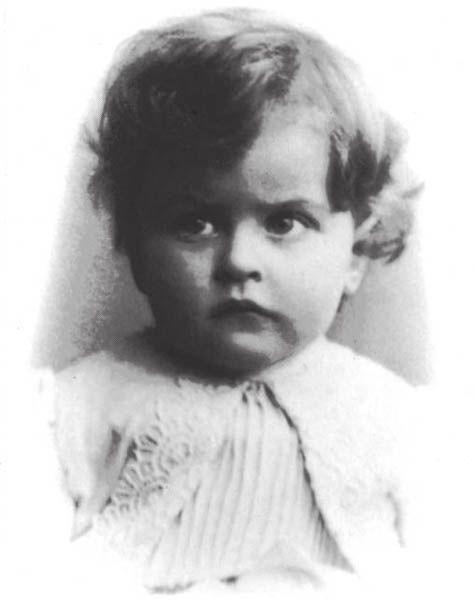
Ludwig, around the 1890s
But beneath the gilded surface, this was an intense and tragic family. Three of Ludwig's brothers committed suicide. Ludwig himself was a haunted, intense, and uncompromising man, who lived his entire life tormented by his wealth and in constant search of purity and clarity.
At 14, he was sent to the secondary school (Realschule) in Linz. In a chilling historical coincidence, a boy from a modest background named Adolf Hitler, born just six days earlier, was in the same class.
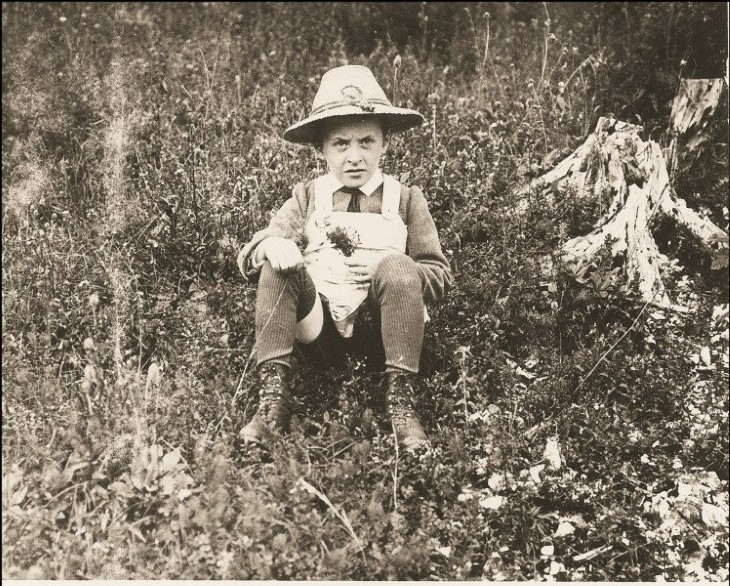
Ludwig sitting in a field as a child
Although the Wittgenstein family had converted to Christianity, they were still considered Jewish. The information you provided quotes Hitler's Mein Kampf, where he writes: "I did not trust this Jew very much... I doubted his reliability." The young Wittgenstein - brilliant, wealthy, and fiercely independent - likely represented everything Hitler hated and envied. Some historians believe this encounter with the "rich Jew" (as Hitler must have seen him) was one of the early seeds of the future Führer's monstrous antisemitism.
Part 2: The Aircraft Engineer Who Asked Russell "Am I an Idiot?"
Wittgenstein didn't turn to philosophy first. He was a man of action. He studied engineering in Berlin and Manchester, where he specialized in designing propellers for jet engines. But while working on mathematical calculations, he became fascinated by the foundations of mathematics itself. What is truth? What is a number? These questions led him to the German logician Gottlob Frege, who in turn sent him to the greatest philosopher of the age: Bertrand Russell at Cambridge University.
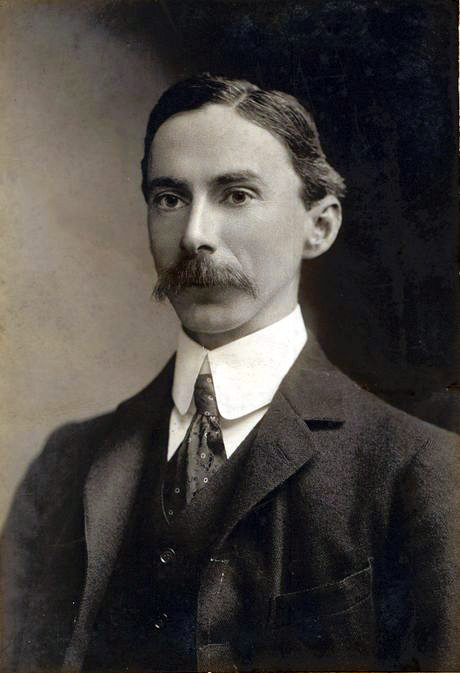
Bernard Russel, 1907
In 1911, Wittgenstein appeared in Russell's office. After a heated argument, Wittgenstein demanded to know: "Will you please tell me whether I am a complete idiot or not?" Russell replied, "My dear fellow, I don't know if you are an idiot or not, but if you write me an essay... I will read it and tell you." Wittgenstein wrote the essay, and after reading just the first sentence, Russell knew he was in the presence of a genius.
Russell became his mentor, but the student soon surpassed the teacher. Russell wrote of him: "He was perhaps the most perfect example I have ever known of genius... creative, profound, intense... His interest in philosophy is more passionate than mine." Within a short time, Wittgenstein was developing ideas that Russell himself struggled to understand, and he began to formulate his first masterpiece.
Part 3: Philosophy in the Trenches (The "Early Wittgenstein")
When World War I broke out in 1914, Wittgenstein was exempt from service. But he immediately volunteered for the Austro-Hungarian army. He sought out danger and suffering, perhaps as a way to atone for his life of luxury. He served on the Russian and Italian fronts, displaying extraordinary courage. Between artillery barrages, huddled in muddy trenches, he wrote in a small notebook one of the most important and strangest books in philosophy: the "Tractatus Logico-Philosophicus."
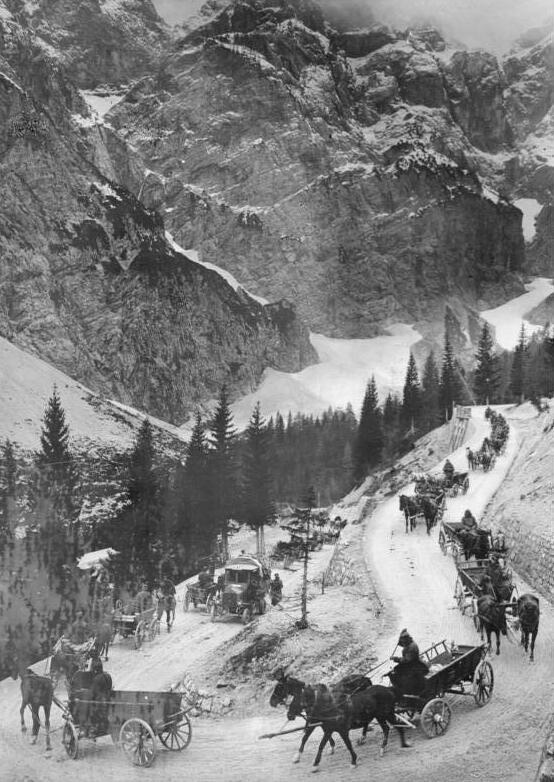
Austro-Hungarian supply line over the Vršič Pass, on the Italian front, October 1917
He was eventually captured by the Italians, with the nearly-finished book in his backpack.
What does the "Tractatus" say (without the headache)?
Wittgenstein believed that all the great philosophical problems (What is truth? What is reality? What is good?) stem from one simple confusion: we use our language carelessly.
He proposed a "picture theory" of language. Think of it this way:
The world is made of "facts" (not objects. "The table is brown" is a fact. "Table" alone is just an object).
Our language "paints a picture" of these facts. The sentence "The cat is on the mat" is meaningful only if it pictures a possible state of affairs in the world.
The limits of my language are the limits of my world. If I cannot say something clearly and logically, I cannot truly think it.
And then came the revolutionary conclusion. What about all the truly important things? Love, ethics, beauty, God, the meaning of life?
According to Wittgenstein, you cannot "say" anything meaningful about them. The sentence "Murder is evil" or "There is a God" is not a "picture" of a fact in the world. Therefore, logically speaking, they are meaningless. This doesn't mean they are nonsense, but rather that they exist outside of what language can describe.
This is where his most famous sentence, which closes the book, comes in: "Whereof one cannot speak, thereof one must be silent."
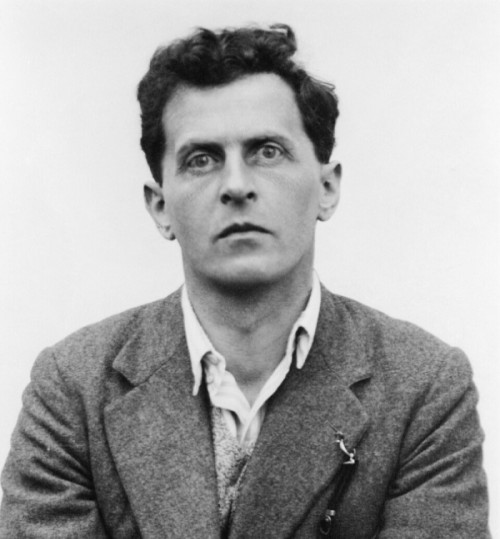
Wittgenstein didn't dismiss these things; on the contrary, he thought they were the most important things of all. But they belong to the realm of the "mystical," things that can only be shown (through art, through the way we live) but never said.
In 1919, returning from the POW camp, he was convinced he had solved all the problems of philosophy. Finito. He gave away his entire massive inheritance to his siblings, published the Tractatus, and went off to do "real" work.
Part 4: The Wilderness Years: The Teacher, the Gardener, and the Architect
If you've solved philosophy, what do you do with your life? Wittgenstein chose a life of extreme simplicity. From 1920 to 1926, he worked as an elementary school teacher in remote Austrian villages. He was a strict and intense teacher, sometimes even violent with his students, which got him into trouble with parents and eventually forced him to leave teaching.
He then worked as an assistant gardener in a monastery and, finally, took on an extraordinary project: designing and building a starkly modern, minimalist house for his sister in Vienna. He obsessed over every detail, designing every door handle and radiator himself. At one point, when the house was nearly finished, he demanded that the ceiling of an entire room be raised by three centimeters just to get the proportions perfectly right.
He lived an ascetic life, sleeping in a small, almost bare room, and believed philosophy was behind him. But he was wrong.
Part 5: The Return to Cambridge (The "Late Wittgenstein")
In the late 1920s, Wittgenstein began to feel that the Tractatus, his masterpiece, was fundamentally wrong. He returned to Cambridge in 1929. Despite being world-famous, he had no doctorate. His friends, Russell and the philosopher G.E. Moore, suggested he simply submit the Tractatus as his doctoral dissertation.
The oral defense became a legend. After a brief discussion, Wittgenstein clapped both of the eminent professors on the shoulders and said, "Don't worry, I know you'll never understand it." They passed him unanimously. Moore wrote in the examiner's report: "I personally believe this to be a work of genius; but, even if I am wrong, it is well above the standard required for a doctorate."
Wittgenstein was appointed a professor and began to develop a second, completely different philosophy, which was only published after his death in the book "Philosophical Investigations."
What do the "Philosophical Investigations" say (sans headache)?
In his second philosophy, Wittgenstein abandoned the idea that language is a rigid, logical "picture" of the world. He realized that language is a living, messy, and changing thing - like a toolbox.
"Meaning is use": The meaning of a word isn't the object it points to, but how we use it. The word "hammer" has meaning because we know what to do with it.
"Language-games": Wittgenstein argued that language is made up of countless "language-games." "Giving an order" is one game. "Telling a joke" is another. "Praying" is a third. "Solving an equation" is a fourth.
Philosophical confusion happens when we take a word from one "game" and try to use it in another. For example, when we ask "What is time?" as if "time" is an object we can point to, like "table."
Think of the word "game." What do chess, soccer, poker, and peek-a-boo have in common? There is no single thing common to all of them. Instead, there is a network of "family resemblances."
Instead of trying to "solve" philosophy, the late Wittgenstein tried to "cure" us of our linguistic confusions. He saw the philosopher's job as "showing the fly the way out of the fly-bottle."
The End of the Road: A Proud Genius and a Hospital Orderly
Wittgenstein remained an extraordinary figure until his last day. When the Nazis rose to power in 1933, he proudly declared his Jewish ancestry. In 1935, he traveled to the Soviet Union intending to move there, but after meeting a Soviet philosopher who explained the dogmatic approach to philosophy in the USSR, he changed his mind.
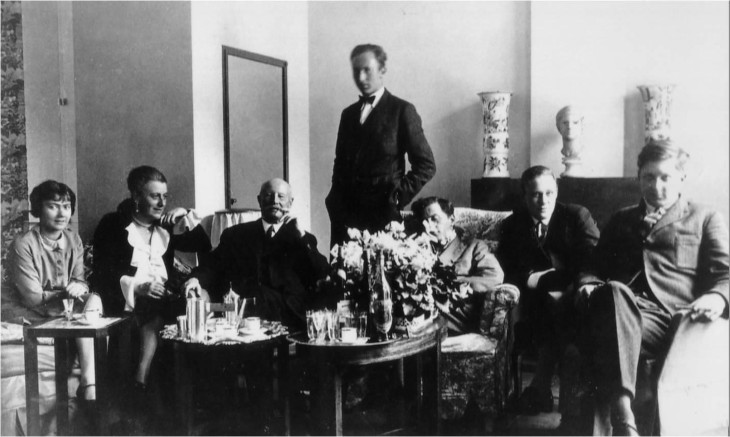 .
.
Wittgenstein sitting with his friends and family in Vienna. Marguerite Respinger sits at the end on the left and the sculpture he made of her sits behind him on the mantel-place.
During World War II, he again left his prestigious professorship at Cambridge to work, this time as an orderly and porter in a London hospital, hiding his identity as the world's most famous philosopher.
He died of cancer in 1951. His last words to his host were: "Tell them I've had a wonderful life."
Ludwig Wittgenstein left behind two contradictory philosophies, each of which shaped modern thought. He was a man who lived in the unbridgeable gap between wealth and poverty, genius and simplicity, and between the obsessive search for cold, logical truth and the understanding that life itself is a complex, warm, and meaningful game. More than any other philosopher, he showed us that the way we talk truly shapes the world we live in.