
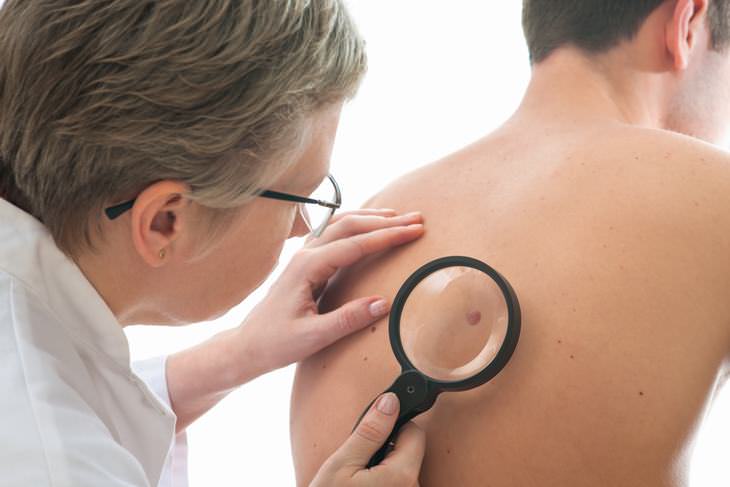
So how does this new device work? Cancer affects the metabolic rate of skin cells, with cancerous cells heating up faster than their healthy counterparts following a shock of cold temperature.
To make identifying these cells easier, the McMaster University team comprised of Michael Takla, Rotimi Fadiya, Prateek Mathur and Shivad Bhavsar, built a skin cancer detector with 16 thermistors that can track the rate of temperature increase following a cold shock from an ice pack. The thermistors are simply placed on the potentially cancerous area of skin, and the device produces a heat map that can be used to determine the presence of melanoma.
The team used widely available and inexpensive components, which allows for melanoma skin cancer detection to be readily accessible to many. It is, undoubtedly, a very clever device that has the potential to save lives around the world. Alongside the Dyson Award, the team also received a cash prize of $40,000 to advance their research and they also received $10,000 at the Forge's Student Start-Up Pitch competition in March.
The team was inspired to create sKan after realizing technology hadn't had the same impact on skin cancer diagnosis as it had on other medical fields. They found research that used the thermal properties of cancerous skin tissue as a means of detecting melanoma. But this was done using expensive lab equipment. So they set out to invent a way of performing the same assessment using a more cost-effective solution.
This will be a big leap forward in the area of detecting skin cancer. As the Guardian reported, nearly 39 people are diagnosed with skin cancer every day in the U.K., and the American Cancer Society estimates 87,110 new cases of melanoma will be diagnosed in the U.S. by the end of 2017, with 9,730 people dying from the condition. So, early detection is key to cancer survival - let's hope that sKan succeeds in significantly reducing that number.
Going forward the sKan team hopes to create a more advanced prototype that will allow them to begin pre-clinical testing. “Our aspirations have become a reality,” said Mathur. “Skin cancers are the most common form of cancer worldwide, and the potential to positively impact the lives of those affected is both humbling and motivating.”
Discover more about sKan in the video below:

Discover the Effects of Drinking Dirty, Contaminated Water
How safe is it to drink contaminated water? Find out here.
8:10
Winter Hikers, Gather Round for the Best Tip of the Season
Here's how advanced snow hikers layer clothing in the winter.
These Non-Routine Medical Tests Could Save Your Life!
Here are 8 non-routine tests that really have the potential to save your life, and some of them even need to be taken as early as 30.
The Spleen – A Guide to a Little-Known Organ
The spleen is an oft-ignored organ of our body. However, it serves an important function and needs to be taken care of properly.
Un-Hunch Your Shoulders Easily With These 7 Exercises!
Got hunched shoulders? This guide will help you improve your posture.
Bet You Never Knew How Beneficial These Foods Are
Include these 12 foods in your diet to reduce the effects of arthritis - they have been shown to fight inflammation, strengthen bones and boost the immune system.
8:12
The Tallest Statues Compared, Even Those Not Built Yet...
In this 3D animated size comparison, we showcase the tallest statues in the world alongside ambitious future projects.
2:41
Trick-Mousing is Such Adorable Entertainment...
Mice are much cleverer than most people believe, and they easily respond to training, as long as you use positive reinforcement, or in other words - reward them frequently for their behavior with food.
8:11
Fascinating: What is the Deepest Hole Humanity Has Dug?

This video explains how low humanity has dug down so far.
4:05
Kirobo: First Robot in Space!
It was one small step for robot and another giant leap for mankind...
18:21
Fascinating: How Do Cats TRULY See Humans?
Understanding a cat's world is the key to strengthening your bond. Let's decode your cat's mind!
20:32
History: Did the Trojan War REALLY Happen?
The Trojan War, the most famous of the ancient wars, fought by thousands of men for ten long years on the beaches of the famed city of Troy. Was all that real?
Hair Regeneration Could Be Possible With This New Process
Learn about an innovative new study which has revealed a novel treatment for effective hair regeneration.
14 Times Nature Inspired Groundbreaking Technology
Let’s explore 14 remarkable examples of how nature has shaped modern technology.
NVIDIA CEO Reveals Which Degree Is Worth Studying
Electrical Engineering, Computer Science, or Physics? Nvidia's CEO has a surprising answer to which area should be studied nowdays.
16:26
Neanderthals Had Strength and Skills Beyond Our Limits
Neanderthals possessed truly exceptional, almost unbelievable, traits.
5:41
Witness the Leading New Electronic Devices of 2026
The experts at CNET and PCMag were on the floor, and they've got their favorites. Let's dive in.
TRIVIA: 25 Shocking Differences Between the Sexes
Did you know that there are some vast differences between the sexes? These 25 scientific facts will probably come as a big surprise to you, they did to me.
5:06
The Only Manmade Object That Will Last Forever
This copper discus contains 116 images we launched into space for aliens to see
What is the Troxler Effect and How Does it Affect You?
Learn about Troxler's effect and the optical illusions it creates in life.
12:34
The World You See Doesn't Really Exist...
his video reveals how your brain constructs reality instead of simply perceiving it.
Has Modern Technology Changed Our Cognitive Abilities?
Modern digital technology is everywhere and it’s changing how we think, how we behave and even how we feel about things.
7 Air Pollution Solutions That Will Help Us Breathe Easy
Let's take a look at some global initiatives that have been launched to reduce air pollution levels.
6:15
K2-18b: The Exoplanet That Might Host Alien Life
Astronomers have detected signs of posisble life in the atmosphere of exoplanet K2-18b.
8:12
How Humans Helped Cats Take Over the World
The relationship between humans and cats goes back as far as 9,500 years. How did it al start? And how did humans help cats essentially take over the world?
The 12 Game-Changing Inventions From 2024 You Missed
2024 was a ground-breaking year in terms of innovation. Here's a look at some of the key breakthroughs from the year.
4:52
Neon Lights: a Beautiful Union of Science and Art
Neon signs are a beautiful blend or artistry and science, and knowing the history and the science behind them make them even more exciting
What Your Phone Habits Say About Your Mental Health
These phone habits might indicate underlying anxiety—and paying attention to them could help you better understand your mental health.
8:48
Fascinating: What Around Us is Invisible?
The Invisible Things that Turn the World...
19:27
20 of the Most Infamous Tech Product Flops In History
Here's a look at some of the most infamous and biggest technology failures in recent history.
14:58
Why IS Fentanyl So Dangerously Addictive?
In this video, we break down what opioids really do to your brain and body, what using them actually feels like, and why so many people are dying from Fentanyl overdoses.
Superwood: A New Material That Could Replace Steel
After decades of relying on steel—a material that produces nearly two tons of CO2 for every ton manufactured—builders may soon have access to something far more sustainable and surprisingly stronger: Superwood.
How AI Is Fixing Problems Humans Struggle With
Here’s how AI is quietly reshaping the world in ways that actually matter.
Science FIRST: A Fully Created Brain Inside a Computer?
Could a Computer Ever "Run" a Human Brain? Scientists Just Took a Big Step
6:05
The Real Reason Companies Prevent You from Fixing Things
Ever felt like you should be able to fix that broken gadget, but something's holding you back? Watch this to know more.
A Quantum Leap? Revolutionary Technique Discovered
Scientists at Singapore University have developed a groundbreaking manufacturing method powered by artificial intelligence that may revolutionize how we understand and create quantum materials at the atomic level.
New Research Shows Eating Sweets Won't Make You Crave More
A groundbreaking new study challenges conventional wisdom, suggesting our preference for sweet tastes may be more stable than we think.
22:52
Will AI Take Your Jobs? An Expert Explains the Future
Gonzaga University's AI professor Graham Morehead some of our most pertinent questions related to AI.
15:34
This Stunning Video Visualizes the Size of the Universe
This video visualizes the number of galaxies in the world, giving you a look into the true size of our enormous universe.
5:56
What on Earth Is a Black Hole? This Video Explains All...
What on Earth are black holes, how do they affect us, and should we be at all worried about their existence? Find out here.
16:31
Why Building a Perpetual Motion Machine Is Impossible
Since the Middle Ages, scholars have been trying to build the mythical perpetual motion machine. Was it all in vain? Is it even possible to build such a machine?
Explore the Most Bizarre Planets We've Discovered So Far
The search for stars, planets, and extraterrestrial life has led to quite a number of extraordinary discoveries, and here are 10 of the strangest!
These 14 Forgotten Robots Promised So Much...
This collection showcases 14 cool vintage robots that were supposed to change everything.
Is Microsoft's "AI Doctor" Better Than a Real Doctor?
A new study presents a committee of digital doctors achieving approximately 80% accuracy in complex medical diagnoses – far beyond the average of general practitioners.
8 Biggest Mysteries Still Surrounding the Human Body
Although modern science has revealed much about the human body, there are some things that still remain unknown. Here are the 8 biggest mysteries about it.
1:14:42
Documentary: How Did Our Universe Come From Nothing?
Can “nothing” truly become “something”? In this video, we’ll dig into this mind-bending question.
8 Important Inventions That Were a Complete Accident
It might be interesting for you to learn that some very important scientific innovations were born as a result of an accident.
To enable your Ad-Free Subscription, please fill the fields below
Your subscription was successful, now you can enjoy an ad-free experience!! Note: To make sure you get no ads, please make sure to log in to your account. If you are logged in already, then refresh the page. The subscription can be cancelled at any time.