
A groundbreaking discovery by Northwestern University researchers reveals an enormous water reservoir deep beneath the Earth's surface, fundamentally altering our understanding of the planet's water origin. This vast underground ocean, found approximately 700 kilometers below us, challenges previously held notions about the Earth's water, suggesting it may have emanated from the planet's interior rather than being introduced from extraterrestrial sources.
The study, published in 2014 and titled "Dehydration melting at the top of the lower mantle," offers compelling evidence of the reservoir's existence within a type of blue rock known as ringwoodite. This mineral, situated in the Earth's mantle—the hot, dense layer of rock between the crust and the core—has the remarkable ability to store water within its structure. The mantle acts as a colossal sponge, holding water in the form of hydrogen and hydroxide ions.
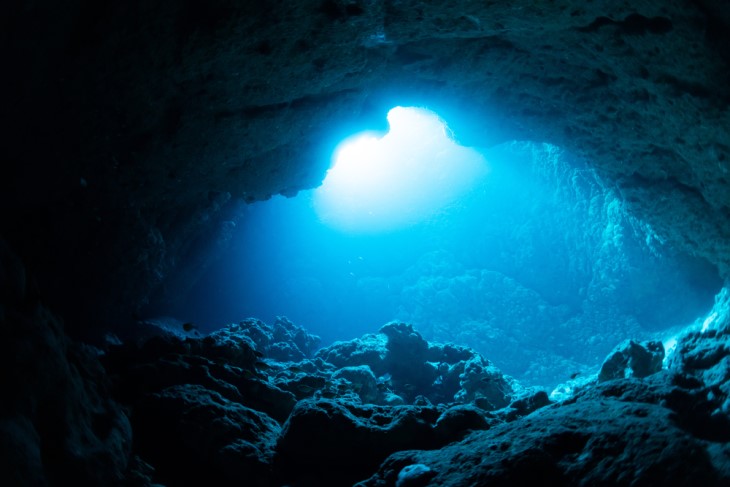
Steven Jacobsen of Northwestern University, who played a pivotal role in the research, conveyed to New Scientist the significance of the discovery, emphasizing its implications for our understanding of Earth's water cycle. The existence of such a reservoir supports the theory that Earth's surface water originated from within, seeping out over time to form oceans.
The researchers utilized a network of 2000 seismometers to analyze the seismic waves generated by over 500 earthquakes. These waves, which travel through the Earth's interior and can be detected at the surface, provided invaluable insights into the subterranean world. By observing variations in wave speed at different depths, the team could identify the presence of dampened rock, indicating water.
This method of investigation highlights the dynamic and interconnected nature of Earth's layers, offering a glimpse into deep geological processes. Jacobsen likened the planet's reaction to seismic waves to a bell that continues to resonate long after the initial event, a phenomenon that allowed for the detailed analysis of the underground landscape.
The discovery not only enriches our understanding of Earth's geology but also carries profound implications for the global water cycle. According to Jacobsen, without this deep reservoir, Earth's surface would be vastly different, with significantly higher sea levels covering much of the land. This hidden ocean, therefore, plays a crucial role in maintaining the balance of water on and within our planet. It could very well be that the oceans we know are actually LEAKAGE of this proto-ocean, a huge body of water coming from inside the earth.
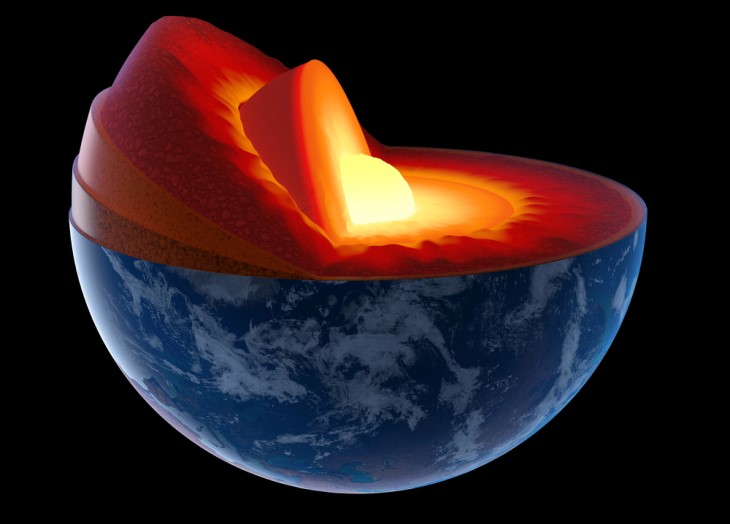
Above is the traditional section of what we THOUGHT Earth's mantle and core looked like. Now imagine that between the different parts is a huge body of water, slowly leaking out to the oceans we know.
Supporting evidence from a separate 2014 study by the University of Alberta researchers further solidifies the findings. They analyzed a diamond expelled from deep within the Earth by a volcano, which contained traces of water-bearing ringwoodite. This additional proof underscores the prevalence of water in the Earth's mantle, specifically within the transition zone—a region characterized by dramatic shifts in temperature, pressure, and mineral composition, located between the upper and lower mantle.
Together, these studies revolutionize our comprehension of Earth's water sources, suggesting a much more complex and internally driven water cycle than previously thought. The existence of such an immense subterranean ocean opens new avenues for research, potentially reshaping our approach to studying Earth's geological and hydrological phenomena.

5:48
3 Surefire Ways to Always Identify Pseudoscience
Find out how you can identify pseudoscience, and learn how it differs from actual science.
9:32
Ocean Showdown: Orcas Take on Humpback Whales
There's a reason why orcas can never get along with humback whales...
Incredible Science Breakthroughs That Made News in 2022
Let’s check out some of the most interesting scientific discoveries of 2022.
18 Photos Showcasing the Best of Ocean Photography 2024
Here are 18 winning and selected photos from the 2024 Ocean Photographer of the Year competition.
8:05
This Giant Tank Will Unlock the Universe’s Big Mysteries
Japan is building a huge underground tank inside a mountain to help unlock the many mysteries of the universe.
18:59
Learning Nature: The Lunatic Biology of the Sunfish
This video delves into the mysteries of sunfish's anatomy, unusual growth patterns, and its peculiar diet
9:54
Neo: The New Tele-Robot that "Cleans" Your Home
Neo is a new robot that has great capabilities and is designed to clean your home. Sounds perfect right? Well, there's a catch.
8 Biggest Mysteries Still Surrounding the Human Body
Although modern science has revealed much about the human body, there are some things that still remain unknown. Here are the 8 biggest mysteries about it.
5 Puzzling Mysteries That Science Finally Managed to Solve
These weird occurrences have puzzled humanity for decades, if not centuries. Finally, scientists solved them & the solutions are exciting...
10:59
Fascinating Science: How Sand is Turned Into Glass
Have you ever looked through a window and wondered how it was made from simple beach sand? This video shows you that incredible process.
What is the Troxler Effect and How Does it Affect You?
Learn about Troxler's effect and the optical illusions it creates in life.
22:52
Will AI Take Your Jobs? An Expert Explains the Future
Gonzaga University's AI professor Graham Morehead some of our most pertinent questions related to AI.
16:31
Why Building a Perpetual Motion Machine Is Impossible
Since the Middle Ages, scholars have been trying to build the mythical perpetual motion machine. Was it all in vain? Is it even possible to build such a machine?
11:28
India Built a Monster Dam That Controls the Weather!
The Polavaram Dam doesn't just control floods - it moves water between regions and much more!
8:11
Fascinating: What is the Deepest Hole Humanity Has Dug?
This video explains how low humanity has dug down so far.
5:50
Why Do We Sometimes Hallucinate? Find Out Here!
In this informative TED-Ed video, Elizabeth Cox details the science of hallucinations.
Space Looks Breathtaking in These Amazing Photographs
There are some absolutely stunning photographs of space out there today, You won't believe how incredible it is!
10:46
Neat Life Hacks To Help You Remember Things Better
A lot of us tend to forget the simplest things at times. This video provides some neat tips to help boost your memory.
33:02
The Entire Story of Earth in 30 Minutes!
The story of our planet, from birth to the adult, ancient planet we see before us today - all in just half an hour.
5:47
This Genius Child is a Better Calculator than a Computer
This ‘human calculator’ could likely outpace you entering the numbers into a calculator.
Superwood: A New Material That Could Replace Steel
After decades of relying on steel—a material that produces nearly two tons of CO2 for every ton manufactured—builders may soon have access to something far more sustainable and surprisingly stronger: Superwood.
5:39
Why Are Your Ears Ringing? The Causes Explained
Nearly 15% of the human population worldwide are plagued by this strange sensation, but most people don't know the causes behind ringing in the ears...
8:46
Science: What is Reality? Dive in and Find Out!
What if everything you see, feel, and experience isn’t real? The simulation argument suggests that our reality might be nothing more than an advanced computer program.
58:37
Science: Here's Everything We Know About Pluto
Join us as we unravel the mysteries of far off Pluto, 3.7 billion miles from our Sun.
6:15
K2-18b: The Exoplanet That Might Host Alien Life
Astronomers have detected signs of posisble life in the atmosphere of exoplanet K2-18b.
See the World From Up Close - 17 Fascinating Macro Photos
Seeing ordinary objects like honey, paracetamol, and snow through a microscopic lens teaches us how beautiful and intricate they really are!
Science News: AI-Designed Drugs Move to Human Trials
Isomorphic Labs, is positioning itself to begin human clinical trials of medications designed entirely through artificial intelligence, marking a potentially transformative shift in how we develop life-saving treatments.
7 Air Pollution Solutions That Will Help Us Breathe Easy
Let's take a look at some global initiatives that have been launched to reduce air pollution levels.
12 Bizarre Scientific Facts You Never Learned at School
The scientific facts we collected in this list aren't the kind of stuff you'll see in a school curriculum.
Science Proves: These 10 Bible Stories Probably Did Happen
The Bible describes many seemingly supernatural cases, but today, science can show that they might have indeed happened.
8:48
Fascinating: What Around Us is Invisible?
The Invisible Things that Turn the World...
Are You Ready to Learn About the Expanse of the Universe?
If you have an interest in the unknown, then look no further than these 15 unbelievably facts discovered about space
2:11
Here are Some Unique Tricks You Can Do at Home With Salt!
This video shows us a few interesting magic tricks that you can do anytime using salt, ice, and other items you can find at home.
4:22
eSIM vs Traditional SIM: What’s the Big Difference?
Are eSIMs and iSIMs the future of connectivity?
1:29
A Must See: White Cells Devouring Bad Bacteria!
A real look at how white cells identify and consume harmful bacteria.

4:20
Ever Wondered About How Our Minds Retain and Lose Memories?
Ever wondered why you can remember something from 20 years ago, but have difficulty remembering what you had for lunch the other day? Learn why here.

5:01
The Truth About Folding Phones You Need to Know
Don’t buy a foldable without knowing this first.
18:21
Fascinating: How Do Cats TRULY See Humans?
Understanding a cat's world is the key to strengthening your bond. Let's decode your cat's mind!
4:40
How to Make a Floating Chair
If you have some rope and wood - you too can build this floating chair!
Chronically Late? What Science Has to Say About You
There are 8 positive things that science says about late people that we all need to know.
7:56
These 6 Chemical Reactions Changed the Course of History
Although we rarely pay much attention to the chemistry that constantly surrounds us, these 6 reactions changed history.
20:04
Emotions Explained: The Science Behind How We Feel
Neuroscientist and psychologist Dr. Richard J. Davidson answers some fascinating questions about emotions you would never expect.
4:52
Neon Lights: a Beautiful Union of Science and Art
Neon signs are a beautiful blend or artistry and science, and knowing the history and the science behind them make them even more exciting
13 Astonishing Things You Never Thought You'd See
Here are 13 photos of rare phenomena you never thought you'd see!
Enjoy This Fascinating Collection of NASA's Best Photos
Here are 15 of NASA's most amazing recent pictures, along with brief explanations of exactly what is going on in each one.
19:27
20 of the Most Infamous Tech Product Flops In History
Here's a look at some of the most infamous and biggest technology failures in recent history.
9:34
Was Roman Concrete Really Superior to Our Own?
How did Ancient Romans make such durable concrete that it still lasts today?
To enable your Ad-Free Subscription, please fill the fields below
Your subscription was successful, now you can enjoy an ad-free experience!! Note: To make sure you get no ads, please make sure to log in to your account. If you are logged in already, then refresh the page. The subscription can be cancelled at any time.